iPhone app iPad app Android phone app Android tablet app More

Facial Expressions: Smiles, Frowns Not Universal After All, Study Suggests

 |  By Posted: 04/18/2012 1:34 pm Updated: 04/18/2012 1:34 pm

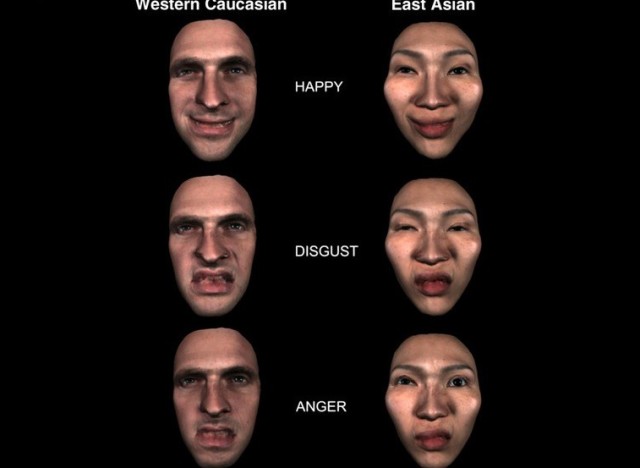
A smile and a frown mean the same thing everywhere—or so say many anthropologists and evolutionary psychologists, who for more than a century have argued that all humans express basic emotions the same way. But a new study of people's perceptions of computer-generated faces suggests that facial expressions may not be universal and that our culture strongly shapes the way we read and express emotions.

The hypothesis that facial expressions convey the same meaning the world over goes all the way back to Charles Darwin. In his 1872 book The Expression of the Emotions in Man and Animals, the famed naturalist identified six basic emotional states: happiness, surprise, fear,
disgust, anger, and sadness. If facial expressions are just cultural traits, passed down through the generations by imitation, their meanings would
have diverged by now, he argued. A smile would signal happiness for some and disgust for others. But that's not what he found, based on his
correspondence with researchers around the world using photos of various facial expressions. So Darwin concluded that the common ancestors of all
living humans had the same set of basic emotions, with corresponding facial expressions as part of our genetic inheritance. Smiles and frowns are
biological, not cultural.


Or are they? Rachael Jack, a psychologist at the University of Glasgow in the United Kingdom, says that there is a fundamental flaw in the facial
expression studies carried out since Darwin's time: Researchers have been using Darwin's six basic expressions as their starting point, and yet they
were first identified by Western European scientists studying Western European subjects. The fact that non-Western subjects can recognize the emotions
from photographs of those facial expressions has been taken as support for the universality hypothesis. But what if non-Western cultures have different
basic emotions that underlie their expressions? Those expressions may be similar to those of Westerners, but with subtle differences that have gone
undetected because no one has looked.


To test the true universality of Darwin's six emotional categories, Jack and colleagues used a computer program to create virtual faces with 4800
expressions. The program generated the faces by contracting virtual facial muscles, pulling the corners of the mouth up or down, widening or narrowing
the eyes, and so forth. Half of the expressions were shown on a Western Caucasian face and half on an East Asian face.


Then Jack's team asked volunteers to decide which emotions the faces were expressing, if any. The researchers tested 15 recently arrived immigrants
from East Asia, using a survey to ensure that they had spent minimal time around Westerners. They also recruited 15 Caucasian Westerners as a control
group. For each of 4800 faces, the subjects could choose one of Darwin's six basic emotional categories and rate the intensity of the expression on a
five-point scale. If they did not perceive a clear expression on a face, the subjects reported, "Don't know." If Darwin's basic emotions are universal,
all the subjects should match the same faces with the same emotions.


That's not what Jack's team found. For Western Caucasians, Darwin's six basic emotional expressions popped right out of the data, in type and
intensity. But the East Asian subjects didn't see the faces the same way, the team
reports online today in the Proceedings of the National Academies of Science. Smiles meant the same thing to everyone, but the responses from
the East Asian subjects did not form clear categories, especially for faces expressing surprise, fear, disgust, and anger.


The researchers conclude that Western Caucasians use a distinct set of facial muscles to express basic emotions. Each culture may have fundamental
expressions, but they are not necessarily shared by other cultures. For East Asians, Jack speculates that facial expressions are built from other
fundamental emotions, such as "shame, pride, or guilt."


The study is "a strong challenge to the widely held belief that certain emotional expressions are biologically basic," says Lisa Feldman-Barrett, a
psychologist at Northeastern University in Boston. If wrong, that belief is doing harm, she says. For one thing, difficulty recognizing facial
expressions is used to diagnose mental illness. For another, she says, "in the U.S. alone, millions of dollars each year are spent on law enforcement
and security training to 'read' emotion in the face." But if those faces belong to people from different cultures, their emotions and intentions may be
illegible.

ScienceNOW, the daily online news service of the journal Science

Also on HuffPost:

FOLLOW SCIENCE

A smile and a frown mean the same thing everywhere—or so say many anthropologists and evolutionary psychologists, who for more than a century have argued that all humans express b...
 
 
  • Comments
  • 407
  • Pending Comments
  • 0
  • View FAQ
Post Comment Preview Comment
To reply to a Comment: Click "Reply" at the bottom of the comment; after being approved your comment will appear directly underneath the comment you replied to.
View All
Favorites
Recency  | 
Popularity
Page: 1 2 3 4 5  Next ›  Last »  (5 total)
07:07 PM on 04/19/2012
My problem with this study is that they didn't use REAL faces. Just by looking at that tiny sample of faces above, I can understand why they wouldn't answer all the questions correctly. Those are terrible interpretations of the human face.

I've seen more realistic facial expressions in video games.
photo
HUFFPOST SUPER USER
The Music Man
I'm not crazy; just a separate reality
07:20 PM on 04/19/2012
Yeah, but the data was clearly different between the West and the East.
09:14 PM on 04/19/2012
That just means that Western and Eastern people respond differently to distorted, unnatural looking images. I think that there would be much less divergence if participants were shown natural, unambiguous images of spontaneously smiling faces.
01:04 PM on 04/20/2012
Correlation does not equal causation.
10:31 AM on 04/19/2012
I was very surprised to read in the first paragraph that scientists previously thought all humans expressed their emotions the same way. That is crazy. I have for many years said to my wife, who grew up in Europe and North America that she is misinterpreting people's emotions. But I had no idea that scientists had the same theories. Otherwise I could have strip them of those fallacies.

Note that in boxing if someone who grew up in W.Europe or North America sustains a punishing blow, the reaction is to frown. Someone who grew up in Mexicao on the other hand would smile. Also if you are giving instructions to someone who respects you there would be at leat 2 different reactions depending on where that individual was accultrated. Most people from the "third word" would avert their eyes. Most North Americans and Western Europeans will stare directly into your eyes.

There are many such differences depending on where you grew up.
photo
BannedInBoston
Everyone is entitled to my opinion.
09:16 PM on 04/22/2012
Good points and examples. I would have said from the get-go that facial expressions are acculturated, just based on common experiences. Why any branch of science would get stuck in 150-year-old absolutist notions just because they were held by Darwin remains a mystery to me, especially when these notions are held in the face (so to speak) of obvious counterexamples.

Additionally, with notable exceptions, facial expressions are not necessarily terribly good indicators of emotion in any case (again, a matter of acculturation)....
08:36 AM on 04/19/2012
Darwin being wrong isn't really all that surprising. Has anyone checked out the pillars of the theory of evolution lately? He was terribly wrong about that lest people still think that theory was in fact, fact. His evolution theory is so full of holes you could fly a 747 through them. So why would you think a theory of his on emotions would be any more accurate?
photo
democratbob
Equality for all, including marriage.
11:03 AM on 04/19/2012
Since those holes are big enough to fly a 747 through, how about you let the rest of the world know what those holes might be.
This user has chosen to opt out of the Badges program
photo
ProudToBeVeryLiberal
Science is the antidote to the poison of religion
11:43 AM on 04/19/2012
Sorry, but only people who don't know anything about science make such ridiculous remarks about evolution. The same people who believe some pretty fantastic stories told by bronze age men.
photo
HUFFPOST SUPER USER
smoknjoe
Condemnant quod non intellegunt.
11:26 PM on 04/19/2012
Unfortunately science has created it's own religion. They can be just as hard headed about their ideas as religions are about theirs. I have been a fan of science as long as I can remember and I can honestly say that the number of objective men and women of science is extremely LOW.
05:56 AM on 04/19/2012
Gee how much did this cost us taxpayers for this useless study and why wasn't the grant money used for something more akin to helping the economy or creating jobs???
imonlyhereforthelaughs
Politicians...they ruin everything.
01:37 PM on 04/19/2012
Rachael Jack, a psychologist at the University of Glasgow in the United Kingdom.

Learn to geography.
08:22 PM on 04/19/2012
lmfao
10:38 PM on 04/19/2012
LMAO!!
photo
wakohnen
Human opinions....a fascinating study....
05:40 AM on 04/19/2012
I guess this means that the guy that sells swampland is happy all of the time?
HUFFPOST SUPER USER
TERPMOM
04:19 AM on 04/19/2012
4800 faces? My face would be soo scrunched up with yawning from boredom, I'd hit number 5 by accident. Continuously. Now the reason this study is so necessary to humankind will be evident after 12-21-12. They don't have any face portending fear. Maybe that expression is too obvious in all cultures.
photo
HUFFPOST SUPER USER
smoknjoe
Condemnant quod non intellegunt.
11:29 PM on 04/19/2012
Fear is mainly instinctual therefore, I believe, universal. There is the widening of eyes, dilation of the pupils, rapid heart beat and rapid breathing and sometimes a snarl. You can tell when anyone of any culture is afraid unless they are trying hard to hide it.
This user has chosen to opt out of the Badges program
photo
ProudToBeVeryLiberal
Science is the antidote to the poison of religion
04:14 AM on 04/19/2012
There's a cultural factor playing here: east Asians are very good at hiding their true emotions and they consider that a strategic advantage in life. I lived in Japan for a couple of years and never quite figured out whether some people were hostile or friendly to me. They all appeared to be very friendly, and yet I had suspicions that some didn't exactly like me (being a woman in uniform and a "gaijin." Some Japanese men don't exactly love women doing things they believe only men should do... Other people in Japan don't like foreigners in general, with a few holding a particular grudge toward Americans, for several reasons.) But hey, I wasn't in competition with them, since I was only a US Navy officer doing my job either on a warship or at a US naval base, and never being a threat to them. But I bet some were still "observing my moves"...

Now, of course, fake-friendly is also very popular here in the US ("frenemies", you know...), but those are A LOT easier to spot and usually fail under any kind of serious scrutiny.
This user has chosen to opt out of the Badges program
photo
michaelnel4449
Infidel chipping away at the 2 party system
05:02 AM on 04/19/2012
I love your mind along with your pretty face.... fanned and faved
06:03 AM on 04/19/2012
I have been working with an "Asian" airline for two decades, and you're quite right. Sometimes it is very difficult to determin who is friendly and who is not. That's often why many of the non asian colleagues often feel some of the asian ones come across as two-faced. I know I'm treading on dangerous ground with this remark. It's only a very vague generality with more exceptions to the rule than not, but there are certainly elememnts that can not be easily dismissed.
photo
HUFFPOST SUPER USER
ash090200
"your micro-bio is empty"
03:49 AM on 04/19/2012
Niche partitioning and bird beaks are a far cry from human anything. Has anyone read the origin of species? I have and I guess I missed the human section
photo
Fentwin
Sedagive?
03:47 AM on 04/19/2012
A lot of butt hurt Darwin fanboys in here I see, lol. Get used too it, as time goes on, and more actual science studies take place, (and not just hypothesis, theories and opinions) the more Darwin and that hack Stephen Hawking will be debunked. Finally, been a long time coming.
photo
HUFFPOST COMMUNITY MODERATOR
ConfuciusSay-
Aglets: their purpose is sinister.
07:25 PM on 04/19/2012
Most people profoundly wish that corrections to existing ideas would occur all the time. That is the nature of the scientific method. The men whom you so slight, would be foremost among those hoping for more enlightenment.
08:25 PM on 04/19/2012
Fanned and Faved.
09:43 PM on 04/19/2012
I am not slighting those men. I am slighting those who refuse too accept their own theories or opinions too be false, in spite of clear evidence. You seem to be not one of those men. But we both know we live in a world of stubborn people.
photo
Fentwin
Sedagive?
12:03 PM on 04/20/2012
"Get used too it, as time goes on, and more actual science studies take place, (and not just hypothesis, theories and opinions)..."

With this one phrase your lack of science education is laid bare and blatantly exposed. To declare that hypotheses and theories are "unscientific" is hilariously sad. As far as "opinion" goes, yes we are all entitled to an opinion, but like yours, if it is based on a lack of knowledge and evidence, it isn't worth the breath it takes to utter it.
01:15 PM on 04/20/2012
Lol I like how you left out the rest of what I said.

But just in case you didn't get it.

I am saying that people who just leave it at hypothesis, and theory only, without going further too solidify their theory's as truth is what I am saying.

There are hacks in every occupation. A science hack is one how has "theory's" and hypothesis only, but never going further too back up their claims. I understand those are the basis of Scientific study, however there has to be a day when one can back up their claims. Now if you're arguing against that, you might want too sit in on a basic High School Science class.

So like I said, get used too it. :)
01:16 PM on 04/20/2012
Oh and I never said those things were "unscientific", nice try putting words in my mouth.
photo
HUFFPOST SUPER USER
Poison Snake
03:12 AM on 04/19/2012
Also, I think it's unfair to test this using computer generated images. They do not really show natural expressions at all. At least half of detecting what a person is feeling by their facial expression is simply the feeling they're projecting. They don't have to be making the EXACT facial expression someone else would (individually OR cross-culturally) for another person to understand the feeling they're getting - whether it's an additional "vibe" they get from them, or body language added to the expression.
photo
HUFFPOST SUPER USER
Poison Snake
03:04 AM on 04/19/2012
In my opinion, I think it's a bit ridiculous to even want to test this. I would say it is fairly obvious that cultural upbringing has little to do with one's natural impulse to make a certain facial expression - considering humans make these expressions from birth with little exposure to prior knowledge or examples. A baby just born looks freakin' miserable no matter what culture they're in - and they are. They don't need an example to show them how to express that, they just do it.

Natural and open facial expressions are involuntary unless someone is actively trying to stonewall themselves. Children never stop to ask what expressions mean. They know what they mean instinctively because of the feeling it generates within them in response to it.

I also think it's unfair to compare cultures as such - because some cultures (especially asian ones) tend to have the ingrained belief that controlling ones self and keeping private matters private is important. Their expressions mirror this - but it's not a natural, open expression. There is a conscious effort made to alter their expression on purpose to conceal what emotion or the degree of the emotion that's there. When that conscious effort is not being made, their expressions are pretty much the same as anyone else.
HUFFPOST SUPER USER
gmikejake
resist evil
05:24 AM on 04/19/2012
Other than phenotypical differencs, perhaps the expressions are the same, it is the interpretations of the expressions that differ? Children are socialized, some more than others and socialization continues throughout life. Included in socialization is taking on language ... using symbols for communication and that varies, obviously, across our planet. 2/3 of human communication is non-verbal ... expressions are a part of that. We learn the meaning of the symbols as we aquire language. We also learn to use the symbols for our own purposes.
photo
HUFFPOST SUPER USER
Poison Snake
04:16 PM on 04/19/2012
I agree with some points you've made, but I also feel they're off topic. Language and other learned behaviours are not what this article is about. It is *only* about involuntary facial expressions and whether they are wholly natural, intrinsic behaviours or whether they are or can be a cultural byproduct. (As in - would someone in a different culture make a different expression or interpret them differently.)

I do not personally see any basis for fact within this study. Aside from how sloppily it was carried out (computer generated expressions can NOT be representative of genuine human emotion, I'm sorry. Even in the examples given of these "faces", they are not making *natural* expressions [esp. the Western set] - and small groups of 15 people from only 2 cultures are not representative of the human race as a whole), my point was that other non-Western cultures make a conscious effort to actually change and/or control their facial expressions - leading to subtle differences noticed when interpreting them. However - this is a *conscious effort* made, not what is naturally occurring on it's own. If they allowed their natural expressions to occur unhindered, not only would they be easily recognizable and similar, they would also likely be interpreted correctly cross-culturally.

Anthropologists - who's *actual* field of study is socialization, cultural development, and the human condition (as opposed to psychologists - whom are those who carried out this study, mind you) would rip this entire study apart in a heartbeat.
photo
HUFFPOST SUPER USER
Poison Snake
04:27 PM on 04/19/2012
These computer generations - even in the examples given - are also very unevenly mismatched. One can clearly tell looking at them that, especially in the Western set - these expressions are far from natural. Look at them closely, and you will notice that almost none of the upper facial muscles (meaning from the nose up and specifically around the eyes / forehead region) are being engaged in ANY of the examples of emotion/facial expressions from this set. If you were to superimpose them on each other, the only differences would be seen from the nose area downward. This is not natural unless a person is actively controlling that, on Botox, or suffering from some form of paralysis. Without *actual* human emotion behind it and *actual* examples of living expressions, of course they can be easily misinterpreted by anyone attempting to identify them. I wouldn't even interpret the Western set as what they've been labeled myself and I AM a Westerner - I was *raised* in this culture myself and I wouldn't call these natural expressions at all.
02:43 AM on 04/19/2012
To start with, these are computer generated faces, i.e. the next thing to cartoons. To end with, real humans are individuals (people think dogs are smiling, which they probably are, but usually they just want a drink of water. it's the way dog's faces work) and being individuals a smile can be a smirk, a scowl can be a result of a surprising thought....on and on.

Somebody in this "study" has way too much time on his/her hands. But then, so did Darwin.
HUFFPOST SUPER USER
hupale
01:36 AM on 04/19/2012
A smile with his lips really shows a person with an harmonious spirit. It shows goodness coming to the surface from a most profound depth of a person's soul. The same goes for an
evil person surfacing from deep down is corrupt and pervert soul.
photo
HUFFPOST SUPER USER
Mark Helfgott
01:31 AM on 04/19/2012
This proves that Darwin was wrong about everything. We did not evolve from apes! Rick Santorum is right. We were creating by the holy being in the clouds. The earth is only 3000 years old. Man danced with dinosaurs. Hey, I'm only pulling your chains.
01:24 AM on 04/19/2012
Um, to me anger and disgust on both faces seemed the same and happy looked pretty scary on both faces. Maybe they just did not describe the findings very well but it does not seem all that earth shattering to me. I do not think that Darwin was implying that all people interpreted all facial expressions the same with no varitation for cultural differences. He was merely stating that the basic emotions were generally recognizable across cultures.