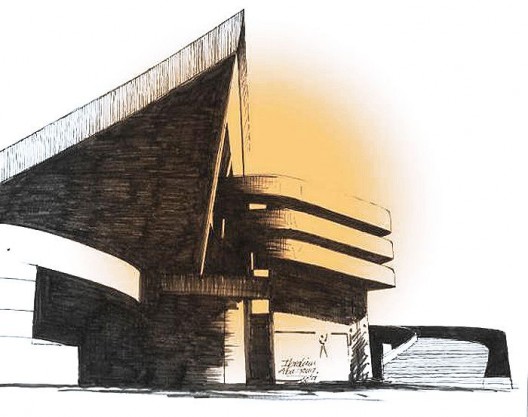
 Gymnasium in Baghdad, Sketch by Le Corbusier. ©SketchPlanet
In Upstate New York, residents are clamoring to raze down their Government Center, Paul Rudolph’s classic 1970 example of brutalist design. Ostensibly, this is due to flood-damage. But it can’t hurt that, as one resident was quoted in The New York Times as saying, it’s “a big ugly building.”
In Minnesota, city officials would rather tear down M. Paul Fiedberg’s Peavey Plaza, a “Modernist gem” completed in ’73, than spend the time, money, and effort to revitalize it.
In Baghdad, on the other hand, a gymnasium completed in 1982, suffering the signs of decades of violence, poverty, and ill-executed renovation, has sparked a small preservation movement, reawakening a country to its neglected cultural heritage.
The architect behind this Iraqi endeavor? None other than Le Corbusier himself.
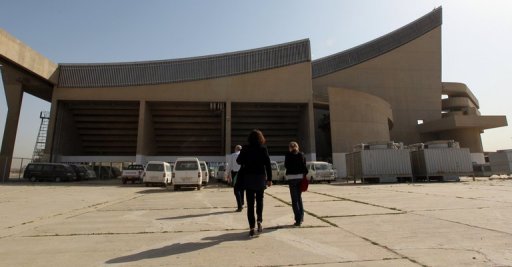 Baghdad Gymnasium, designed by Le Corbusier in 1957, built in 1982. © AFP
As the AFP reported Monday, the forgotten Le Corbusier building was “rediscovered” in 2005, when Caecilia Pieri, researching her thesis on modern architecture in Baghdad for the Institut Francais du Proche-Orient, came across the gymnasium and contacted the Le Corbusier Foundation in France.
“This is a posthumous work, and researchers did not have access to Iraq. They did not even know if it was properly built, as they had never seen it,” Pieri said.
After bringing the President of the Foundation, Jacques Sbriglio, to the site, a French-Iraqi alliance was formed: the Foundation, Baghdad University, the UN Educational, Scientific and Cultural Organisation, and the French embassy have made plans to publish a book and hold a colloquium to raise public awareness of the building.
Beyond Le Corbusier’s stature, which in itself would merit the Gymnasium’s preservation, the building is a fascinating example of Iraq’s changing, historical relationship with modernist architecture and the West.
The design was first commissioned in 1957, as part of Baghdad’s (unsuccessful) bid for the 1960 Olympics, by King Faisal II, who was heavily invested in attracting modernist architecture greats to Baghdad – from Walter Gropius to Gio Ponti. However, this modernist revival, and Le Corbusier’s involvement, was short-lived. Just one year later, the monarchy was overthrown, and the King killed, in the 1958 Revolution.
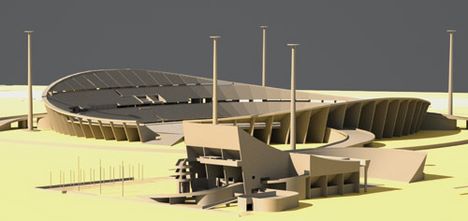 Le Corbusier's design for the Baghdad Gymnasium. © Iraq Art & Architecture's Facebook Page
Despite the failed bid, Faisal’s overthrow, mounting financial difficulties, and Le Corbusier’s death in 1965, the plans remained pending. They were finally taken up again during the reign of Sadamm Hussein and finished in 1982, under the guidance of one of Le Corbusier’s associates, Georges-Marc Presente.
According to its current director, Wasfi al-Kinani, the Gymnasium hosted numerous international competitions and ”generations of Iraqi athletes” throughout the ’80s and ’90s. “For Iraqi sports, this is a historic inheritance, a symbol.”
But in 2003-4, the Iraqi people saw another overthrow, this time of Hussein, and the Gymnasium went from housing athletes to American soldiers. The years of violence and shoddy reconstruction have affected the Gymnasium’s design: the roof, originally designed to allow natural light, has been blocked by a false ceiling; the seats are brightly colored; and the Gymnasium’s perspective has become crowded with newer constructions.
However, the building’s preservation may be the first step towards a greater movement. As Pieri noted to the AFP: ”After all this upheaval, we are witnessing the renaissance of new awareness about [Iraq's] modern heritage, and it can lead to similar movements, sparking positive momentum for other major modern buildings.”
Cite: Quirk , Vanessa . "“Lost” Le Corbusier Building Sparks Preservation Movement in Iraq" 24 Apr 2012. ArchDaily. Accessed 24 Apr 2012.
Our 2024 Coverage Needs You
It's Another Trump-Biden Showdown — And We Need Your Help
The Future Of Democracy Is At Stake
Our 2024 Coverage Needs You
Your Loyalty Means The World To Us
As Americans head to the polls in 2024, the very future of our country is at stake. At HuffPost, we believe that a free press is critical to creating well-informed voters. That's why our journalism is free for everyone, even though other newsrooms retreat behind expensive paywalls.
Our journalists will continue to cover the twists and turns during this historic presidential election. With your help, we'll bring you hard-hitting investigations, well-researched analysis and timely takes you can't find elsewhere. Reporting in this current political climate is a responsibility we do not take lightly, and we thank you for your support.
Contribute as little as $2 to keep our news free for all.
Can't afford to donate? Support HuffPost by creating a free account and log in while you read.
The 2024 election is heating up, and women's rights, health care, voting rights, and the very future of democracy are all at stake. Donald Trump will face Joe Biden in the most consequential vote of our time. And HuffPost will be there, covering every twist and turn. America's future hangs in the balance. Would you consider contributing to support our journalism and keep it free for all during this critical season?
HuffPost believes news should be accessible to everyone, regardless of their ability to pay for it. We rely on readers like you to help fund our work. Any contribution you can make — even as little as $2 — goes directly toward supporting the impactful journalism that we will continue to produce this year. Thank you for being part of our story.
Can't afford to donate? Support HuffPost by creating a free account and log in while you read.
It's official: Donald Trump will face Joe Biden this fall in the presidential election. As we face the most consequential presidential election of our time, HuffPost is committed to bringing you up-to-date, accurate news about the 2024 race. While other outlets have retreated behind paywalls, you can trust our news will stay free.
But we can't do it without your help. Reader funding is one of the key ways we support our newsroom. Would you consider making a donation to help fund our news during this critical time? Your contributions are vital to supporting a free press.
Contribute as little as $2 to keep our journalism free and accessible to all.
Can't afford to donate? Support HuffPost by creating a free account and log in while you read.
As Americans head to the polls in 2024, the very future of our country is at stake. At HuffPost, we believe that a free press is critical to creating well-informed voters. That's why our journalism is free for everyone, even though other newsrooms retreat behind expensive paywalls.
Our journalists will continue to cover the twists and turns during this historic presidential election. With your help, we'll bring you hard-hitting investigations, well-researched analysis and timely takes you can't find elsewhere. Reporting in this current political climate is a responsibility we do not take lightly, and we thank you for your support.
Contribute as little as $2 to keep our news free for all.
Can't afford to donate? Support HuffPost by creating a free account and log in while you read.
Dear HuffPost Reader
Thank you for your past contribution to HuffPost. We are sincerely grateful for readers like you who help us ensure that we can keep our journalism free for everyone.
The stakes are high this year, and our 2024 coverage could use continued support. Would you consider becoming a regular HuffPost contributor?
Dear HuffPost Reader
Thank you for your past contribution to HuffPost. We are sincerely grateful for readers like you who help us ensure that we can keep our journalism free for everyone.
The stakes are high this year, and our 2024 coverage could use continued support. If circumstances have changed since you last contributed, we hope you'll consider contributing to HuffPost once more.
Already contributed? Log in to hide these messages.