iPhone app iPad app Android phone app Android tablet app More

Pigeons Navigate Using Brain Cells That Gauge Earth's Magnetic Fields, Scientists Say

 |  By Posted: 04/27/2012 4:25 pm Updated: 04/27/2012 4:25 pm

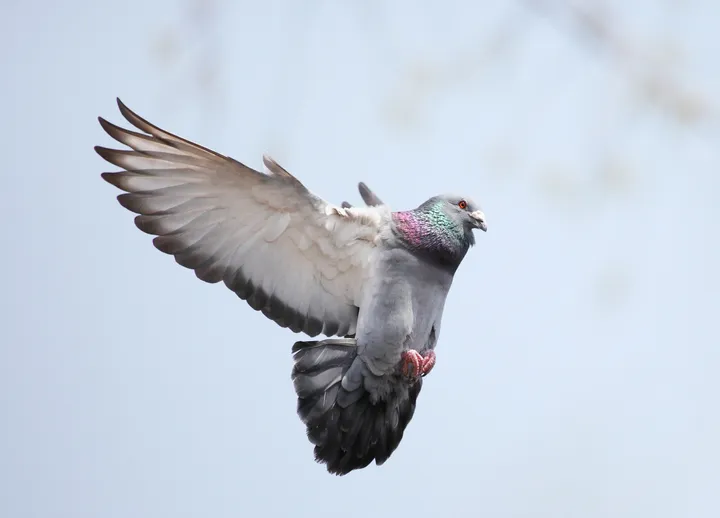
Pigeon Flying

Release a pigeon thousands of kilometers from home, and it'll fly across seas, forests, or deserts to return. It's not sight or smell that allows this amazing navigation; migratory birds can sense the magnetic fields that vary across Earth's surface. Now, scientists have identified a collection of brain cells that let pigeons interpret these magnetic fields. They hope the findings will help reveal how the birds sense the magnetism in the first place, and shed light on this mysterious sixth sense.

"This is very exciting," says biologist John Phillips of Virginia Polytechnic Institute and State University in Blacksburg, who was not involved in the new study. "There have been very few clear-cut findings in the past."

Debate on how birds sense geomagnetic fields has largely revolved around magnetite particles found in various parts of their heads. Scientists have hypothesized that magnetite, a form of iron that's the most magnetic of naturally occurring minerals, is the key ingredient in specialized cells that react to changes in magnetism. And the presence of magnetite in birds' beaks had led some researchers to believe that this structure was key to birds' homing abilities.

But earlier this month, a team of scientists showed that the iron in birds' beaks isn't magnetite—it's balls of another, less magnetic, form of iron accumulated in white blood cells that are cleaning toxins out of the animals' bodies."That whole story just crashed and burned," says Phillips.

At Baylor College of Medicine (BCM) in Houston, Texas, biologist David Dickman had previously found magnetite in the inner ears of pigeons, offering an alternate hypothesis for where the magnet-sensing cells are located. Last year, he discovered that four areas of the brain that are largely linked to inner ear function each showed a broad change in activity when pigeons were exposed to magnetic stimulation.

In the new study, published online today in Science, Dickman and BCM biologist Le-Qing Wu placed seven homing pigeons (Columba livia) in a dark room in the center of a cube-shaped set of magnetic coils. As the cube was rotated, the intensity of the magnetic field felt by the pigeon in the center varied. The scientists turned it in every direction, testing out the effect of various magnetic fields found on Earth. As they did this, Dickman followed the activity of 329 neurons in one of the areas of the brain he'd previously implicated. Fifty-three of the brain cells showed significant changes in activity as the coils rotated, reacting to field strength and polarity. The properties of the neurons allow them to have a unique activity pattern for every different spot on Earth, the scientists realized. Not only can the neurons allow the pigeons to pinpoint their longitude and latitude, says Dickman, but they can differentiate the Northern Hemisphere from the Southern Hemisphere and tell the pigeons which direction they're facing.

The data don't reveal which cells detect the magnetic fields, but, when combined with Dickman's previous results, they suggest that the inner ear is key. Some scientists still hold that the magnetic sensing cells will be found in the beak, or in birds' eyes, but working backward from the brain will help sort it out, says Dickman. "We now have a tool to study this with. We can go back and ask what cells and organs are feeding into this circuitry."

The new findings could apply to other animals as well, says Phillips. Sea turtles, fish, and vertebrates including mice, cattle, and deer have been found to be sensitive to geomagnetic fields. But whether it applies directly to humans is unknown, he says. "There's no evidence for that now. But there could be some kind of unconscious magnetic sense that helps us sense direction and spatial orientation."

ScienceNOW, the daily online news service of the journal Science

Also on HuffPost:

FOLLOW SCIENCE


  • Comments
  • 27
  • Pending Comments
  • 0
  • View FAQ
Post Comment Preview Comment
To reply to a Comment: Click "Reply" at the bottom of the comment; after being approved your comment will appear directly underneath the comment you replied to.
View All
Favorites
Recency  | 
Popularity
This user has chosen to opt out of the Badges program
06:45 AM on 05/10/2012
Birds that can detect the Earth's magnetic field, porpoises and bats that can echo-locate, elephants that can hear subsonically, dogs that can hear hypersonically, owls that can fly in the dark and pin point a mouse by the sound of its heartbeat.....animals are capable of evolving in ways that we are only just discovering.

If a tiny pigeon's brain is capable of such wonders, might not our much larger brains be capable of infinitely more? Perhaps some of the things imagined in science-fiction will someday come to pass.
photo
HUFFPOST SUPER USER
karen lyons kalmenson
i poem/paint, sometimes, i ain't
08:00 AM on 04/30/2012
garage eagles rock,
as do all birds,
our flying spocks.
brains, and more
our fine feathered
dinosaurs☺♥☻
This user has chosen to opt out of the Badges program
10:17 AM on 04/29/2012
Hasn't this been known for some time now?
06:08 AM on 04/29/2012
My Grandfather, who learned his way around the lone prairie on the back of a horse, never got lost. I had a pretty good sense of direction as well until I moved 6,000 miles from home. I've been lost for 3 years here and carry a compass when traveling about. My sense of direction is returning slowly.
03:59 AM on 04/29/2012
perhaps Mr. Dickman finally bothered to read the 1030's book... "the secret of life" by Georges Lakhovsky

http://www.amazon.com/The-Secret-Life-Georges-Lakhovsky/dp/142092995X/ref=sr_1_1?ie=UTF8&qid=1335686105&sr=8-1

it should be required reading in any first level biology class.

Of course we are no less than birds and have these electromagnetic abilities as well. We just have not tuned them.
This user has chosen to opt out of the Badges program
photo
01:57 AM on 04/29/2012
"The properties of the neurons allow them to have a unique activity pattern for every different spot on Earth"

That just sounds so freaking awesome.
photo
HUFFPOST SUPER USER
ImaTroll2
Don't hate me for being pretty
12:16 PM on 04/28/2012
I hid a tiny magnet in my ex-wife's hearing aid and she never came home again. Thank you science!
10:55 AM on 04/28/2012
A homing device??Some animals use soundwaves to pinpoint their echolocation.
This user has chosen to opt out of the Badges program
10:26 AM on 04/29/2012
"Some animals use soundwaves to pinpoint their echolocation"

I think they use sound waves to pinpoint the location of other creatures, such as the ones they eat. Like bats with moths and dolphins with fish. And that process is called echolocation. But I guess they also use it navigate around in places where vision is tricky. I think I read that river dolphins do that in places where the water is murky.
There's a fantastic chapter in Dawkins' The Blind Watchmaker about echolocation in bats and how amazing it is.
This user has chosen to opt out of the Badges program
photo
09:32 AM on 04/28/2012
Any latent ability to sense and or follow magnetic fields...is utterly obliterated and negated by the brain's resource demanding, visual processing center.
photo
Vintage59
Seeking tickets to First Class
06:27 PM on 04/29/2012
Tell that to the cultures which have no words for left, right, front, or back. They use north, south, east, and west instead and they are never wrong, even if you plop them down in the middle of a desert on a cloudy night.
08:47 AM on 04/28/2012
And nature continues to prove more complex than we ever thought.
01:42 AM on 04/28/2012
I'll bet sitting in the middle of the rotating magnetic field was for the pigeons like the wildest amusement park ride ever, as if they were moving very rapidly over all parts of the earth, yet no other physical sensations of motion to back it up. Probably the worst case of motion sickness ever for them. Like the way we feel when the sensations from our inner ears and our eyes don't match up.
photo
HUFFPOST SUPER USER
jennielake
Intellect is Learned... Wisdom Already Knows
11:44 AM on 04/28/2012
... nice post - I was wondering that as well

Bird motion sickness pills on sale now - lol
photo
tssent
The facts, ma'am, just the facts
10:03 PM on 04/27/2012
My curiosity is more about why this ability exists in the
first place.  For most of Earth's inhabitants, any place
we hang our hat can be home.  Why is it among some
species -- like pigeons and dolphins and Monarch
butterflies and certain hummingbirds for example --
that a migratory need still prevails?

Why has nature not simply evolved these species in
a way that allows them to skip the migratory process?
ThinkCreeps
Seriously, it's time.
09:54 AM on 04/28/2012
Arctic terns that refuse to budge in the winter die out quickly.
photo
phal4875
The world is run by cats; we just feed them.
12:02 PM on 04/28/2012
Fanned for a question that is relevant for species that do not move from one place to another as a way to keep their environments similar in summer and winter. If that is not the reason for migration, it seems to make little sense.
photo
HUFFPOST SUPER USER
Linus521
In wildness is the salvation of mankind
09:11 PM on 04/27/2012
I've always been fascinated with migration, of both mammals and birds. When the seasons change, they know, and they know the way.

For me, it's deeply emotional to watch a vee of great Canada's heading home. Geese mate for life, and if one is injured and can't make the journey, it's mate stays behind with him/her.

We have much to learn about the miracles of life that enrich our Earth and expand our imaginations and the human soul. Going home...
10:22 AM on 04/28/2012
I found this interesting set of illustrations and descriptions of the Canada Goose in flight. One summer evening after an extremely windy storm had passed, I stood out on my deck ( which is raised ) and was surprised by a loud noise . First it sounded like a bicycle flying through the air and then I heard the familiar sole honk. I believe this Canada goose was diverted by the storm and desperately trying to find its way home. It passed so close to my head in the black of the night and I felt felt like I was right beside it.

http://www.squidoo.com/why-birds-fly-in-v-formation
photo
HUFFPOST SUPER USER
Linus521
In wildness is the salvation of mankind
12:31 PM on 04/28/2012
Thank you so much for the v-formation site. I remember the first time a v of great Canadas flew over my house. My first experience with Canadas. I heard them coming, and I thought it was a storm cloud approaching. I ran outside as I had never heard anything like it before. They flew very close to me overhead.

Wow! For me, it was a deeply spiritual experience. Sounded like Gabriel blowing his trumpet. That's exactly how I would have felt if, indeed, it had been a flock of angels instead of a cloud of great Canadas. Breathtaking.
01:41 PM on 04/28/2012
Yes, it is quite amazing to see a vee of geese flying.

Did you ever notice that one leg of the vee is longer than the other?

Ever wonder why that is?

˙ǝpıs ʇɐɥʇ uo ǝsǝǝb ǝɹoɯ s,ǝɹǝɥʇ --
photo
HUFFPOST SUPER USER
Linus521
In wildness is the salvation of mankind
01:58 PM on 04/28/2012
I don't know why one leg of the vee is longer. When I see a vee in person or even in a photo or painting, I become deeply moved, very emotional. I couldn't be more moved if I had seen a flock of angels overhead.

The vee always gives me a profound "oceanic experience", the term used when man is in and with wildness, a feeling difficult to put into mere words, but it's a feeling of something masterfully greater than man understands. Many people get it, alone, on the ocean. The vee going home, blowing trumpets as they race the sky does it for me, and once at Yosemite Nat'l Park, high on a ridge, looking at a mountain range at twilight, I experience this spirituality too, a connectedness to something beyond explanation.

Scientific research on the human mind indicates, nothing provides the joy and happiness response like being in wildness, the art of the gods.

Did you read, they are going to shoot the geese at Kennedy Airport in N.Y?
photo
HUFFPOST SUPER USER
Reno Fickler
Head Lifeguard/Dead Sea Marina
08:09 PM on 04/27/2012
I always thought it had to have something to do with the magnetic field, which be extention dictated a magnetic substance in or very near the brain. I just kind of assumed that was the only logical way it could work. It also can not be that uncommon in many animals.
Think whale migrations, salmon finding their way back to the body of water they were born in, penquins in the Antarctic, etc. To a point some humans even seem to have a sense of direction with little to go on. Perhaps left over from the genes of the cave dwellers when GPS was a bit uncommon. Those pigeons will be freaked out if they ever take them to Mars
No magnetic field.