Saving Suburbia Part I: Bursting the Bubble

2012-02-16-archdailyreal.jpg  |  Posted: 04/30/2012 7:37 am Updated: 05/07/2012 4:53 pm

Suburbs

By Vanessa Quirk
(click here for original article)

Poverty and violence, boarded windows and weedy lawns, immigrants jammed ā€œby the dozen into houses conceived for the Cleavers.ā€ In ā€œCan this Suburb be Saved?,ā€ The New York magazine critic, Justin Davidson, begins by painting a bleak but realistic picture of suburbia today. It’s these conditions that are making thousands flee to cities everyday, making headlines predict the ā€œdeath of sprawl.ā€ [1]

Davidson makes the case, and I agree, that the suburbs and architects need each other – now, more than ever. But Davidson ends with a defeatist conclusion. He seems to say, it’s just too difficult, that, ultimately: ā€œsuburbanites like the suburbs.ā€ There are suburbanites like these, who believe nothing’s wrong, who shudder at the word ā€œdensity.ā€ But who are they? The ones jammed ā€œby the dozensā€ into single-family homes? The ones scraping to make ends meet?

Herein lies the great complication of suburbia. Its myth – of wealth, whiteness, a steady-job in the big city, and a space to call your own – keeps getting in the way of the big-picture: the thousands in need of change. If architects are to ā€œsaveā€ the suburbs, and redesign them based on their multiple realities, they’ll have to start by separating themselves from the myth. By bursting the ā€˜burbs’s bubble.

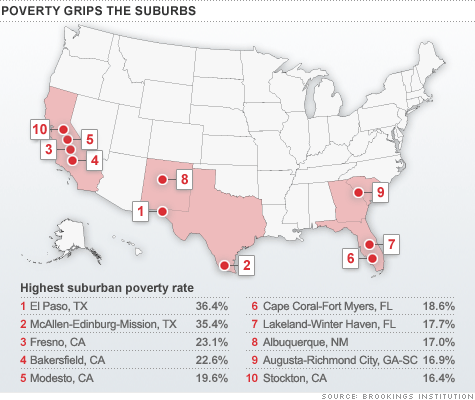
2012-04-30-suburbs4.jpg
Ā© Brookings Institute via CNN Money


Myth: ā€œPoverty doesn’t exist here.ā€

Thanks to the Recession, this myth has become too obvious, too uncomfortable, to ignore. For the first time, suburbs have a higher percentage of the nation’s poor than cities. Many are newly-impoverished: home-owners who lost their nest-eggs, who are chained to mortgages they can’t afford.

However, those most affected by the Recession are the nearly 10 million people in suburbia who were living below the poverty line before 2000, including many new immigrants who flocked to the suburbs for the availability of low-wage construction/service jobs. With the housing market folding and those jobs dwindling, suburban poverty, in ten years, has increased by 53%. [2]

But, these are just facts and figures. It’s hard to imagine what it really means to be poor in Suburbia, especially when the ā€˜burbs persist in seeming so darn idyllic.

So let’s think about that idyllic suburban lay-out for a second: consider how it was designed, and for who (Commuters and Soccer Moms, ostensibly), and how it has grown along long, linear corridors. The suburbs are almost perfectly designed to make the lives of the ā€œdisencarchisedā€ poor as miserable as possible.

2012-04-30-suburbs5.jpg
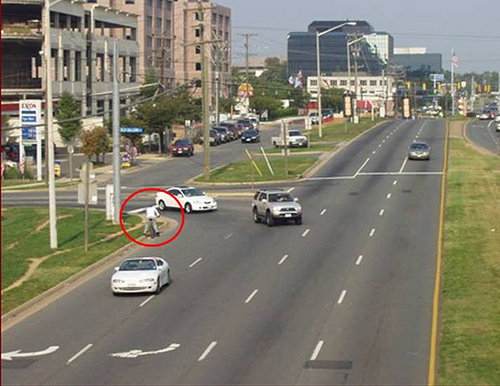
An Unwalkable Street in Suburbia. Source SwitchBoard via The Atlantic Cities


Myth: ā€œEverybody Drives!ā€

Imagine, if you will, that for the financial burden, the price of gas, the difficulty in attaining a license, you don’t have a car. What are your options?

In suburbia, public transportation is rare or nonexistant. Take Buffalo for example. Although 61% of Erie County’s population lives beyond the 42 square miles of the city-center, rapid transit exists only within city limits.ā€ As one blogger bemoaned: ā€œSprawl means stranding.ā€ [3]

What about walking, or bicycling? But then again, no. Beyond the extreme distances characteristic of suburbia (its poor ā€œdestination accessibilityā€), consider the hazard of just crossing the street: cars on multiple lanes that whip past your face, nonexistent intersections or sidewalks. As an article in The Atlantic Cities put it: ā€œWe have engineered walking and bicycling out of our communities,ā€ making them ā€œthe most dangerous and least attractive option.ā€

We’ve propagated these pedestrian-hostile environments based on the assumption that the car would forever be King. But the reign is numbered.
2012-04-30-suburbs6.jpg
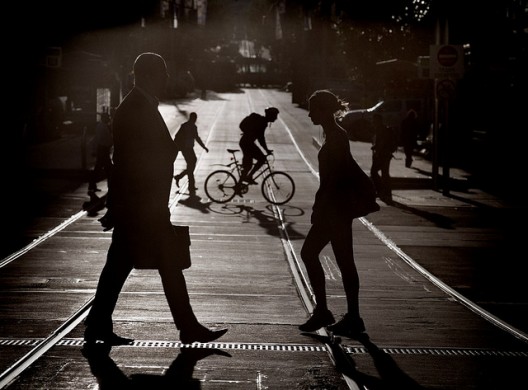
Ā© Flickr User CC mugley


Truth: The Car Is No Longer King

A recent report from the U.S. PIRG Education Fund found that Americans, particularly young Americans, are driving less. Much less. Between 2001 to 2009, the average annual number of vehicle miles traveled by people aged 16 to 34 went from 10,300 miles per capita to 7,900 miles per capita. [4]

This 23% decrease can’t be explained by economics alone; the trend was also seen among the young employed and financially stable as well.

What has changed, then, is our culture. In Davidson’s words, what was once ā€œa passport to independence [is now] a toxic jail cell.ā€ And as Americans, particularly young Americans, are avoiding cars, it should come as no surprise that they’re avoiding the car-centric suburbs too.

In his book, The Great Reset, Richard Florida calls it the New Normal, ā€œWhether it’s because they don’t want them, can’t afford them, or see them as a symbol of waste and environmental abuse, more and more people are ditching their cars and taking public transit or moving to more walkable neighborhoods.ā€ Leading the pack of this great migration to inner-cities and mixed-used suburbs? The Baby Boomers, post-retirement and down-sizing, and Generation Y. [4]
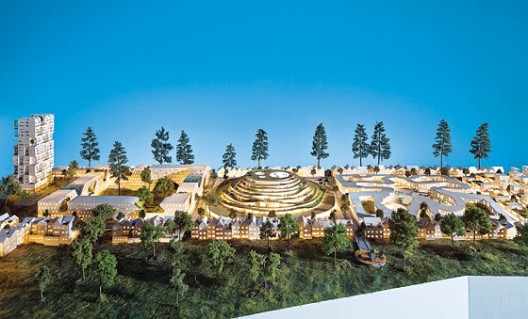
2012-04-30-suburbs7.jph.jpg
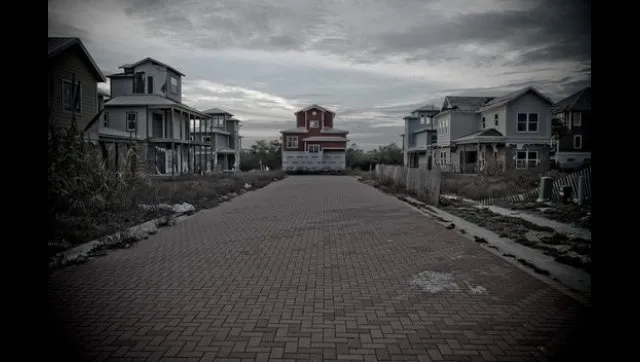
A reinvention of Keizer, Oregon, by WorkAc. Ā© James Ewing via The New Yorker


Truth: A Need For Space

As the young and the old abandon the suburbs for denser neighborhoods, there of course remain two camps: the poor who do not have the option to leave, and the families who, as Davidson pointed out, like the suburbs.

Here is where the myth and the reality collide. For those wealthy enough not to feel its hostility, who have the time/money to chauffeur their kids around, the suburbs are exactly the kind of place you would want your children to grow up in: safe cul-de-sacs, backyards for running around, parks to spend a Sunday in.

It wouldn’t work to force an urban high-density model upon the suburbs; its appeal depends upon its characteristic greenery and open space. But must those qualities be sacrificed? If so, to what extent? In Part II of this series, I will suggest how to confront the challenges facing systemic change in Suburbia (laws, bureaucracy, lack of resources, the myth, race/class tensions, etc.).

But for now, I leave you with this thought. The myth of Suburbia, upon which its design has been predicated, is hostile to those living its reality. Instead of catering to the desires of the ideal, we must enlist them in re-thinking suburbia for its forgotten citizens, its poor and ā€œdisencarchised,ā€ its young and old.

The suburbs are ripe to be re-imagined. Are we up to the challenge?

You just read about the problem, are you up for the solution? Check out Part II of the Saving Suburbia series: ā€œGetting the Soccer Moms on Your Side.ā€œ


References

[1] Davidson, Justin. ā€œCan this Suburb Be Saved?ā€ The New Yorker. February 12, 2012.

[2] Luhby, Tami. ā€œPoverty Pervades the Suburbs.ā€ CNN Money. September 23, 2011.

[3] Bruce. ā€œPublic Transportation and the Suburbs.ā€ ArtVoice. May 19, 2008.

[4] Baxandall, Phineas, Bejamin Davis, and Tony Dutzik. ā€œTransportation and the New Generation: Why Young People Are Driving Less and What It Means for Transportation Policy.ā€ The Frontier Group and The U.S. PIRG Education Fund. April 2012.

Cite:
Quirk , Vanessa . "Saving Suburbia Part I: Bursting the Bubble" 26 Apr 2012. ArchDaily. Accessed 30 Apr 2012.

Related on HuffPost:

FOLLOW CULTURE

By Vanessa Quirk (click here for original article) Poverty and violence, boarded windows and weedy lawns, immigrants jammed ā€œby the dozen into houses conceived for the Cleavers.ā€ In ā€œCan thi...
 
 
  • Comments
  • 83
  • Pending Comments
  • 0
  • View FAQ
Post Comment Preview Comment
To reply to a Comment: Click "Reply" at the bottom of the comment; after being approved your comment will appear directly underneath the comment you replied to.
View All
Favorites
Recency  | 
Popularity
Page: 1 2  Next ›  Last »  (2 total)
photo
KarmaPatrol
Riverboat Gambler, satellite whisperer. Independe
11:09 AM on 05/08/2012
Designed around cheap energy. Still expand the concrete sidewalks into asphalt mini-roads to accommodate bikes and those motorized wheelchairs, both which will be how our citizens will run errands around the neighborhood. Also ADA compliancy.
This user has chosen to opt out of the Badges program
photo
Joseph LeCompte
The USA isnt broke.It was robbed.
01:21 AM on 05/08/2012
Suburbs rely on the big cities they border. They are mostly residential zones and have no businesses to support the tax base. When the economy weakens suburbs have no lifeline. The price of gas and lack of public transportation makes them vulnerable. However the suburbs used to be full of middle class residents with enough earnings to support suburban living. That is less true now.
11:11 AM on 05/05/2012
It is self evident that continued suburban sprawl is wasteful. At some point, we have to say, enough!!!! Enough new infrastructure: enough new roads, enough new reservoirs, enough new sewage systems, enough new fire stations and police departments and hospitals and schools, and strip malls, and shopping centers. Especially when we already have more existing infrastructure than we can possibly use! It is disgracefully wasteful. And only the developers are really benefiting, along with the corrupt politicians who do their bidding. I live in Richmond, and the old beautiful downtown has been allowed to rot, even while developers continue to plow up farmland to the east and to the west. They are shameless.
04:19 AM on 05/03/2012
You don't need to destroy the suburbs, they can be rebuilt. A co-op style housing could be used with solar panels on top. Front yards could be adjusted to allow more interaction between residents and backyards could be used for organic farming. Roads could be narrowed down to allow wider pavements and perhaps bicycle paths. Huntington village in NY is a good example of a walkable area.

I understand some people are not comfortable living in apartments, they prefer having their own house so individual houses can be kept as well; with some modifications they can be improved and made more sustainable. Mcmansions definitely need to go away though.

Of course..this all requires money, a desire to improve communities and collaboration.
photo
HUFFPOST SUPER USER
James F Barry
Interior Designer * Very Gay
02:10 PM on 05/05/2012
Your 100% right.
photo
HUFFPOST SUPER USER
OliviaBolivia27
from the Sosialistisk Venstreparti of Wisconsin
02:59 PM on 05/02/2012
Why save the suburbs? They're unsustainable in just about every way. Let them fade away.
photo
HUFFPOST SUPER USER
BigWillyG
07:59 PM on 05/01/2012
Haven't "end of suburbia" predictions like this been happening since the '50s despite being wrong every time?
photo
HUFFPOST SUPER USER
writersbloc
07:17 PM on 05/01/2012
I would guess that shifting preferences and economic incentives will lead the suburbs to take care of itself even if this means its destruction. Those who want to leave and have the means to leave will do so. They will also tend to be from wealthier households. As they leave, the revenue for public services will decline and the "experiential quality" will decline in kind. At some point, the lowest income households will remain, living in an area sparse in services...or so I think. At least all these are testable propositions.
photo
SF TKF
Cthulhu thinks you'd make a nice sandwich.
06:47 PM on 05/01/2012
Could they start by abandoning the hideous cracker box McMansions they’ve been building for the past fifteen to twenty years? One of the many reasons I would NEVER live in the burbs is the appalling architecture out there.
HUFFPOST SUPER USER
whoBBoo
Just because you don't agree with my statement doe
03:24 PM on 05/01/2012
When white suburbians stop moving into places like Harlem, while pushing the price of rentals up to the point where the natives cannot afford to no longer live there, blacks and other minorities will stop moving to the burbs
photo
SF TKF
Cthulhu thinks you'd make a nice sandwich.
06:49 PM on 05/01/2012
Gentrification is fact of city life, so is neighborhood transformation. In San Francisco, neighborhoods that were once Irish became heavily Hispanic and are now rapidly becoming Asian. It’s not as if any of these groups purposefully set out to displace the other. It’s just the laws of demographics and supply and demand.
HUFFPOST SUPER USER
onionboy
Blessed are the Cheese Makers
11:01 AM on 05/04/2012
As the suburbs die out gentrification is going to go up.
HUFFPOST SUPER USER
whoBBoo
Just because you don't agree with my statement doe
03:14 PM on 05/01/2012
Awwwwwwww so the white man is pissed off because they allowed the immigrants to move into their hoods. Good for them, that's what they get for discriminating against the blacks who could actually afford to live there.
HUFFPOST SUPER USER
nightingale11
03:11 PM on 05/01/2012
We like the suburbs. I have absolutely NO desire to live in a city. Not of any kind.
photo
HUFFPOST SUPER USER
OliviaBolivia27
from the Sosialistisk Venstreparti of Wisconsin
03:00 PM on 05/02/2012
Then you don't get to complain about gas prices.
HUFFPOST SUPER USER
BLMer
02:04 PM on 05/01/2012
The map showing poverty in Cape Coral - Ft. Myers must be old information. You have to realize that the 18.6% is for full time working residents. Two thirds of the homes are retired, europeans or "snow birds" and there is no money worries with this group. There are few homes for sale ( all are quickly purchased) and there was a 31.5% increase in home values. Most of the 18.6% were construction workers out of work from the boom years. Unemployment is now less than 10%. It apprears that it's lazynest on the part of those writing this article to research correct and current information.
10:03 AM on 05/03/2012
Has anyone else posting on Huffington noticed the chronically POOR research that is done on many of the articles written? There is a lot of misinformation being given on HuffPo. More than I think I have ever seen with other online publications. Are they having problems getting a high caliber of writers? What's wrong with HuffPo's editors? It's called editing and fact checking.
HUFFPOST SUPER USER
BLMer
11:48 AM on 05/03/2012
The information they are quoting is from early 2009. Saw in the paper yesterday that unemployment is at 8% for Cape Coral - Ft. Meyers now.
01:33 PM on 05/01/2012
Who writes these important pieces? Suburbs have an increase in poverty because we are in a recession and the areas can more easily be measured. A major city with a dense population, large homeless and immigrant population is harder to measure. Tell the folks living in the projects with aunts, uncles, cousins, new babies, visiting relatives, and returning sons and daughters all stuffed into government housing that they are more well off than the poeple in the suburbs and see what they tell you.
photo
HUFFPOST SUPER USER
Canefighter
I post my thoughts on subjects, not opinions.
11:26 AM on 05/01/2012
After living in cities our whole lives we finally moved beyond the suburbs to Farm country about three years ago. We love it here. Nearest gas and groceries are about five miles away and major shopping is about a twenty minute drive. Lower property taxes being out of city limits, great price for a new home and some quiet, finally. We have city water, electric service only and are at the end of the line for cable TV and internet and 4 G cell service. We have Volunteer fire and rescue stations on either side of us about two miles to either of them. Sure we have to drive a bit more to go shopping or see our Doctor but it is so well worth it to be living here with a more laid back lifestyle and enjoying our retirement.
photo
Scholastica8
RINOS & Bull-Mooses UNITE! People Matter!
12:28 PM on 05/01/2012
And what happens if both you and your spouse should become unable to drive? Are there local senior services? Or if we see a huge spike in gas prices and it becomes too expensive to drive? What happens if there should be a medical crisis? How far to a hospital.... and if the stay should be extended, how far would one of you have to commute in order to visit? Is there a viable support system for those who don't or can't drive?

My grandmother lived in a rural Indiana town. When she was in her 60s all was well.... friends and neigbors were all around.... but many were of the same generation. The younger people in town began to move away. She didn't drive so she relied on others to go to the doctor, etc. By the time she was in her 70s, the local stores had closed. A Super Walmart had opened about 25 miles away, but it might as well have been 500 miles. Houses were empty as neighbors died or moved away. People no longer cut thru the yard headed to the post office or the local cafe. Those, too, were gone. She relied on her brother, who was 3 years younger, and lived 20 miles away... he came once a week, but his sight and car were failing. She was very isolated at the time of her death @78.
photo
HUFFPOST SUPER USER
Canefighter
I post my thoughts on subjects, not opinions.
01:02 PM on 05/01/2012
Thanks for caring. Gas costs are not a problem for us, we do not drive much, as far as Hospitals and a support system is involved we have all that covered, we did planned for that before we moved here, Since we moved we have also met some great neighbors. All is well. Once again, thanks for caring.
HUFFPOST SUPER USER
Mouse223
Tornado at your doorstep.
11:05 AM on 05/01/2012
THE ONLY THING TO SAVE THE SUBURBS IS THE SURBAN INVADERS! YOUTUBE AND LISTEN!