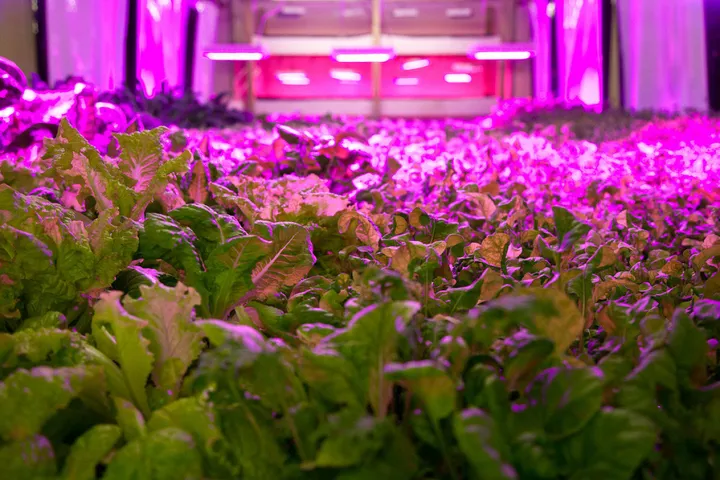
In April, the Associated Press reported on The Plant, an urban "aquaponics" farm in Chicago that's situated in an old meat-packing warehouse in the middle of a food desert.

The Plant is a fish hatchery, hydroponic garden, commercial kitchen, and brewery for both beer and kombucha tea. Perhaps best of all, the waste from one part of farm serves as raw material for another, making it a net-zero energy system, according to Arch Daily. Everything is recycled, making it a kind of "green factory."

A new informational video produced by Today's Green Minute briefly explains the complex network of relationships that make up the farm's man-made ecosystem.

Scroll Down For Video

For example, fish feed on spent barley from the brewery, and plants feed on waste from the fish. Kombucha cultures feed off oxygen produced by plants, while plants feed off carbon dioxide produced by the kombucha cultures.

But the "heart" of the operation at The Plant will be an anaerobic digester, which will convert waste to biogas, which will then be used to power turbines that create electricity. Once the anaerobic digester is installed, The Plant will be completely off the grid.

According to a spokesperson for the Plant, who e-mailed The Huffington Post, the anaerobic digester may be installed by June 2013.

"[We are] in the process of finishing the permits and beginning to order equipment, but [it's] a massive piece of machinery," she wrote.

Correction: A previous version of this story implied that the anaerobic digester had already been installed.

WATCH: The Plant's Net-Zero Energy System Explained

LOOK: A Quick Tour Of Chicago's Amazing Green Factory

Loading Slideshow...
  • Hydroponic Garden Under UV Light

    Light that shines on the Plant's hydroponic gardens is powered by electricity generated by an anaerobic digester. (Flickr: The Plant Chicago - http://www.flickr.com/photos/plantchicago/)

  • Arugula Beds

    Oxygen produced by plants benefit kombucha cultures; Carbon dioxide produced by kombucha cultures benefit plants. (Flickr: The Plant Chicago - http://www.flickr.com/photos/plantchicago/)

  • Tilapia At The Plant

    Tilapia are an ideal fish for an urban hatchery. They are fast-growing, lean and short-lived, with a primarily vegetarian diet. (Flickr: The Plant Chicago - http://www.flickr.com/photos/plantchicago/)

  • Fish Tanks

    Waste from fish is used as fertilizer for plants. Plants produce clean water for the fish. (Flickr: The Plant Chicago - http://www.flickr.com/photos/plantchicago/)

  • Brewery Demolition

    Spent grain from the brewery "feeds" the Plant's anaerobic digester. Spent barley literally feeds fish in its hatchery. (Flickr: The Plant Chicago - http://www.flickr.com/photos/plantchicago/)

  • Greens To Feed A Kitchen

    The Plant's greens will be used to prepare meals in a commercial kitchen located on-site. This kitchen will provide jobs and nourishment in a food desert. (Flickr: The Plant Chicago - http://www.flickr.com/photos/plantchicago/)

  • The Plant, Exterior

    What was once a meat-packing warehouse is now an urban farm. (Flickr: The Plant Chicago - http://www.flickr.com/photos/plantchicago/)

  • A Salvaged Air Compressor

    Situated in an 87-year-old meat packing warehouse in Chicago's distressed Back of the Yards neighborhood, the Plant's location was a boon for salvaged material. (Flickr: The Plant Chicago - http://www.flickr.com/photos/plantchicago/)