iPhone app iPad app Android phone app Android tablet app More

Bianca Bosker
GET UPDATES FROM Bianca:

Google Knowledge Graph Could Make Clicking Unnecessary

Posted: Updated: 05/17/2012 12:13 am

Google Knowledge Graph

When one searches for "Homer," Google gets confused. Does it refer to the cartoon character? The Greek epic poet? The fishing town in Alaska?

The search engine spits back a list of blue links with information about all three, and displays images of Homer Simpson's bald yellow noggin, side by side with marble busts of the famous poet. Diving into the details about the cartoon, town or ancient Greek requires clicking through the sites shown on the page.

All that is about to change with a major upgrade to Google's search results that aims to eradicate ambiguity and make clicking on the sites shown in search results increasingly unnecessary.

In what it bills as one of its biggest launches in years, Google is leveraging its "Knowledge Graph," a database of 500 million people, places and things that Google has compiled over two years from sources such as Wikipedia, CIA World Factbook, Freebase and Google Books, to better connect vague keywords to real topics, summarize facts about the subject one is searching, and inject serendipity into search results. Google notes that by connecting billions of disparate points of data, its search results can present users with a more coherent narrative, thus providing a better understanding of the relationships between facts.

"To put this into perspective, one of the biggest launches in the past was Universal Search," said Ben Gomes, a Google Fellow and vice president of the company's search group. "The Knowledge Graph features affect a larger fraction of queries than Universal Search. Users will see these features more often than they see Google Maps in Google Search.”

Much like its existing Google Maps feature, which displays detailed information about a business to the right of relevant links, Google's latest upgrade will deliver a brief profile of the queried subject, from an author's birthplace to a band's discography.

For example, rather than having to visit the Frank Lloyd Wright Foundation's website to learn more about the architect, Google will use Knowledge Graph to showcase biographical details about the architect on its own website, serving up his birthdate, spouse, children and images of his most famous buildings (See screenshot below). Of course, it's just a cursory glance at the architect -- but one that might satisfy many.
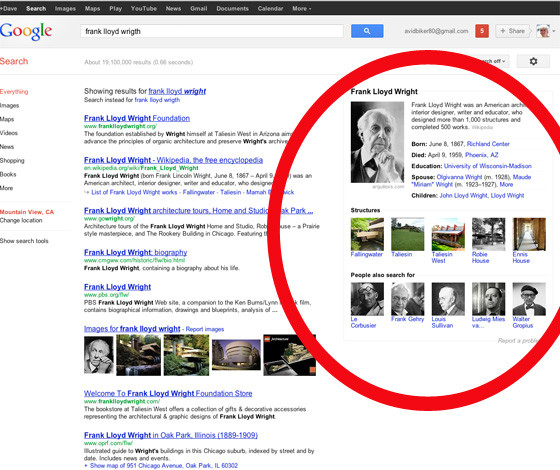
google knowledge graph

Google will customize the selection of facts to reflect users' most common queries relating to that person or place. The summary for astronaut Eileen Collins includes details about her space missions and total time in space, while the profile for Florence and the Machine displays the group's albums, upcoming gigs and band members. Clicking on terms included in the summary will take users to Google search results for those particular terms.

The change puts Google front and center, and promises to keep some users on Google, rather than diverting them to the websites where they could have found similar facts. It also promises to irk some sites, which could see traffic diverted from their own pages, as well as attract the attention of antitrust regulators, who are already investigating charges that Google cooked its algorithms to feature its own products ahead of competitors'.

The summaries will also add some surprises into users' search results, surfacing information users didn't know they wanted but may be interested in. Search for "The Simpsons" and the results include more cartoons that people "also searched for," such as "Family Guy," "South Park" and "Futurama." The change underscores the steps tech companies are taking to engineer serendipity and introduce us to ideas we might not have discovered otherwise.

"We can connect things to what you're searching for in ways you might not have expected," said Gomes. "In terms of search, this will greatly increase the amount of serendipity in search as you browse from a topic to things related to it."

Another new feature uses the Knowledge Graph to help users move from the an ambiguous query -- i.e. "Kings," which could refer to a hockey team, basketball team or television series -- to the specific topic they intended to search. Google will present a list of more specific queries to the right of its results, i.e., "Los Angeles Kings," "Sacramento Kings" or "Kings TV Show." (The screenshot below features an example of this feature using the term "Andromeda.")
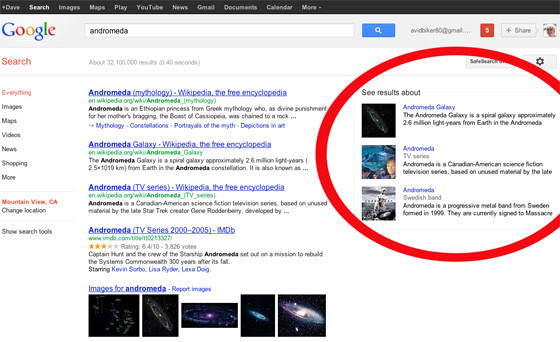
google knowledge graph 2

Gomes explains that Google hopes its Knowledge Graph will help the search engine answer more advanced questions that take into account specific locations and times of year, or require bringing together information from discreet databases. Among the "harder questions" offered as examples by Google are: "Where can I attend a Lady Gaga concert in warm outdoor weather?" and "What is the coldest lake in the world in July?"

The Knowledge Graph features are being rolled out to English-language users beginning May 16.

Check out more screenshots from the new feature (below).

Loading Slideshow...

FOLLOW TECH

From our partners


When one searches for "Homer," Google gets confused. Does it refer to the cartoon character? The Greek epic poet? The fishing town in Alaska? The search engine spits back a list of blue links with...
 
 
  • Comments
  • 235
  • Pending Comments
  • 0
  • View FAQ
Post Comment Preview Comment
To reply to a Comment: Click "Reply" at the bottom of the comment; after being approved your comment will appear directly underneath the comment you replied to.
View All
Favorites
Bloggers
Recency  | 
Popularity
Page: 1 2 3 4 5  Next ›  Last »  (7 total)
photo
HUFFPOST SUPER USER
TisKishnsing
Brutal logic, unexpected honesty
04:40 PM on 05/17/2012
don't like google?
here's an alternative: stay off the internet.
photo
HUFFPOST SUPER USER
ThaGovna
I walk on water, eat bullets, and poop ice cream.
11:19 AM on 05/17/2012
I ♥ Google.
11:05 AM on 05/17/2012
It sounds like they are tracking my web activities without my permission and are then selling that information to advertizers
This user has chosen to opt out of the Badges program
photo
Johnny Hempseed
The Founding Fathers grew hemp.
10:19 AM on 05/17/2012
Google effectively filters your results.

http://dontbubble.us/

Google keeps an eye on you.

http://donttrack.us/

Duckduckgo FTW!
09:29 AM on 05/17/2012
I didn't realize how many Google haters there are. I guess FB should have done something like this first so everyone would have blindly loved it.
04:48 AM on 05/17/2012
http://liveoncampus.com/wire/show/3380953
Twitter: Here's How to Hide Your Tweets from Google
04:40 AM on 05/17/2012
What you can do if you do SEO, don't panic. This is not a new penalty update like Panda and Penguin. This is actually good stuff, and I found a few tips already: https://bitly.com/knowledgegraph I'm actually excited since this would give more relevant results and kick out all the garbage results.
02:42 AM on 05/17/2012
Just another way to try to push google+ on everyone.
HUFFPOST SUPER USER
CR90
02:25 AM on 05/17/2012
Kill it before it becomes self aware!!!
photo
HUFFPOST SUPER USER
dwhuston
Why do people say strangers are perfect?
09:56 AM on 05/17/2012
Way to late.
photo
HUFFPOST SUPER USER
Saumya Shrivastava
Broke is only temporary; poor is a state of mind
01:35 AM on 05/17/2012
http://liveoncampus.com/wire/show/3380915
Thanks to Google. COMPUTERS CAN NOW THINK..!!
Here’s an under the hood look at the next frontier in Search, from the team at Google behind the technology. The Knowledge Graph is a huge collection of the people, places and things in the world and how they're connected to one another. With this technology, Google can get you the best possible answers and help jump start your discovery.
photo
HUFFPOST SUPER USER
stopgeorge
Paper Ballots WORK. Unverifiable e-voting doesn't
11:37 PM on 05/16/2012
"Google Knowledge Graph Could Make Clicking Unnecessary"

-----------------------------------------------

How Huffpo came up with this headline for this article is beyond me. Did the editors even read this article?!

This does not make clicking unnecessary. If anything, it encourages clicking (or pressing). The user will get results that are related to their search query -- which makes searching easier. It encourages "surfing" -- which requires more clicks.
05:53 AM on 05/17/2012
haha, way to go, negative comment on huffpost's title.
photo
HUFFPOST SUPER USER
RealityMyFriend
11:31 PM on 05/16/2012
Making it hard to find what you need and instead provide you paid keyword name listings.
11:15 PM on 05/16/2012
will it help me find male on male porn easier?? im all for it.
photo
Enroh Mot
Veritas Lux Mea
11:21 PM on 05/16/2012
Who dat, you dat.
photo
Enroh Mot
Veritas Lux Mea
11:39 PM on 05/16/2012
You must live in the loneliest place in Louisiana...Bayou Self.
photo
HUFFPOST SUPER USER
CrazyThisIs
An eye for an eye only makes the whole world blind
01:33 AM on 05/17/2012
Ha! Very clever, you.
This user has chosen to opt out of the Badges program
photo
10:40 PM on 05/16/2012
I developed an elegant theory of information topology years ago which is probably beyond this new Google thing but I could not interest anyone in it at the time. It's very frustrating. Maybe I'll become a Bond villain.
photo
Enroh Mot
Veritas Lux Mea
10:46 PM on 05/16/2012
Be a hero....AquaBond.
This user has chosen to opt out of the Badges program
photo
10:51 PM on 05/16/2012
I'm tried of being good. I want to be bad. Besides, the villain has all the chicks and those goons in the jumpsuits.
photo
Trapped in Arizona
This, I believe* (*subject to change)
01:53 AM on 05/17/2012
Check out "The Myths of Innovation" by Scott Berkun. He has an entire section dedicated to innovators whose innovations were "ahead of their time" but who could not drum up any interest. Summary: There are complex economic, cultural, sociological, and psychological reasons why some seemingly great ideas do not take hold at any given time. (e.g., Alexander Graham Bell had doors slammed in his face because, among other reasons, the telegraph makers might have feared that their telegraph business would be threatened).
photo
HUFFPOST SUPER USER
Dr Juan
We built America without BO
10:38 PM on 05/16/2012
I thought they were going to say Google looks up your profile, all your past searches and all the web sites you visited and then looks at all your associate yo uhave ever e-mailed and considers their profile too and then uses this data to narrow down all the hits to the ones you are most likely looking for.

ie surveillance they keep on you narrows the hits
photo
HUFFPOST SUPER USER
tc399
Your personal Eschatologist.
11:17 PM on 05/16/2012
No, the NSA does that.