By: Charles Q. Choi
Published: 05/16/2012 01:22 PM EDT on SPACE.com
Stars like our sun can release "superflares," explosions of up to 10,000 times more energy than the solar flares seen from our sun, researchers say.
However, it looks unlikely that our sun currently has superflares, scientists added.
Astronomers have previously detected superflares from a variety of star types, which release bursts that have 10 to 10,000 times more energy than the largest solar flare ever detected from our sun. Scientists wanted to know how common these outbursts might be from stars like the sun — those with masses and temperatures similar to our star. Even normal solar flares can damage satellites, endanger astronauts and wreak havoc on electrical grids on Earth, suggesting that superflares might be catastrophic to life on Earth.
Until now, few superflares have been detected from sunlike stars. This rarity has hampered detailed analysis of what might cause them to happen. Now, with NASA's Kepler planet-hunting satellite, researchers have a way to analyze many sunlike stars at once. The scientists monitored about 83,000 sunlike stars over 120 days and detected365 superflares from 148 of the stars, each lasting one to 12 hours.
Slowly rotating solar-type stars were responsible for only 101 of the superflares seen in the sample. This suggests that slowly whirling stars like our sun have superflares much less often than rapidly spinning ones. [Video: No Chance of Superflares Destroying Earth in 2012]
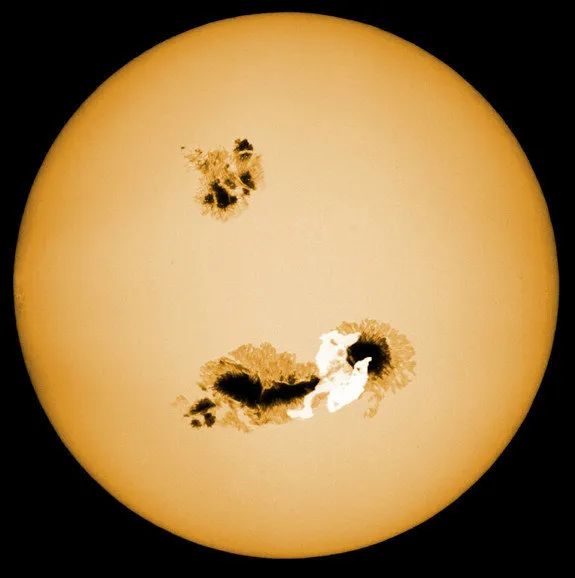
Somewhat regular fluctuations in the brightness of the superflaring stars hints they all possess large starspots, much larger than the sunspots seen on our sun. This suggests they are caused by magnetic activity of the stars, just as solar flares are linked with sunspots and solar magnetic activity. Rapidly spinning stars are expected to experience more magnetic activity than slower-whirling ones, which likely explains why they have more superflares.
Scientists had thought superflares of sunlike stars were caused by magnetic interactions between the stars and so-called hot Jupiters — gas giant planets orbiting extraordinarily near their stars, at a tenth or less of the distance of Mercury from our sun. However, the researchers found that no hot Jupiters were discovered around any of the superflaring stars they studied, suggesting that superflares from sunlike stars are actually only rarely linked with hot Jupiters.
On average, sunlike stars appear to release superflares 100 times stronger than any known solar flare about once every 800 years, and flares 1,000 times stronger than solar flares about every 5,000 years, researchers estimated. Still, that might not mean that a superflare 100 times stronger than any known solar flare really happens every 800 years — for instance, a sunlike star might release 100 superflares in 10 years, but then no more for another 79,990 years, which would still produce the same average, said study lead author Hiroyuki Maehara, an astronomer at Kyoto University in Japan.
The researchers noted there is no historical record of superflares from our sun in the past 2,000 years, and strong evidence indicates that there has not been one in the past billion years. "Most superflare stars have large starspots, but the present sun does not," Maehara explained. "Further studies are necessary to understand why and how such large starspots are formed on solar-type stars, and whether our sun can produce superflares."
To know whether superflares happen on the sun, "we need detailed observations — for example, high-resolution spectroscopy — of superflare stars, which allow us to know whether superflare stars are really similar to our sun," Maehara told SPACE.com.
The scientists detailed their findings online May 16 in the journal Nature.
Follow SPACE.com for the latest in space science and exploration news on Twitter @Spacedotcom and on Facebook.
Copyright 2012 SPACE.com, a TechMediaNetwork company. All rights reserved. This material may not be published, broadcast, rewritten or redistributed.
Our 2024 Coverage Needs You
It's Another Trump-Biden Showdown — And We Need Your Help
The Future Of Democracy Is At Stake
Our 2024 Coverage Needs You
Your Loyalty Means The World To Us
As Americans head to the polls in 2024, the very future of our country is at stake. At HuffPost, we believe that a free press is critical to creating well-informed voters. That's why our journalism is free for everyone, even though other newsrooms retreat behind expensive paywalls.
Our journalists will continue to cover the twists and turns during this historic presidential election. With your help, we'll bring you hard-hitting investigations, well-researched analysis and timely takes you can't find elsewhere. Reporting in this current political climate is a responsibility we do not take lightly, and we thank you for your support.
Contribute as little as $2 to keep our news free for all.
Can't afford to donate? Support HuffPost by creating a free account and log in while you read.
The 2024 election is heating up, and women's rights, health care, voting rights, and the very future of democracy are all at stake. Donald Trump will face Joe Biden in the most consequential vote of our time. And HuffPost will be there, covering every twist and turn. America's future hangs in the balance. Would you consider contributing to support our journalism and keep it free for all during this critical season?
HuffPost believes news should be accessible to everyone, regardless of their ability to pay for it. We rely on readers like you to help fund our work. Any contribution you can make — even as little as $2 — goes directly toward supporting the impactful journalism that we will continue to produce this year. Thank you for being part of our story.
Can't afford to donate? Support HuffPost by creating a free account and log in while you read.
It's official: Donald Trump will face Joe Biden this fall in the presidential election. As we face the most consequential presidential election of our time, HuffPost is committed to bringing you up-to-date, accurate news about the 2024 race. While other outlets have retreated behind paywalls, you can trust our news will stay free.
But we can't do it without your help. Reader funding is one of the key ways we support our newsroom. Would you consider making a donation to help fund our news during this critical time? Your contributions are vital to supporting a free press.
Contribute as little as $2 to keep our journalism free and accessible to all.
Can't afford to donate? Support HuffPost by creating a free account and log in while you read.
As Americans head to the polls in 2024, the very future of our country is at stake. At HuffPost, we believe that a free press is critical to creating well-informed voters. That's why our journalism is free for everyone, even though other newsrooms retreat behind expensive paywalls.
Our journalists will continue to cover the twists and turns during this historic presidential election. With your help, we'll bring you hard-hitting investigations, well-researched analysis and timely takes you can't find elsewhere. Reporting in this current political climate is a responsibility we do not take lightly, and we thank you for your support.
Contribute as little as $2 to keep our news free for all.
Can't afford to donate? Support HuffPost by creating a free account and log in while you read.
Dear HuffPost Reader
Thank you for your past contribution to HuffPost. We are sincerely grateful for readers like you who help us ensure that we can keep our journalism free for everyone.
The stakes are high this year, and our 2024 coverage could use continued support. Would you consider becoming a regular HuffPost contributor?
Dear HuffPost Reader
Thank you for your past contribution to HuffPost. We are sincerely grateful for readers like you who help us ensure that we can keep our journalism free for everyone.
The stakes are high this year, and our 2024 coverage could use continued support. If circumstances have changed since you last contributed, we hope you'll consider contributing to HuffPost once more.
Already contributed? Log in to hide these messages.