iPhone app iPad app Android phone app Android tablet app More

'Symphony Of The Soil': New Documentary Connects Soil Health To Human Health

Posted:

Grazing
Jack Algiere's kids, Ojiah and Sedge, graze the fields at Stone Barns Center For Food and Agriculture.

Jack Algiere has no qualms about letting his kids eat their veggies straight out of the ground from the fields and greenhouses he manages in Pocantico Hills, N.Y.

He knows the rich, organic soil will provide Sedge and Ojiah with delicious, nutrient-rich food. Not to mention a possible boost to their immune systems.

His sons have their favorites. "Carrots are up there and consumed after a brush with the shirt sleeve. But spinach in winter seems to be the prize," said Algiere, the farm manager at Stone Barns Center For Food and Agriculture. "With most greens, they prefer to graze -- no hands -- rather than pick."

Perhaps most importantly, Algiere knows that toxic fertilizers and pesticides will not have touched the carrots or spinach, and therefore can't pose any risks to his sons' health.

"Thanks to our improved understanding of the dynamics of soil, the luster of chemical agriculture has worn off," Algiere said. He once worked farmland the conventional way, but said he has since learned that nature really does know best when it comes to warding off unwanted weeds and insects, and feeding a plant what it needs to thrive.

Nature's secret: healthy soil, composed of billions of tiny creatures that essentially become a plant's immune and digestive systems.

But despite the way Algiere manages Stone Barns, many people are acting as soil spoilers, according to a new documentary called "Symphony of the Soil." Our chemical dependencies are stripping soil of its life-giving duties and turning it into lifeless dirt, the film says. We've destroyed half the world's topsoil in the last 50 years, and a quarter of what's left is degraded. Experts in the film suggest that this loss is contributing to a range of today's ills: flooding, droughts, toxic algae blooms, contaminated drinking water, cancer, developmental problems, antibiotic-resistant infections, obesity and more.

"The connection between healthy soil and healthy people is so obvious," said Deborah Koons Garcia, director and producer of the film, which screened last weekend at Stone Barns.

So, when and how did we lose sight of such a vital relationship? And can we find it again?

DEGRADED INTO DIRT

Fred Kirschenmann, a distinguished fellow at the Leopold Center for Sustainable Agriculture at Iowa State University, pointed to his grandfather's generation: The first synthetic nitrogen fertilizers and pesticides emerged from the chemistry of weapons during the world wars, he said.

"[The chemicals] came as a saving grace," Kirschenmann, also board president at Stone Barns, says in the documentary. Greedy farming methods had already begun to increasingly outpace the land's natural production of nitrogen fertilizer, a delicate collaboration between plant, bacteria and other soil microorganisms.

Applying chemical fertilizer, Kirschenmann's grandfather and other farmers could enjoy record returns from their land -- at least for the short term. But it wasn't long before the new tactics triggered a downward spiral for their soil, their crops and the overall health of the nation, the film says.

Research suggests that the addition of synthetic fertilizer lowers a plant's natural defenses against pests. That increased vulnerability attracts more pests and can prompt a farmer to apply increasing amounts of insecticides and herbicides, which often kill beneficial insects and animals along with the intended targets. Over time, such use can lead to pesticide resistance and the need to apply even larger quantities or altogether different chemical concoctions.
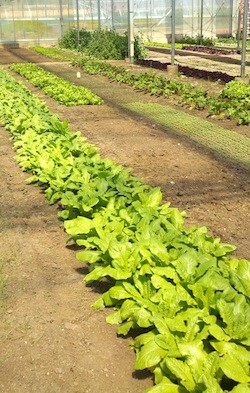
Growing a mix of crops keeps the soil happy.
Photo by Lynne Peeples

Meanwhile, synthetic fertilizers are also subject to the law of diminishing returns. More and more may be needed to help plants grow over time, which is especially true if only one type of plant is grown in a field. Without a diverse mix or rotation, the soil doesn't get a well-balanced, nourishing diet; Kirschenmann likened it to a person only eating French fries every day. What's more, these so-called monocultures are highly prone to pest outbreaks.

And the cycle continues.

"There's always something else. This is great for pesticide companies," Garcia said. "If you have healthy, alive soil, you don't need chemicals. Healthy soil exudes protection from bad guys."

CHEMICAL CONCERNS

More than 10,000 chemicals are currently registered for agricultural use in the U.S., Paul Hepperly, who was research director of the nonprofit Rodale Institute during filming, says in the documentary. And with the ongoing development of new pesticides and new genetically modified crops designed to withstand them -- one of the latest being 2,4-D-resistant corn -- it doesn't seem like farmers will stop applying the annual 1.1 billion pounds of pesticides.

When a chemical product is used, it is rarely confined to a farmer's fields.

Research suggests that less than half of the synthetic fertilizer is actually absorbed by crops. The excess may be released into the air as a potent greenhouse gas, or it may leak into the soil and water systems, potentially contaminating drinking water and contributing to toxic algae blooms. Pesticides find a similar fate.

In most cases, the health effects of these chemicals or mixtures of chemicals remain unknown. But science is slowly starting to catch up, as The Huffington Post has reported, and prenatal or early childhood exposures appear capable of causing everything from birth defects to cancer to infertility. New research suggests that even tiny amounts of a toxic chemical can prove harmful to a developing child.

A mixture of fertilizer and pesticide chemicals may be particularly dangerous -- and are often found together in waterways. As Warren Porter of the University of Wisconsin, Madison, explains in "Symphony of the Soil," nitrates from fertilizer can worsen the situation by shutting off the body's defenses to toxic chemicals.

"It's like tying your hands behind back," he said.

Even chemical-free operations can pose water woes. Poor soil can mean an increase in the frequency and intensity of both droughts and floods, even without changes in rainfall. (Of course, more extreme weather is predicted with climate change.)

"My prerogative is to protect the water system," said Stone Barns' Algiere, calling water the biggest public health concern for agriculture outside of production.

According to the U.S. Department of Agriculture, soil with a healthy amount of living matter, say 5 percent, can absorb about six times more water than soil containing only 1 percent of organic material. The living content of the soil at Stone Barns tends to fall between 5 and 6 percent.

If there is more absorption, then less soil -- as well as pesticides and fertilizers -- will run off the surface into waterways, and more freshwater will be able to restore aquifers. Further, if the soil soaks up a greater amount of water, it won't need as much additional water later to quench its thirst.

About 70 percent of the planet's fresh water is currently used for agriculture irrigation. And that resource is depleting at a rapid and unsustainable rate. The water level of the Ogallala aquifer in the Midwest, for example, has dropped by more than half in 50 years.

"We need to adjust agriculture to suit nature, not the other way around," Kirschenmann said in an interview with The Huffington Post.

'BETTER LIVING THROUGH BIOLOGY'
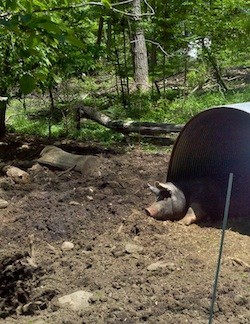
Pigs and soil cohabitate on Algiere's farm.
Photo by Lynne Peeples

Past Stone Barns' row of greenhouses, and a few hundred feet down a wooded trail, lies a pair of pigs caked in dark mud under the shade of trees.

"These animals have a reason to be in the woods," Algiere said. "That is where they're from."

Letting the pigs roll around in their natural surroundings is benefiting the farm as well. "The pigs are digging up invasive species, opening up ground. These are things we never could do with a tractor," Algiere added.

For millennia, animals were a farm staple, pooping out fertilizer and feeding the soil. "When you take animals off the farm, you tend to get too much manure in one place," film director Garcia said, "so you end up with two problems: excess manure and a lack of fertility."

At the same time, having too many animals in one place can cause an array of other problems. Factory farms can become a breeding ground for infectious disease and antibiotic resistance.

"Whatever they're giving the animal is probably killing anything that would have killed that infestation," said Algiere, who uses no antibiotics and often lets his chickens freely roam sections of his fields. "It's all part of the same story."
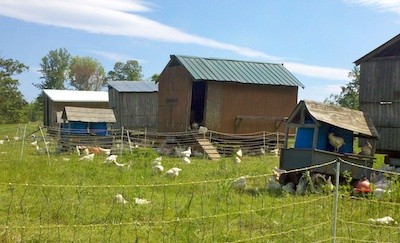
Free-range chicken: better for the soil, better for humans.
Photo by Lynne Peeples

Hepperly, of the Rodale Institute, suggests that story needs to be changed, perhaps by revising the 1960s-era notion that "chemistry was better than life forces" to one that "lets life live."

"We call this better living through biology," he says.

FOLLOW GREEN

Jack Algiere has no qualms about letting his kids eat their veggies straight out of the ground from the fields and greenhouses he manages in Pocantico Hills, N.Y. He knows the rich, organic soil ...
 
 
  • Comments
  • 90
  • Pending Comments
  • 0
  • View FAQ
Post Comment Preview Comment
To reply to a Comment: Click "Reply" at the bottom of the comment; after being approved your comment will appear directly underneath the comment you replied to.
View All
Favorites
Recency  | 
Popularity
Page: 1 2 3  Next ›  Last »  (3 total)
11:19 AM on 06/04/2012
well said. I've been organic for over 8 years. Even tho it's a medium sized backyard, every little bit helps. I've planted many trees & shrubs to help capture the water. If just everyone would pitch in by planting more trees & shrubs and moving to organic it would help. I read an article that finally had urban governments putting in rain gardens at strategic points to help reduce the amount of water going into sewers, and it reduced water by 80%. I was surprised that my city was even putting one it.
01:45 AM on 05/29/2012
Is any work being done or is there consideration about finding links between chemical residues used in food animals as the residues builds up in consumers. Many drugs are banned by the FDA in food animals but are considered legal in dogs and horses. Recent postings in social media related to horse slaughter indicate that some posters believe that phenylbutazone and ivermectin can be used safely in cows. However, the IG’s Report to FSIS in March 2010 indicates that this is not the case. It is of concern that people who may be dabbling in food animal production or think they know what is common practice suggest that banned substances are OK to use when these drugs are known to remain in the tissue of the animal for its entire life.
12:09 AM on 05/21/2012
This is not new. It has been known for years. The classic work is The Soil and Health (1947) by Sir Albert Howard. A more recent work is Teaming With Microbes, by Lowenfels & Lewis if you want to know more.
01:43 PM on 05/20/2012
Of course, the key to organic gardening is to learn how to activate the natural harmony of the fauna and flora in the soil. There is an added benefit to gardening that has been lost in our "kindgergardening" tradition. In the 19th century, the German pedagogues who invented kindergarten, believed that this activity was a natural method for training a child's spirit as well as one's mind and body. It is a perfect pre-emergent for controlling bullying instincts, by weeding out hatred and sowing the seeds of peace, love, and respect.
11:56 AM on 05/20/2012
as the population grows the same land is asked to produce more and more food thus chemicals etc.
the solution is reducing the population not growing the population we have more than enough people on planet earth yet some groups of people breed like rats and have no sense of responsibility to the good earth.
IMOPINIONH8D
because I want it empty...
09:01 PM on 05/21/2012
"some groups of people breed like rats and have no sense of responsibility to the good earth." Nearly every "group of people" has had a hand in the abuse of the earth.
01:49 AM on 05/29/2012
That is not the only solution. You can rest the soil or a pasture by growing a different crop or alternating which species grazes a defined amount of land. Of you can let a field lie fallow. Growing crops and raising animals efficiently and healthfully is a scientific endeavor.
06:39 AM on 05/20/2012
easy solution to this debate= EAT MORE MEAT !
photo
HUFFPOST SUPER USER
ttigerlilyx2
10:48 PM on 05/19/2012
The hippies figured this out in the 60's. The only news flash here is the faint hope that it might finally become a 'fad' enough to actually make more believers and converts to restoring the balance between us and the Earth we've poisoned and abused in the name of science, ignorance and greed.
07:10 PM on 05/19/2012
Intresting article but, when I was reading it only reassured me to grow some of our veggies at home and to go with my mom's growing techniques. We use fertilizer but, its very much organic. We have chickens at home at we get their eggs (we don't feed them layer since they lay eggs on their own, just at a slower rate) and when were done instead of throwing the egg shells away, we crush them and scatter them near our plants as fertilizer. Other people found it strange but the results are very good and its not hurting anyone in the process. I'm not sure if store bought eggs do the same effect though since free range eggs are different.

What I was wondering though was since reading this article, is the soil bought in stores, like potting soil chemically treated also or does it become chemically treated just when it touches pesticides and herbicides.
IMOPINIONH8D
because I want it empty...
09:06 PM on 05/21/2012
Good question, check the bag it came in some claim to belong to a standards board that follows a compost code? Not sure what they call themselves I just remember seeing it on a bag the other day. I assumed it was a good thing.
HUFFPOST SUPER USER
ddanimal
01:31 PM on 05/19/2012
N, P and K are not the only nutrients need by plants.
photo
HUFFPOST SUPER USER
EdRea
Trees are our native friends.
09:59 AM on 05/19/2012
I knew it all along
You're the one for me

I heard it in a song
Whispered to me by an old hemlock tree

Hawks are circling in the wind
And the trees, they are our native friends

Might be circling in a dome
But it's our skin and it's our home

It grows the soil,
And the soil
Our soul,
It is
Our skin

Ed Reagan ©1991, 2011
Info: http://vermontartcart.org
09:26 AM on 05/19/2012
As a farmer I am shocked at the stupidity expressed in all of these comments. Sorry folks you have no idea what you are talking about. I have farmed for 50 years and you have no idea what you are talking about. When was the last time you were on a farm? Easy talk to throw words around that you have no idea what they mean, you have no idea what you are talking about. Be thankful for what agriculture has done over the last 50 years to feed the world, including all of you, with the best safest food anywhere. Stone Barn may be a wonderful place to get away from the city but does not feed the world or you.
outnow
Ban the bomb
10:07 AM on 05/19/2012
Feeding the world means more people who eat more. Meanwhile, the soils are depleted. Why is that such a difficult concept? Better nutrition means better practices in agriculture.

Not wanting to change practices is always justified by exploding human population levels. Is this good in your mind? If so, why?

Mankind has farmed for over 10 thousand years. We can learn by looking back as well as forward. Current agricultural practices are unsustainable. That's reality. Reality should offend no one, but it does if your ox is gored. Collectively, we all march forward to our fates without seeing that ever-expanding population can be controlled and does not justify many current practices.

Mother Nature cannot be fooled. We will pay a heavy price for those who refuse to see the light. Pesticides and fertilization techniques can and must be improved, not "justifed."
HUFFPOST SUPER USER
bzimmerman
11:22 AM on 05/19/2012
I was born and raised on a family diary farm, in the 1950s. We had 60 Holsteins, and a host of other animals. We used no chemicals of any kind, and we fed ourselves, or animals, and all those who bought milk, meat and produce from our family farm.

The trouble began with the corporatization of agriculture. Factory farms displaced the family, organic farm, just as big box stores forced family retail out of business.
photo
HUFFPOST SUPER USER
ttigerlilyx2
11:08 PM on 05/19/2012
Very true, bzimmerman, and now is the time for anyone who can or wants to go back to small farming.
I hated that the city killed the Farmers Market we have enjoyed for 100 years by moving the highway. Ironic it was about the same time Whole Foods came to town, and more people are demanding local produce.
My daughter is pregnant with our first grandchild, and I worry worry worry everything 'fresh' available for her to eat is covered in pesticides, herbicides, fungicides not to mention the antibiotics and God alone knows what else has gone into the meats or the linings of the cans and packaging of our foods!
If I had the money and was a little (ok alot) younger, I'd be building a farm to feed her and my other loved ones.
photo
HUFFPOST SUPER USER
Roadrun
In Financial Theocracy we Trust
08:04 AM on 05/19/2012
What the writers of "Soylent Green" forgot about is that people had become toxic themselves.
photo
HUFFPOST SUPER USER
Roadrun
In Financial Theocracy we Trust
08:00 AM on 05/19/2012
Even a cursory investigation into the evolution of man shows that this article reeks of common sense and intelligence. But if you need further proof then study just a little of the medical miladies society is suffering from currently. The chemicals are working their way into our children and the results are pretty shocking. We didn't evolve in a chemical factory. Autism is very prominent and gets press but I am still wondering what else is going on that we don't even know about yet.

We very much need to say no to Monsanto, while we still can.
photo
HUFFPOST SUPER USER
WESmith
Energy Conservation can save you M-O-N-E-Y!!!!!!!!
09:35 AM on 05/19/2012
According to "Science," man has not evolved in 5200 years (except we are more lactose tolerant). Vaccines and medical treatment is doing the same thing to our children as the fertilizers, going against nature. Everything is a chemical. Water is a chemical. Crude oil and marble headstones are organic. Semantics and placing blame is irrelevent.
Assuming we evolved, this had to happen in a chemical factory. The only other choices are a god created us, aliens planted us here or (my favorite scientific theory) we are computer simulations.
Or problem is waste and inefficiency. We pollute worse than industry. They are regulated. We are not. We pour oil down our drains followed by copious quantities of dispersant everyday. We caused the Dead zone in the GOM, not just fertilizer companies. We killed the all of coral reef in the GOM with our use of sunscreen.
We need to educate ourselves. We need to inventory all of the chemicals in our homes. We need to look up their MSDSs and learn how we should be treating the hundreds of chemicals we purchase, use, and spread into the environment. The Monsantos of the world exist because of our demand. Nothing more, nothing less.
outnow
Ban the bomb
10:09 AM on 05/19/2012
We should quit polluting and reproducing.
01:57 AM on 05/29/2012
Don’t give us quite so much credit. Monsanto is trying to shape our demand to fit what it needs to sell us so it can make the greatest profit. I have been researching another issue that is related to the food industry. I have discovered there are many concerns about Monsanto that are valid, not the least of which are its attempts to sell farmers seeds to grow fruit and vegetables without seeds.
07:17 AM on 05/19/2012
The Huffington Post named this article: "The Scoop on Dirt".
How more insulting one can get. How can you call the earth , the soil, dirt? This is one of the big problems in this culture, naming soil as dirt. How more arrogant can we get. The living substance that nourishes us we call dirt.I think the original title" Do not call it Dirt "was the appropriate one. Why did you change it?
This user has chosen to opt out of the Badges program
photo
06:31 AM on 05/19/2012
Big Agro isn't having it.