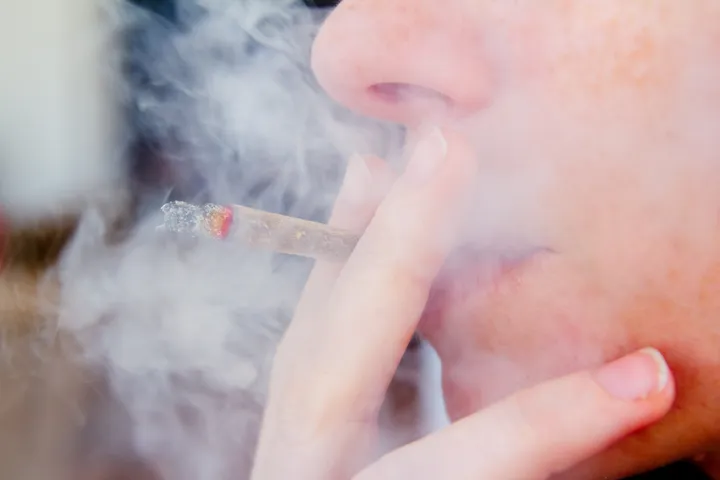
Marijuana use among teens has been on the rise for some time--it's become more popular than smoking cigarettes in recent years--but a provocative new study shows that legalizing pot for medical purposes doesn't increase the chance that teens will abuse it or certain other drugs.

"There is anecdotal evidence that medical marijuana is finding its way into the hands of teenagers, but there's no statistical evidence that legalization increases the probability of use," Daniel I. Rees, an economics professor at the University of Colorado Denver who worked on the study, said in a written statement.

Rees and his team looked at nationally representative data from high school students from 1993 through 2009--medical marijuana was legal in 13 states during that time--and found that legalization didn't affect marijuana use at school. According to study co-author Benjamine Hansen, assistant professor of economics at the University of Oregon, the data showed the opposite: There was often an inverse relationship between legalization and marijuana use.

What's more, the researchers found no evidence that medical marijuana legalization led to an increase alcohol or cocaine use.

"This result is important given that the federal government has recently intensified its efforts to close medical marijuana dispensaries," Hansen said in the statement.

The news adds another layer to the ongoing debate over whether medical marijuana should be legalized in more states. Currently, medical marijuana is legal in 17 states.

Just last month, a judge suffering from cancer wrote a New York Times op-ed in favor of legalization for medical reasons in New York state, confessing that he sometimes smokes before meals to relieve nausea and pain resulting from his illness and the medicines used to treat it.

In December, a study out of Rhode Island found that legalization of the drug did not lead to an increase in illegal use among teens.

On the other hand, there are those who argue that marijuana use has become too blase of a subject, even among parents, and such attitudes on the drug have led to an increase in use among young people.

As recently as December, R. Gil Kerlikowske, director of the White House Office of National Drug Control Policy, tied the increase in teen marijuana use to the drug's legalization for medical purposes, according to the Los Angeles Times.

"We know that any substance that is legally available is more widely used," Kerlikowske told the paper.

Related on HuffPost:

Loading Slideshow...
  • First American Woman In Space

    On June 18, 1983, Sally Ride became the first American woman in space. The California-born physicist, then 32, was also the youngest American astronaut at the time. Ride went into orbit aboard the Space Shuttle Challenger.

  • Boron Isolated

    French scientists announced the isolation of the element boron (atomic number 5) on June 21, 1808. Louis-Joseph Gay-Lussac and Louis-Jacques Thenard reported their discovery just nine days before an English chemist announced similar research.

  • UFO Crash Dismissed

    On June 24, 1997, the U.S. Air Force released a report officially dismissing claims that a UFO had crashed in Roswell, New Mexico in 1947. The document, "The Roswell Report, Case Closed," denied any evidence of an alien landing at the site, claiming the widely reported "crash" was actually nothing more than a government program that was testing parachutes.

  • Moon Of Pluto Discovered

    Charon, the largest moon of the dwarf planet Pluto, was discovered on June 22, 1978 by astronomer James Christy. Charon, which is covered in ice and has no atmosphere, was named after Christy's wife, Charlene.

  • Alaskan Pipeline Goes On Line

    On June 20, 1977, the 800-mile trans-Alaska oil pipeline began delivering oil from Alaska's North Slope. Though criticized for its impact on a delicate ecosystem, the pipeline is considered an epic feat of engineering.

  • Landmark Creationism Ruling

    The U.S. Supreme Court overturned the Louisiana "Creationism Act" on June 19, 1987. The law had prevented the teaching of evolution in public schools unless teachers also taught biblical creationism. Justice William J. Brennan (pictured here) led the 7-2 decision, now considered a major stride for science education in public schools.

  • SpaceShipOne

    The first manned private spaceflight occurred on June 21, 2004, when Mike Melvill piloted SpaceShipOne to an altitude of 62 miles. Built by Burt Rutan and Paul Allen, the one-of-a-kind craft garnered the $10-million Ansari X Prize.

  • Galileo Recants

    On June 22, 1633, Italian physicist and astronomer Galileo Galilei (1564-1642) was forced to repudiate his heliocentric theory of the solar system, which says that the Earth orbits the sun. First proposed by Copernicus, the theory was considered heresy by church authorities in Rome.

  • Darwin's Tortoise Dies

    On June 23, 2006, a tortoise believed to have been captured by Charles Darwin in the Galapagos Islands died of of heart failure at an Australian zoo. The celebrated reptile--whose age at death was estimated to be 175 years--was considered a national treasure, and was cared for by famous "Crocodile Hunter" Steve Irwin.

  • Way Before The MacBook...

    On June 23, 1868, American inventor Christopher Latham Sholes received a patent for his "Type-Writer" machine. The machine described in the patent helped spark a revolution in communications. Sholes is also credited with the QWERTY keyboard layout.

  • River On Fire

    The Cuyahoga River caught on fire in Cleveland on June 22, 1969. The river, which had been used as a dumping ground for local industrial plants in the area, was likely sparked by a passing train. Outrage over the fire helped fuel the nascent environmental movement.