Robert Crumb's adult cartoons give a similar feeling to being insulted by a kindergardener. The kid is presumptuous, offensive and totally out of line -- but oftentimes they are right. For 50 years, Crumb's off-kilter comics have rendered, with beyond brutal honesty, the rated-R dreams of adult life: sex, drugs and bluegrass. His ability to depict twisted fantasies without judgment has made Crumb one of the most infamous comics of all time.
The comic artist was raised in a family he has portrayed as highly dysfunctional, with a militant Marine father and an amphetamine-addicted mother keeping him company in 1940s Philadelphia. Bored with popular culture and stomped on by his pig-tailed lady friends, Crumb became immersed in music, and began collecting 1920s and 1930s blues, bluegrass, cajun and swing LPs. He later referred to music as one of two great loves of his life, the other being his devoted wife, Aline Kominsky-Crumb -- who is also a comic artist and frequently collaborates with him on drawings.
Crumb was introduced to comic drawing by his older brother Charles, and quickly developed an illustration style that combined the silliness of Looney Tunes, the brutishness of porno and the nightmarish dexterity of Daumier. He worked as an illustrator for a publication that offered up free toasters to gum salesmen and designed hokey cards for American Greetings corporation before moving to San Francisco and becoming a fixture in California counter-culture.
He draws bizarre yet hugely popular characters inspired by traumatizing LSD trips and even more traumatizing relationships. His most beloved characters were Mr. Natural, a short and squat bearded guru who spurts mantras of truth to pathetic disciples and Fritz the Cat, a con artist feline lacking a moral conscience. Yet Crumb is most notorious for his hyper-sexualized depictions of women, covered in fur with bodacious curves that are bursting at the seams. His unkosher fantasies recall the unsuspected and politically incorrect emergences of arousal that, if present in childhood, were soon ironed out.
Never one to shy away from his love-hate relationship with women, Crumb invited the world into his most perverted fantasies, one which includes riding on his mother's boot. Although he has been dubbed a sexist and misogynist time and time again, his raw honesty and acceptance of the immoral nature of desire has kept his ever-growing audience entranced.
Over time Crumb's drawings have become more and more realistic, including a four year chronicling of "The Book of Genesis." For the uncharacteristic project Crumb drew from three versions of the biblical text, combining background information and commentary to create a graphic interpretation faithful to the original. The work, respectful to the divine and devoted to tradition, presents a great departure from Crumb's signature irreverence.
The exhibition "Crumb: From the Underground to the Genesis" captures Crumb's evolution from counter-culture icon to contemporary art icon. Although he is currently represented by David Zwirner's powerful blue chip gallery, Crumb seems unphased by his newfound art star status. He once told the New York Times regarding the art world, "When you get inside that world and start talking to the people who actually operate in it, it's not that smart, really."
Crumb's retrospective will show until August 19 at The Modern Art Museum of the City of Paris.
Loading Slideshow
The Playful Attitude of the Model, 2002 35 x 27 cm
Publié dans Art & Beauty Magazine (Fantagraphics Books), no 2, 2003 Collection privée, Anvers
Photo : Courtesy Paul Morris and David Zwirner, New York
© Robert Crumb
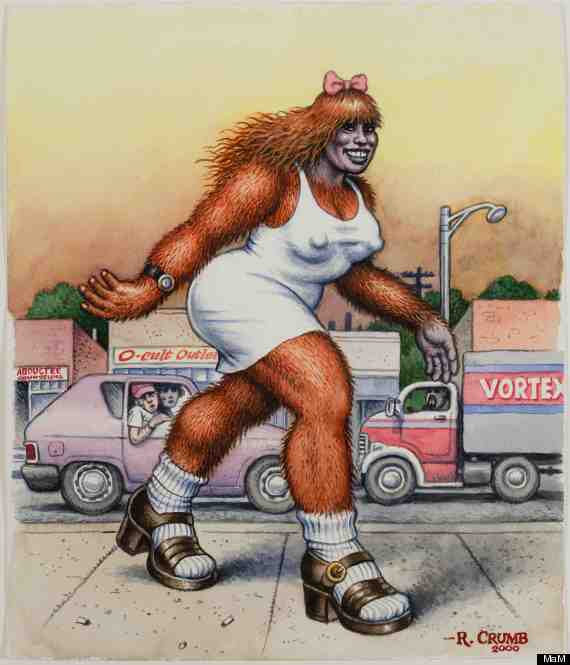
Yeti Woman, 2000
45 x 35,5 cm
Couverture Fate Magazine (Clark Publishing Company), novembre 2000
Collection Paul Morris and Samuel Grubman, New York
Photo : Courtesy Paul Morris and David Zwirner, New York
© Robert Crumb
Bigfoot Couple, 2000
Aquarelle sur papier
45 x 35.5 cm
Publié dans Fate Magazine (Galde Press), janvier 2003
Photo : Courtesy Paul Morris and David Zwirner, New York
© Robert Crumb
My True Inner Self
Page de carnet de croquis
vers 1995
20,6 x 34,6 cm
Collection Paul Morris and Samuel Grubman Photo : Courtesy Paul Morris and David Zwirner, New York
© Robert Crumb
Outside Magazine Where to Look for Bigfoot, 2002 Crayon et aquarelle sur papier
46 x 36 cm
Photo : Courtesy Paul Morris and David Zwirner, New York
© Robert Crumb
Mystic Funnies no. 3, 2002
Encre et fluide correcteur sur papier
35.5 x 28 cm
Photo : Courtesy Paul Morris and David Zwirner, New York
© Robert Crumb
Sans titre [Serena Williams], 2002
35,5 x 28 cm
Publié dans Art & Beauty Magazine (Fantagraphics Books), no 2, 2003
Photo : courtesy Paul Morris and David Zwirner, New York
© Robert Crumb
Sans titre, 1966
45,5 x 35,5 cm Collection particulière © Robert Crumb
Sans titre, ("Don't worry everything's going to be fine ..."), 1985
Encre sur papier et encre de couleur sur acétate 35,5x43cm
Collection particulière © Robert Crumb
Robert Johnson, Hell hound On My Trail, s.d. (vers 1996)
Collage, dessin original et photocopie
42,5 x 35 cm
Photo : Courtesy Paul Morris and David Zwirner, New York
© Robert Crumb
Cheap Thrills, 1968
Pochette de disque
Big Brother & The Holding Company - Cheap Thrills - Columbia, 1968
Collection particulière
© Robert Crumb
Marriage license, 2009
Aquarelle et encre sur papier
Couverture non retenue pour The New Yorker (Condé Nast)
Photo : Courtesy Paul Morris and David Zwirner, New York
©Robert Crumb
Hot Women, 2002
26 x 30 cm
Pochette d'un disque de 24 chansons compilées par Robert Crumb ; Kein & Aber Records, 2003 Photo : Courtesy Paul Morris and David Zwirner, New York
© Robert Crumb
Crazy Horse, 1996
Encre et fluide correcteur sur papier
31.4 x 53 cm
Publié dans Art & Beauty Magazine (Fantagraphics Books), no 1, 2003
Photo : Courtesy Paul Morris and David Zwirner, New York
© Robert Crumb
Tribal Musette, (Dominique Cravic et Les Primitifs du Futur), 2008
Encre et fluide correcteur sur carton
24 x 27 cm
Photo : Courtesy Paul Morris and David Zwirner, New York
© Robert Crumb, 2008.
R. Crumb Presents R. Crumb, 1973
Publié dans Zap Comix (Apex Novelties), no 7, 1974
31.7 x 20.3 cm
Collection Eric Sack, Pennsylvanie
© Robert Crumb
Autoportrait au 3e
Wife in front of the Record Collection, 2002 Publié dans Aline Kominsky-Crumb, Need More Love. A Graphic Memoir
(MQ Publications, 2007)
© Robert Crumb
Les Primitifs du Futur, 1999
Encre et fluide correcteur sur papier
28 x 31 cm
Pochette de disque (Sketch Studio)
Photo : Courtesy Paul Morris and David Zwirner, New York
© Robert Crumb
Drawn Together, 2012
Couverture pour Aline et Robert Crumb, Drawn Together
(W.W. Norton & Company), 2011
© Robert Crumb
Bécassine, 1992-1993
Publié dans Nausea (Cornélius), 2011 Collection de l'artiste
© Robert Crumb
Regardons-les en face, Gardons-les en surface ?
1994
Publié en carte postale par le Collectif Rhodanie Collection André Gélis, Sérignan
Photo : © Jean-Paul Planchon
© Robert Crumb
Couverture du catalogue de l'exposition
(bilingue anglais - français)
Textes de Jean-Luc Fromental, Sébastien Gokalp, Fabrice Hergott, Todd Hignite, Jean-Pierre Mercier et Joann Sfar.
220 dessins, 252 pages, 29€
éditions Paris Musées
© Robert Crumb
The Complete Fritz the Cat, 1977 Couverture pour The Complete Fritz the Cat (Belier Press, 1978)
Encre et aquarelle sur papier
Collection particulière
© Robert Crumb
Mr. Natural, 1970
Couverture pour Mr. Natural (Apex Novelties), no 1, août 1970
Collection particulière
© Robert Crumb
Crumb dans son atelier, 2011 © Sébastien Gokalp
Portrait de Robert Crumb, 2011 © Sébastien Gokalp
Also on HuffPost:
Posted: 07/03/2012 2:45 pm Updated: 07/03/2012 3:00 pm