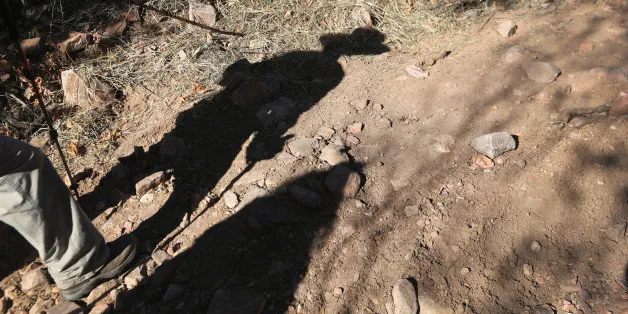
The number of people attempting to illegally cross the U.S-Mexico border has plummeted, but the number of migrants dying during the trek through the mostly desert region has not.
The U.S. Customs and Border Protection continues its efforts to secure the border and prevent deaths in the area, Border Patrol officials said. But, while the number of border crossings has declined dramatically in the last five years, the number of deaths has not decreased at the same pace. Human rights organizations attribute the problem to the increased militarization of the U.S.-Mexico border and the absence of government policy addressing the social and economic motivations that prompt migrants to continue to cross, despite the dangers.
"We never thought that we'd be in the business of helping to identify remains like in a war zone, and here we are," said Isabel Garcia, co-chair and founder of the Tucson-based Coalición de Derechos Humanos.
While the precise number of individuals crossing the U.S.-Mexico border without authorization is impossible to tally, Border Patrol’s apprehensions and death data offer the most accurate picture available. Each year the CBP reports the number of bodies found along the Southwest border and the number of migrants that agents bring into custody.
In fiscal year 2011, 327,577 migrants attempted to cross the border illegally, down from 858,638 in FY 2007 -- a nearly 62 percent drop. A closer look at the numbers reveals that although illegal border traffic has slowed and deaths have slightly declined, the proportion of border crossing fatalities to border crossing apprehensions has continued to rise.
In FY 2011, Border Patrol found 368 people dead, compared to 398 in FY 2007. The number of deaths to live interceptions rose to just over 0.11 percent in FY 2011 compared to some 0.05 percent in FY 2007. While the numbers may seem small, they indicate that illegal border crossings have become less common, but more dangerous.

In May, the Pew Hispanic Center found that migration from Mexico to the United States had reached a "standstill" that began in 2005, a first since the wave of immigration to the north began in the 1970s.
During the same period, U.S. Border Patrol increased the number of agents and technology used to monitor the border.
"U.S. Customs and Border Protection has more than doubled the size of the Border Patrol since 2004," Kerry Rogers, a spokeswoman for the Border Patrol, said in an e-mail to The Huffington Post. "Taken as a whole, the additional manpower, technology and resources provided in the last six years represent the most serious and sustained action to secure our border in our nation's history. And it is clear from every key measure that this approach is working."
Increased border monitoring and the historic number of undocumented immigrants deported from the United States has caused migrants to take riskier routes across the border, said Garcia, of the Coalición de Derechos Humanos. Some are desperate to return.
"The more we have militarized the border," Garcia said, "the more walls we put, [the] more technology, [the] more agents we put, people who find that they've got to cross -- whether because they're starving and, more and more right now, because they've got to come back and reunite with their families -- they're going further and further out into the more dangerous areas. That's why we continue to see, at least ratio wise, an increase in the deaths."
Crossing the border is inherently dangerous, Rogers said.
"Regardless of how many agents are on the ground or the technology available, the dangerous terrain and inhospitable weather remain a dangerous factor to would-be border crossers," Rogers said. "U.S. Customs and Border Protection has made multiple efforts to try to prevent as many deaths and injuries as possible, most notably the Border Safety Initiative."
The CBP began the Border Safety Initiative in 1998, a bi-national strategy to reduce deaths along the Southwest border. The agency equipped agents with first responder medical training, installed rescue beacons that migrants in crisis can use to call for help and warning signs to deter migrants from making the possibly fatal trek. In 2005, the CBP also began funding the "No Más Cruces en la Frontera" (No More Crossings at the Border/No More Crosses at the Border) campaign to educate potential immigrants about the dangers of crossing the border.
"We are emotionally understanding of the plight of these humans beings," said Jimmy Learned, president of Elevación, the ad agency in charge of the No Más Cruces campaign since its launch. "And I think that's a very important component, too. This is not about laws or anything like that. It's really more humanitarian and education[al]."
Over the years, No Más Cruces has communicated its message through "migra-corridos" -- songs that narrate the dangers migrants face while crossing the border -- mini-documentaries, ads and posters in domestic markets, eight Mexican states and Guatemala. Although CBP finances the $3 million campaign, the materials do not indicate the U.S. government pays for them, Learned said.
While the Coalición de Derechos Humanos and other immigrant advocacy groups support educational efforts to save lives, the campaign cannot solve the problem alone, Garcia said.
"It's a public relations move because we know so well that none of our policies and measures are addressing any root cause issue, addressing why people are coming, and addressing issues that would prevent people from having to come," Garcia said. "Migration is not a law enforcement, military or homeland security issue. It never has [been], especially along this border. It has been an economic, more than anything, social, and political issue."
TEN MAJOR FEDERAL IMMIGRATION LAWS:
Loading Slideshow
The Naturalization Act of 1790
The Naturalization Act of 1790 was our country's first set of laws dealing with citizenship.
Applicants had to be "<a href="http://rs6.loc.gov/cgi-bin/ampage?collId=llsl&fileName=001/llsl001.db&recNum=226 " target="_hplink">a free white person</a>" of "good moral character." This excluded indentured servants and slaves. Good moral character was substantiated by establishing residence for at least one year in the state from where he was applying, and at least two years of residence in the country. The Naturalization Act of 1795 would extend that requirement to five years, and is still standard today.
The Fourteenth Amendment, 1868
A Reconstruction Amendment that was added to the U.S. Constitution following the Civil War, the Citizenship Clause of the 14th Amendment establishes for the first time that children born on U.S. soil would be conferred U.S. citizenship regardless of their parent's citizenship status, race, or place of birth.
Last year, Rep. Steve King (R-IA) introduced the <a href="http://www.govtrack.us/congress/bills/112/hr140 " target="_hplink">Birthright Citizenship Act of 2011</a> to Congress, and challenged this. The bill would require that at least one parent be a U.S. citizen or permanent resident for a child to be granted citizenship. According to the <a href="http://www.opencongress.org/bill/112-h140/text " target="_hplink">bill's text</a>, the Birthright Citizenship Act of 2011 would amend the Immigration and Nationality Act of 1952, and "clarify those classes of individuals born in the United States who are nationals and citizens of the United States at birth."
Prior to this, Rep. Nathan Deal (R-GA) <a href="http://www.huffingtonpost.com/2009/05/26/nathan-deal-georgia-lawma_n_207485.html " target="_hplink">introduced</a> a similar <a href="http://www.opencongress.org/bill/111-h1868/show" target="_hplink">bill</a> in 2009.
The Naturalization Act of 1870
The Naturalization Act of 1870<a href="http://thepoliticsofimmigration.org/pages/chronology.htm " target="_hplink"> explicitly extended</a> naturalization laws to "aliens of African nativity and persons of African descent." This meant that for the first time, African-American children would be conferred citizenship upon birth. Asian immigrants and other people of color are excluded per the Naturalization Acts of 1790 and 1795.
The Page Act of 1875
Named after Republican Representative Horace F. Page, this is the first U.S. federal immigration law to explicitly prohibit the immigration of a particular group: persons of Asian descent. Primarily meant to limit Chinese immigrant labor and prostitution, the Page Act prohibited the immigration of: (1) contracted labor from "China, Japan, or any Oriental country" that was not "free and voluntary," (2) Chinese prostitution and (3) criminals and women who would engage in prostitution.
Ultimately, the <a href="http://www.uchastings.edu/racism-race/pageact.html " target="_hplink">Page Act</a> severely <a href="http://immigration-online.org/228-page-act-united-states-1875.html " target="_hplink">restricted</a> the immigration of Asian women. Only 136 of the the nearly 40,000 Chinese immigrants who arrived in the months before the bill's enforcement were women. And, it would pave the way for the Chinese Exclusion Act.
In this picture, Michael Lin, chair of the 1882 Project, a coalition of rights groups seeking a statement of regret over that year's Chinese Exclusion Act, speaks on May 26, 2011 in Washington, DC, at the US House of Representatives in front of a reproduction of a 19th-century sign that aimed at rousing up sentiment against Chinese Americans. Lawmakers introduced a bill that would offer an official statement of regret for the act, which banned further immigration of Chinese to the United States and ended citizenship rights for ethnic Chinese. (AFP PHOTO/SHAUN TANDON).
The Chinese Exclusion Act, 1882
Signed by President Chester A. Arthur, the <a href="http://www.pbs.org/weta/thewest/resources/archives/seven/chinxact.htm " target="_hplink">Chinese Exclusion Act</a> was the first federal immigration law to prohibit immigration on the basis of race. The bill barred all Chinese laborers, skilled and unskilled, from immigrating to the U.S. for ten years. It was made permanent by 1903, and was not lifted until the 1943 Magnuson Act.
The 1898 Supreme Court <a href="http://ocp.hul.harvard.edu/immigration/exclusion.html " target="_hplink">decision</a> in <em>United States v. Wong Kim Ark</em> finally extended naturalization laws to persons of Chinese descent by ruling that anyone born in the United States was indeed a U.S. citizen.
This editorial cartoon from 1882 shows a Chinese man being excluded from entry to the "Golden Gate of Liberty." The sign next to the iron door reads, "Notice--Communist, Nihilist, Socialist, Fenian & Hoodlum welcome. But no admittance to Chinamen." At the bottom, the caption reads, "THE ONLY ONE BARRED OUT. Enlightened American Statesman--'We must draw the line <em>somewhere</em>, you know.'" (Image Source: Frank Leslie's illustrated newspaper, vol. 54 (1882 April 1), p. 96. [Public domain], via <a href="http://commons.wikimedia.org/wiki/File:The_only_one_barred_out_cph.3b48680.jpg" target="_hplink">Wikimedia Commons</a>).
The Naturalization Act of 1906
The Naturalization Act of 1906 further <a href="http://www.understandingrace.org/history/gov/eastern_southern_immigration.html" target="_hplink">defined</a> the naturalization process: the ability to speak English was made a <a href="http://www.enotes.com/topic/Naturalization_Act_of_1906" target="_hplink">requisite</a> for immigrants to adjust their status.
The Immigration Act of 1924
U.S. President Coolidge signed this U.S. federal <a href="http://history.state.gov/milestones/1921-1936/ImmigrationAct " target="_hplink">bill</a> into law. It capped the number of immigrants who could be admitted entry to the U.S. and barred immigration of persons who were not eligible for naturalization. And, as the Naturalization Act of 1790 required, an immigrant had to be white in order to naturalize. The quotas varied by country.
Image Source: Flickr Creative Commons, <a href="http://www.flickr.com/photos/nycmarines/6306315902/" target="_hplink">NYCMarines</a>.
The Immigration and Nationality Act of 1952 (The McCarran-Walter Act)
The <a href="https://docs.google.com/viewer?a=v&q=cache:zwaVG82lZisJ:www-rohan.sdsu.edu/dept/polsciwb/brianl/docs/1952McCarranWaltersAct.pdf+&hl=en&gl=us&pid=bl&srcid=ADGEESjEwx76FIBTixZAfyncZz-1CSuSeciv5qB6vvWTrUfW58XRpXq8zkpnI57XSuuG5Bu-WSySGbEhxYvZxP7y6qDQuOsDhgDa6qUqUaJ8F4imTzKJsVtppHc_-eew2dK6vGhoIUZs&sig=AHIEtbTNQ5GFiNMVS-xyThq8VVSj_gG9KA " target="_hplink">McCarran-Walter Act</a> kept up the controversial Immigration Act of 1924, but <a href="http://history.state.gov/milestones/1945-1952/ImmigrationAct" target="_hplink">formally</a> ended Asian exclusion.
Immigration and Nationality Act of 1965
When President Lyndon Johnson signed the Immigration and Nationality Act of 1965, it <a href="http://library.uwb.edu/guides/USimmigration/1965_immigration_and_nationality_act.html" target="_hplink">abolished</a> the quota system that favored immigration from Europe and limited immigration from Asia and South America.
Illegal Immigration Reform and Immigrant Responsibility Act of 1996
The 1996 <a href="http://www.uscis.gov/ilink/docView/PUBLAW/HTML/PUBLAW/0-0-0-10948.html " target="_hplink">Illegal Immigration Reform and Immigrant Responsibility Act</a> (IIRIRA) is a piece of legislation that <a href="http://library.uwb.edu/guides/usimmigration/1996_illegal_immigration_reform_and_immigrant_responsibility_act.html " target="_hplink">defined</a> an array of issues to do with legal and illegal immigration -- from outlining how border patrol agents should administer visa processing, to the minutiae of how to handle deportation proceedings -- IIRIRA established enforcement and patrolling practices.
Posted: 08/17/2012 12:49 pm Updated: 08/17/2012 5:03 pm