iPhone app iPad app Android phone app Android tablet app More

Posted:

Mars Rover Curiosity Update: Self Portrait & New Images Released, First Destination Announced (PHOTOS)

NASA on Friday released the latest images to be sent back by the Mars Rover Curiosity, including a high-resolution self-portrait taken by the rover's Navigation camera.

According to NASA, the portrait, available below, is composed of a mosaic of 20 images taken on Aug. 8, just several days after the rover landed on Mars.

SCROLL DOWN FOR IMAGE

Curiosity's deck, some of the science lab's instruments and two of the rover's six wheels are visible in the 120-degree image. The rim of Gale Crater, in which the rover landed in the early morning of Aug. 6, can be seen in the background of the picture.

"What's really exciting about this is that we see the rover — a self-portrait, with the rim of Gale Crater in the background," John Grotzinger, the Curiosity chief scientist, said, according to Space.com.

Space.com also reports that the specs on the deck of the rover are small bits of gravel "kicked up" by the rocket-powered sky-crane that lowered Curiosity to the Marian surface.

In a news conference on Friday, NASA scientists also said that they had decided that the rover's first destination will be a site they've named Glenelg, which is about 1,300 feet from where the rover landed. Scientists chose the site because it "is a natural intersection of three kinds of terrain," according to NASA.

Before Curiosity begins its journey to Glenelg, it will "exercise" its wheels and go on several short test drives. NASA scientists expect these tests to occur in the next few days.

The Rover is also expected to use its Chemistry and Camera instrument, or ChemCam, for the first time on the evening of August 18.

The ChemCam uses a laser to analyze the composition of rocks and can assist scientists in determining if liquid water was once present in a certain area.

LOOK: Curiosity Self-Portrait
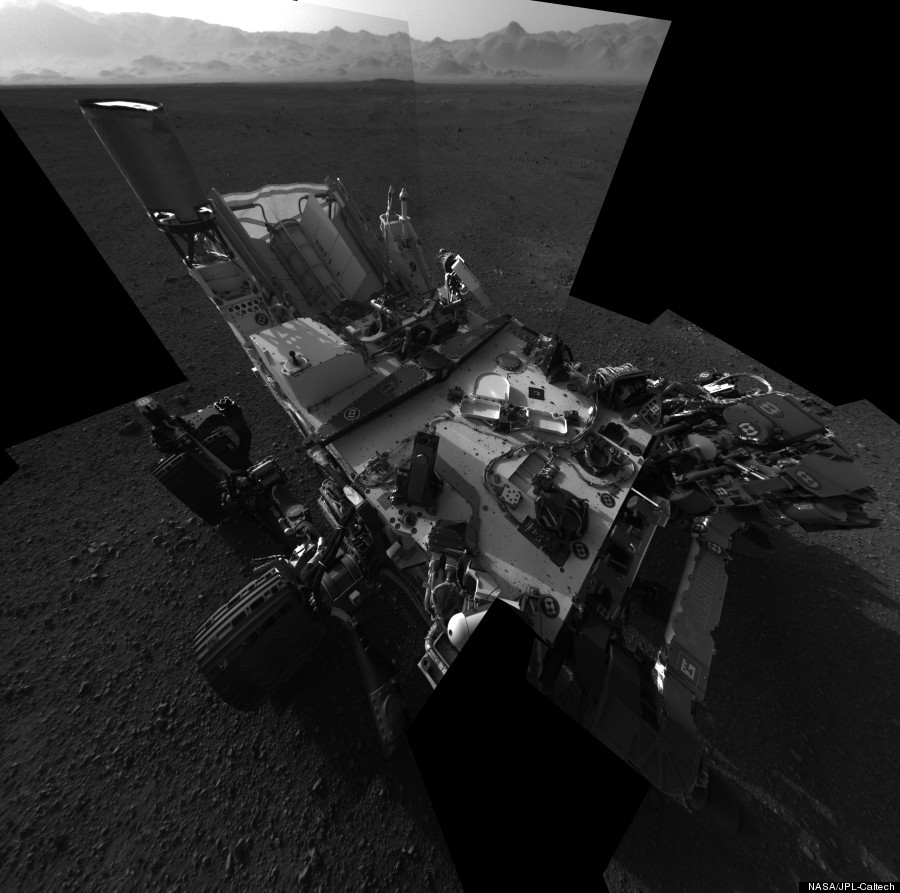
curiosity self portrait

Loading Slideshow...
  • 'Still Life with Rover'

    This full-resolution self-portrait shows the deck of NASA's Curiosity rover from the rover's Navigation camera. The back of the rover can be seen at the top left of the image, and two of the rover's right side wheels can be seen on the left. The undulating rim of Gale Crater forms the lighter color strip in the background. Bits of gravel, about 0.4 inches (1 centimeter) in size, are visible on the deck of the rover. This mosaic is made of 20 images, each of 1,024 by 1,024 pixels, taken late at night on Aug. 7 PDT (early morning Aug. 8 EDT). It uses an average of the Navcam positions to synthesize the point of view of a single camera, with a field of view of 120 degrees. Seams between the images have been minimized as much as possible. The wide field of view introduces some distortion at the edges of the mosaic. (NASA)

  • This image shows the landing site of NASA's Curiosity rover and destinations scientists want to investigate. Curiosity landed inside Gale Crater on Mars on Aug. 5 PDT (Aug. 6 EDT) at the green dot, within the Yellowknife quadrangle. The team has chosen for it to move toward the region marked by a blue dot that is nicknamed Glenelg. That area marks the intersection of three kinds of terrain. The science team thought the name Glenelg was appropriate because, if Curiosity traveled there, it would visit it twice -- both coming and going -- and the word Glenelg is a palindrome. Then, the rover will aim to drive to the blue spot marked "Base of Mt. Sharp", which is a natural break in the dunes that will allow Curiosity to begin scaling the lower reaches of Mount Sharp. At the base of Mt. Sharp are layered buttes and mesas that scientists hope will reveal the area's geological history. These annotations have been made on top of an image acquired by the High Resolution Imaging Science Experiment (HiRISE) camera on NASA's Mars Reconnaissance Orbiter.

  • his image shows a closer view of the landing site of NASA's Curiosity rover and a destination nearby known as Glenelg. Curiosity landed inside Gale Crater on Mars on Aug. 5 PDT (Aug. 6 EDT) at the blue dot. It is planning on driving to an area marked with a red dot that is nicknamed Glenelg. That area marks the intersection of three kinds of terrain. Starting clockwise from the top of this image, scientists are interested in this brighter terrain because it may represent a kind of bedrock suitable for eventual drilling by Curiosity. The next terrain shows the marks of many small craters and intrigues scientists because it might represent an older or harder surface. The third, which is the kind of terrain Curiosity landed in, is interesting because scientists can try to determine if the same kind of rock texture at Goulburn, an area where blasts from the descent stage rocket engines scoured away some of the surface, also occurs at Glenelg. The science team thought the name Glenelg was appropriate because, if Curiosity traveled there, it would visit the area twice -- both coming and going -- and the word Glenelg is a palindrome. After Glenelg, the rover will aim to drive to the base of Mount Sharp. These annotations have been made on top of an image acquired by the High Resolution Imaging Science Experiment on NASA's Mars Reconnaissance Orbiter. (NASA)

  • Scientists have now named the four marks near NASA's Curiosity rover where blasts from the descent stage rocket engines blew away some of the Martian surface material. Scientists have named the scour marks, clockwise from the most north: Burnside, Goulburn, Hepburn and Sleepy Dragon. These names were chosen by the science team from a list of rock formations in northern Canada because they all have something to do with heat, for example "burn" or "dragon." This cropped image is part of a larger panorama from Curiosity's Mast Camera (see pia16051).

  • Goulburn Scour Mark

    This cropped image from NASA's Curiosity rover shows one set of marks on the surface of Mars where blasts from the descent-stage rocket engines blew away some of the surface material. This particular scour mark is near the rear left wheel of the rover and is the left-most scour mark on the left side of this larger panorama from Curiosity's Mast Camera (see PIA16051). This scour mark is named Goulburn after a 2-billion year-old sequence of rocks in northern Canada.

  • This image (cut out from a mosaic) shows the view from the landing site of NASA's Curiosity rover toward the lower reaches of Mount Sharp, where Curiosity is likely to begin its ascent through hundreds of feet (meters) of layered deposits. The lower several hundred feet (meters) show evidence of bearing hydrated minerals, based on orbiter observations. The terrain Curiosity will explore is marked by hills, buttes, mesas and canyons on the scale of one-to-three story buildings, very much like the Four Corners region of the western United States. A scale bar indicates a distance of 1.2 miles (2 kilometers). Curiosity's 34-millimeter Mast Camera acquired this high-resolution image on Aug. 8, 2012 PDT (Aug. 9 EDT). This image shows the colors modified as if the scene were transported to Earth and illuminated by terrestrial sunlight. This processing, called "white balancing," is useful to scientists for recognizing and distinguishing rocks by color in more familiar lighting. (NASA)

  • Readying ChemCam

    This image shows the calibration target for the Chemistry and Camera (ChemCam) instrument on NASA's Curiosity rover. The calibration target is one square and a group of nine circles that look dark in the black-and-white image. The calibration target set can be seen in the middle left in this image, to the right of the rover's power source. The materials used in these circles are the types of materials scientists anticipated they might encounter on Mars. The square is a titanium alloy with a painted edge. The ChemCam instrument will be firing a series of powerful, but invisible, laser pulses at a target rock or soil. It is located on the rover's mast, near the Navigation camera that took this image. A telescopic camera known as the remote micro-imager will show the context of the spots hit with the laser. This image was taken by the right-side Navigation camera on Aug. 16, 2012. (NASA)

  • Curiosity's First Rock Star

    This mosaic image shows the first target NASA's Curiosity rover aims to zap with its Chemistry and Camera (ChemCam) instrument. ChemCam will be firing a laser at this rock, provisionally named N165, and analyzing the glowing, ionized gas, called plasma, that the laser excites. The instrument will analyze that spark with a telescope and identify the chemical elements in the target. The rock is just off to the right of the rover. This image is part of a set of images obtained by Curiosity's Mast Camera on Aug. 8 PDT (Aug. 9 EDT). See PIA16051 for the larger mosaic. (NASA)

  • Head of Mast on Mars Rover Curiosity

    This view of the head of the remote sensing mast on the Mars Science Laboratory mission's rover, Curiosity, shows seven of the 17 cameras on the rover. Two pairs of Navigation cameras (Navcams), among the rover's 12 engineering cameras, are the small circular apertures on either side of the head. On the top are the optics of the Chemistry and Camera (ChemCam) investigation, which includes a laser and a telescopic camera. The Mast Camera (MastCam) instrument includes a 100-millimeter-focal-length camera called MastCam-100 or M-100, and a 34-millimeter-focal-length camera called the MastCam-34 or M-34. The two cameras of the MastCam are both scientific and natural color imaging systems. The M-100 looks through a 1.2-inch (3-centimeter) baffle aperture, and the M-34 looks through a 2.1-inch (5.3-centimete) baffle aperture. (NASA)

  • Curiosity's First Rock Star, Up-Close

    This close-up image shows the first target NASA's Curiosity rover aims to zap with its Chemistry and Camera (ChemCam) instrument. ChemCam will be firing a laser at this rock, provisionally named N165, and analyzing the glowing, ionized gas, called plasma, that the laser excites. The instrument will analyze that spark with a telescope and identify the chemical elements in the target. The rock is just off to the right of the rover. This image is part of a set of images obtained by Curiosity's Mast Camera on Aug. 8 PDT (Aug. 9 EDT). See pia16051 for the larger mosaic.

FOLLOW SCIENCE

NASA on Friday released the latest images to be sent back by the Mars Rover Curiosity, including a high-resolution self-portrait taken by the rover's Navigation camera. According to NASA, the portr...
Filed by Timothy Stenovec  | 
 
 
  • Comments
  • 977
  • Pending Comments
  • 0
  • View FAQ
Post Comment Preview Comment
To reply to a Comment: Click "Reply" at the bottom of the comment; after being approved your comment will appear directly underneath the comment you replied to.
View All
Favorites
Recency  | 
Popularity
Page: 1 2 3 4 5  Next ›  Last »  (14 total)
photo
HUFFPOST SUPER USER
Blackspeare
07:41 PM on 09/10/2012
Take a picture of itself??!!----what is this?----a 6 billion dollar Instagram robot?!
photo
Depleroma
All is one
05:20 PM on 08/28/2012
The hills in the background are surprisingly rounded. Nothing jagged at all.
Must be all the dust storms.
12:06 PM on 09/07/2012
Spectacular new images of Curiosity on Mars

http://huntall.com/spectacular-new-images-of-curiosity-on-mars
photo
Depleroma
All is one
02:31 PM on 09/07/2012
cool.  thanks.
photo
HUFFPOST SUPER USER
dkelban
02:56 PM on 08/20/2012
If you want to see the REAL pictures from mars, use google images and type something like "martians hold up signs": it's hilarious. Those martians are pretty smart: they know what they're in for if we "superior beings" start coming there (lol).
photo
HUFFPOST SUPER USER
JohnnyRivers
Join The Sean Hammity STOP SUCCESS EXPRESS!
01:11 AM on 08/20/2012
Why is this in Canadian news?
HUFFPOST SUPER USER
Karen Pottruff
read and surf internet
09:30 AM on 08/20/2012
It's important for the world, an amazing achievement. The U.S. had the resources for a space program, and they went ahead and did it.
photo
HUFFPOST SUPER USER
JohnnyRivers
Join The Sean Hammity STOP SUCCESS EXPRESS!
02:55 PM on 08/21/2012
An amazing AMERICAN achievement. Canadians resent and truly hate Americans. Why pretend? You are still celebrating the 1812 War as Canada's greatest achievement with government sponsored TV propaganda. Think before you voice the slur "Ugly American". The USA is your life's blood.
This user has chosen to opt out of the Badges program
photo
06:17 PM on 08/22/2012
Because apparrently the goings on on a lifeless planet of rocks and dust is more interesting than actual Canadian news.
HUFFPOST SUPER USER
ray13666
Independent Here, Following BBC news
11:00 PM on 08/19/2012
Great Pics! At least I can see some payback here. We need to explore the inner and outer planets as well as the rest of our home galaxy the milky way. We can learn a lot from NASA and the military from what they learn and discover along the way.
09:53 PM on 08/19/2012
I LOVE this 'photo'----

now, if NASA was 'smart' they would make this into a smaller poster---offer it up for sale world wide @ $10 each --modest so all folks could afford at least one---I'll bet they would rake in multi-millions of dollars that would be designated ONLY for NASA programs--how awesome would that be:)!!!!
HUFFPOST SUPER USER
ray13666
Independent Here, Following BBC news
10:54 PM on 08/19/2012
islandgirl, you are onto something!
good thinking
Faved
03:25 AM on 08/20/2012
NASA is a taxpayer supported program and therefore almost all images are in the public domain.
photo
HUFFPOST SUPER USER
JaPaKDaily
Fish killer.
09:29 AM on 08/20/2012
true Bob....but, it shouldnt be funded by tax payers as it is not in the constitution to do so. if it was fully privately funded, it would be MUCH more efficiently run and therefore more successful and even more ground breaking! and if it was so then they could sell pics and all kinds of other stuff to raise money which would be only one small way of funding NASA. for example, there are an infinite number of ways NASA could pay for itself using the technologies it develops of livingery (a term coined by Buckminster Fuller)...to create better systems for living in both, inner and outer space.

AND....our taxes could be lowered significantly! ;)

Go Liberty!
05:43 PM on 08/20/2012
from islandgirl50
I was replying to your kind reply and info when I had to answer my door and when I came back 'we were both gone!!' :) I was saying that perhaps a lot of folks don't have the ability to access this domain and also many folks in other countries are not 'on-line'-but in any case your thoughtful reply was appreciated--thanks and cheers!!
09:25 PM on 08/19/2012
There seems to be several concerns voiced here:

1. That Moon / Mars money could be used for the POOR.
2. its a marvelous thing exploring the universe.

Comments
1. The poor are screwed. Only a vast social, cultural and attitude upheaval will help them.
And of course we should not ignore doing that....

2. It IS a marvelous thing exploring the universe.
This user has chosen to opt out of the Badges program
09:24 PM on 08/19/2012
Man, I wish I could go there and plunder Mars for its natural resources. Gold, Silver, Oil. can you imagine the billions of dollars just waiting there? I would probably need a huge company like Haliburton to help.

Since no one is there, you can make your own rules, none of that epa regulation. You don't have to worry about messing up its climate it is mostly CO2 already.

And you know this barren sand heap would be the perfect place for the earth to get rid of all our waste product, (toxic sludge, spent nuclear fuel rods, Obama yard signs, etc.)
10:22 PM on 08/19/2012
great answer, Halibutron rules!!, DICK Cheney RULES!!! The BUSH'S RULE!!!! That whole twin towers thing really worked out for everybody!!!
photo
HUFFPOST SUPER USER
Gas-Bag
There's nothing endearing about perfection.
10:43 PM on 08/19/2012
In order to make a profit on gold for instance, you would have to bring back a very large volume in order to cover your costs and to make money. But by bringing back so much you would flood the market and the value would plummet. I could cover the rest of your ideas but if you don't understand my point it would be a waste of time. Maybe you'd be better suited at doing something other than being a businessperson, maybe there's an opening for a 'nickle a post' job for a lobbying firm that you could get.
This user has chosen to opt out of the Badges program
06:21 AM on 08/20/2012
Bring it back? Why would the Emperor of Mars return to Earth?
photo
NYnotLiberal
Don't crush that Dwarf, hand me the pliers.
08:30 PM on 08/19/2012
Excuse me while I geekoejaculate here. I just think that this whole mission is the coolest thing......and those folks at JPL.... are the BEST! (No, I have no relation to this project). I do have a smathering of an engineering background, and when I think about all the thought and problem solving that went into this...it blows me away. Keep politics out of this.....this is a tremendous accomplishment of the Human species.....yes, we do stupid things....but we also do tremendously inspiring things...to move us all forward, and this is one of them....in our lifetime.
photo
mwelchRMI
sssSSssss....
11:47 AM on 08/20/2012
it's cool, i can't judge because i pop a science boehner every day over this project
This user has chosen to opt out of the Badges program
08:19 PM on 08/19/2012
Wonderful! I can't wait for that probe to reach Pluto too. Can you believe it? We only discovered Pluto had a moons not too long ago. Hell, its a amazing we even found Pluto when you consider it would only cover 40ish states if it was sat down on the U.S.

We may never even get close to leaving our solar system as a species, but this is one of the few achievements done by our kind that I can be proud of.
10:04 PM on 08/19/2012
The Singularity is coming
HUFFPOST SUPER USER
joemensa3
07:52 PM on 08/19/2012
Was Rover one of the auto companies Obama bailed out?
08:26 PM on 08/19/2012
President Bush signed into law an emergency aid package for the U.S. airline
industry ... "the terrorists who attacked our country on September 11th will not
shut down our vital. ... Congress approves $15 billion airline bailout ...
CNN

HOW SOON WE FORGET BUSH GOT US WHERE WE ARE NOW
photo
HUFFPOST SUPER USER
JaPaKDaily
Fish killer.
09:34 AM on 08/20/2012
it wasnt only bush. it has been a snowball effect of most presidents during the last 100 years. please stop playing blame games. it is no longer about left or right or democrats or republicans. it is about liberty, as it has been since the europeans, who first founded this country, departed from the exact kind of government which we now have again today in this supposed new world. oh, tristan s., how we how we truly forget. ;)
This user has chosen to opt out of the Badges program
StillAmused
Some mayo on that troll, please...
07:41 PM on 08/19/2012
These images (and the very success of the project) are stupefying. All the carping about cost and the many problems here on Earth overlook the magnificent lesson of 'Curiosity': The same species that awkwardly grapples, often unsuccessfully, with the failures and shortcomings of mankind is also capable of awe-inspiring accomplishments.

Without the hope inspired by that lesson, what's the point of our stumbling existence?
08:29 PM on 08/19/2012
Dont you want them to find something that floors you though ?
This user has chosen to opt out of the Badges program
StillAmused
Some mayo on that troll, please...
09:43 AM on 08/20/2012
Where, exactly, did you see THAT in my comment?
07:03 PM on 08/19/2012
The problems here on earth are the very reason it is necessary to scope out the other planets. As we have just experienced, a $ 16 trillion shot in the arm produces absolutely nothing and ruins everything - so why quibble over a couple of billion dollars on a Mars roving mission? What the earth needs is a way to turn 7 billion people into just slightly less than a billion people - now, that is great math - less pollution, etc., etc. - maybe North Korea or Iran can help us with our problem...
photo
HUFFPOST SUPER USER
All Seeing Guy
Center of the storm
07:24 PM on 08/19/2012
We could have bought tanks for that money!
photo
HUFFPOST SUPER USER
CSOTUS
Somedays you're the pigeon, some days the statue
11:21 PM on 08/19/2012
Yeah, because we don't have enough tanks..
This user has chosen to opt out of the Badges program
09:10 PM on 08/19/2012
Okay I have a solution that does both. On our next mars mission we could mount some yet to be invented massive rockets on either Phobos or Deimos (mars moons) and rocket one back to collide with earth, then we get both the exploration and world wide holocaust that you suggested. (and honestly we could probably get it done for less that 16 trillion)
06:45 PM on 08/19/2012
wow great pics !! i love astronomy but i have come love GODS best creation and thats the Earth.
photo
HUFFPOST SUPER USER
rpokeytruck
06:54 PM on 08/19/2012
Well be glad that someone thinks enough of Gods creation to find another home. God gave brains to figure why and how to do that. Only a fool keeps all his eggs in one basket.
photo
HUFFPOST SUPER USER
All Seeing Guy
Center of the storm
07:26 PM on 08/19/2012
Which "gods"? Personally I think Hittite was the one 'true' religion.
07:47 PM on 08/19/2012
The God Mars, obviously! :) Btw, most Pagan peoples never insist their religion is the 'one true one'. That characteristic is most found in monotheistic faiths.
06:10 PM on 08/19/2012
I can't help but think it looks a lot like the sandbox in Afghanastan
photo
HUFFPOST SUPER USER
kazenoya1
08:13 PM on 08/19/2012
well said