From LiveScience Staff:

In March 2011, a devastating earthquake and tsunami set off a partial meltdown at the Fukushima nuclear plant on Japan's coast. A recent study led by European researchers found Fukushima is not alone, as 22 other plants around the world may be similarly susceptible to destructive tsunami waves, with most of them in east and southeast regions of Asia.

The 23 facilities on the list (including Fukushima) house a total of 74 nuclear reactors. Thirteen of the plants are active, while the others are either nearing completion or being expanded to house more reactors. The researchers say East and Southeast Asia are at the greatest risk of a nuclear crisis triggered by a tsunami because of the rise of atomic power stations in the region, especially in China, which houses 27 of the world's 64 nuclear reactors currently under construction.

"The most important fact is that 19 (two of which are in Taiwan) out of the 27 reactors are being built in areas identified as dangerous," state the authors of the study.

Meanwhile, in Japan, seven plants — one of which is currently under construction — are located in zones at risk of a tsunami, and South Korea is now expanding two plants in risk zones, the researchers said.

The study, which appears in a recent issue of the journal Natural Hazards, urges energy officials in these countries to consider how they would deal with the potentially far-reaching consequences of a catastrophe.

"The location of nuclear installations does not only have implications for their host countries but also for the areas which could be affected by radioactive leaks," study researcher Joaquín Rodríguez-Vidal, of the University of Huelva, told SINC, a Spanish news agency.
nuclear plants tsunami

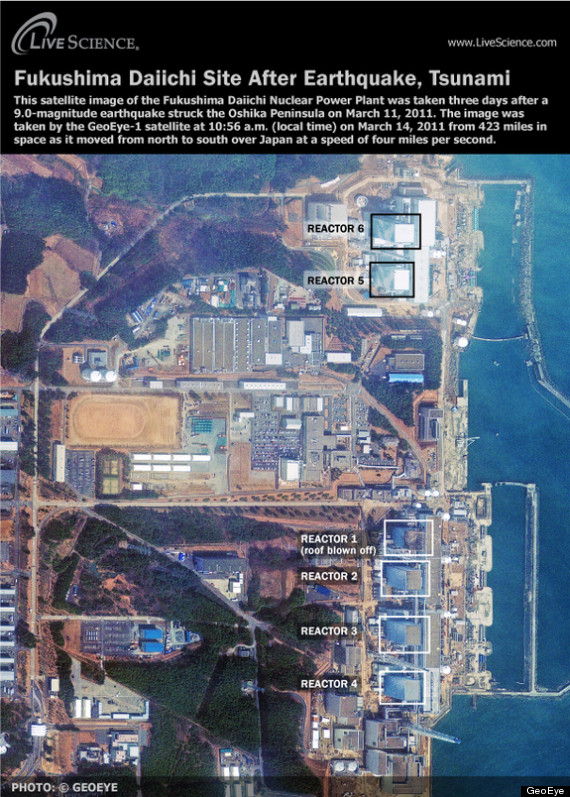
This GeoEye satellite image shows the nuclear reactors (labeled) at the Fukushima Daiichi plant after the earthquake and tsunami hit northeastern Japan.

Follow LiveScience on Twitter @livescience. We're also on Facebook & Google+.

Copyright 2012 LiveScience, a TechMediaNetwork company. All rights reserved. This material may not be published, broadcast, rewritten or redistributed.

Also on HuffPost:

Loading Slideshow...
  • In this combination photo, Tayo Kitamura, 40, kneels in the street to caress and talk to the wrapped body of her mother Kuniko Kitamura, 69, after Japanese firemen discovered the dead body in the ruins of her home in Onagawa, Japan, on March 19, 2011, top, and a newly built home sits at the site of the now-cleared but destroyed area on Wednesday, Feb. 22, 2012. (AP Photo/David Guttenfelder)

  • A few homes have been rebuilt in the year since an earthquake and tsunami roared across Japan's coastline, killing 19,000 people. But most communities remain unrecognizable, and their residents' futures uncertain. (AP Photo/David Guttenfelder)

  • The tsunami that slammed into Japan's coastline one year ago was merciless, sparing little in its path. Homes were reduced to rubble, cars tossed about like toys, and boats -- such as this one photographed in Kesennuma, Japan, on March 28, 2011 -- flung from the sea into streets and onto roofs. The ocean's fury, and the earthquake that preceded it, left around 19,000 people dead, hundreds of thousands homeless, and sparked the worst nuclear crisis the world had seen in a quarter century. (AP Photo/David Guttenfelder)

  • In this combination photo, Japanese vehicles pass through the ruins of the leveled city of Minamisanriku, Japan, on March 15, 2011, top, four days after the tsunami, and vehicles pass through the same area on Thursday, Feb. 23, 2012. (AP Photo/David Guttenfelder)

  • The earthquake and tsunami, which killed around 19,000 people, delivered one of their worst hits to the once-scenic, blue-collar fishing town of Minamisanriku, Japan, photographed here on March 15, 2011. The wall of water spared little in its path, sweeping away nearly every business and every job, and leaving more than half the town's residents dead or homeless. (AP Photo/David Guttenfelder)

  • A year after the earthquake and tsunami people across Japan and leveled this town, there are hints of progress _ the main roads are free of debris, and some temporary houses have been built. But many in Minamisanriku, and elsewhere across Japan's battered coastline, remain in a hellish state of limbo. (AP Photo/David Guttenfelder)

  • In this combination photo, a ship washed away by the tsunami sits in a destroyed residential neighborhood in Kesennuma, northeastern Japan, on March 28, 2011, top, and the same ship sits on the same spot on Thursday, Feb. 23, 2012. (AP Photo/David Guttenfelder)

  • A year after an earthquake and tsunami ravaged the country's coastline and killed around 19,000 people, many of the boats carried inland by the wall of water have been removed. But some, like this one, remain _ providing a stark reminder of nature's fearsome power. (AP Photo/David Guttenfelder File)

  • One year later, more than 3,200 people presumed killed in the earthquake and tsunami have yet to be found. They are among the 19,000 people who lost their lives on March 11, 2011. (AP Photo/David Guttenfelder)

  • In this combination photo, Japanese residents of Kesennuma, northeastern Japan, pass through a road that was cleared by bulldozer through the ruins of the city on March 17, 2011, six days after the tsunami, top, and people cross the same street on Thursday, Feb. 23, 2012. (AP Photo/David Guttenfelder)

  • In the days after the earthquake and tsunami ravaged Japan's coastal towns, the bulldozers began to arrive, clearing away the rubble that littered the roads, such as this street in Kesennuma, Japan, photographed on March 17, 2011. Those tasked with clearing away the wreckage faced a monstrous task: towering piles of twisted metal and wood, boats perched atop roofs, mountains of family heirlooms, sodden furniture and children's toys. They also faced the grim reality that many of the 19,000 people killed lay entombed in the rubble, waiting to be discovered. (AP Photo/David Guttenfelder)

  • One year after a powerful tsunami battered Japan and killed around 19,000 people, the streets have been cleared and the wreckage removed from town centers. But the process of destroying all that debris has been slow, with much of it still sitting in huge mountains in temporary holding areas. (AP Photo/David Guttenfelder)

  • Also On The Huffington Post...

    A 132-ton concrete dock from Japan has washed ashore at Oregon's Agate Beach State Park. Ripped loose from Japan during last year's tsunami, it's now drawing thousands of gawkers to the shoreline.