From Climate Central's Andrew Freedman:
As officials begin the arduous task of pumping corrosive seawater out of New York City’s subway system and try to restore power to lower Manhattan, and residents of the New Jersey Shore begin to take stock of the destruction, experts and political leaders are asking what Hurricane Sandy had to do with climate change. After all, the storm struck a region that has been hit hard by several rare extreme weather events in recent years, from Hurricane Irene to “Snowtober.”
Scientists cannot yet answer the specific question of whether climate change made Hurricane Sandy more likely to occur, since such studies, known as detection and attribution research, take many months to complete. What is already clear, however, is that climate change very likely made Sandy’s impacts worse than they otherwise would have been.
There are three different ways climate change might have influenced Sandy: through the effects of sea level rise; through abnormally warm sea surface temperatures; and possibly through an unusual weather pattern that some scientists think bore the fingerprint of rapidly disappearing Arctic sea ice.
If this were a criminal case, detectives would be treating global warming as a likely accomplice in the crime.
Warmer, Higher Seas
Water temperatures off the East Coast were unusually warm this summer — so much so that New England fisheries officials observed significant shifts northward in cold water fish such as cod. Sea surface temperatures off the Carolinas and Mid-Atlantic remained warm into the fall, offering an ideal energy source for Hurricane Sandy as it moved northward from the Caribbean. Typically, hurricanes cannot survive so far north during late October, since they require waters in the mid to upper 80s Fahrenheit to thrive.
Scientists said about 1°F out of the 5°F East Coast water temperature anomaly may have been due to manmade global warming. Warmer seas provide more water vapor for storms to tap into; this water vapor can later be wrung out as heavy rainfall, resulting in flooding.
The most damaging aspect of the storm was the massive storm surge that struck the coastline from Massachusetts to Maryland. Global warming-related sea level rise gave the surge a higher launching pad than it would have had a century ago, making it more damaging than it otherwise would have been. This is only going to get worse as sea level rise continues as a result of warming ocean waters and melting polar ice caps and glaciers.
The storm surge at The Battery in Lower Manhattan was the highest ever recorded at that location. It surpassed even the most pessimistic forecasts, with the maximum water level reaching 13.88 feet above the average of the daily lowest low tide of the month, known as Mean Lower Low Water, including a storm surge component of 9.23 feet. That broke the official record of 10.5 feet above Mean Lower Low Water set in 1960 during Hurricane Donna, as well as a record set during a hurricane in 1821.
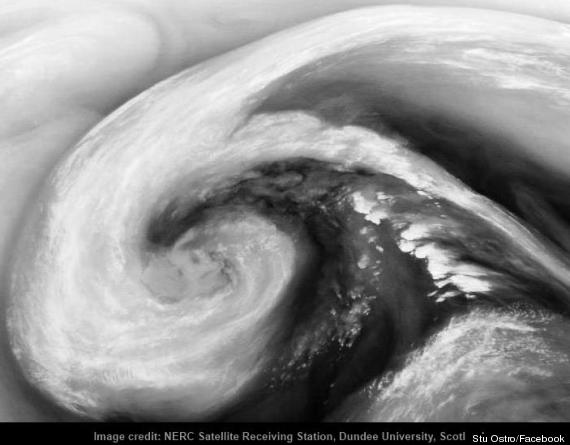
![]()
A water vapor satellite image of Superstorm Sandy on Tuesday, Oct. 30. Credit: Stu Ostro/Facebook.
Or, to put it in simpler terms, the water level reached 9.15 feet above the average high tide line.
Katharine Hayhoe, a climate researcher at Texas Tech University in Lubbock, said manmade climate change likely contributed to the storm surge at The Battery in Lower Manhattan, with 1 foot 3 inches of long-term sea level rise recorded at that location, the result of manmade sea level rise, sinking land, and ocean currents. She said the manmade contribution to the storm surge may have been a small amount.
But to the Metropolitan Transit Authority or Con Ed, the main electric utility in Manhattan, each inch of sea level rise matters a great deal.
If a similar storm were to strike New York in 2050, it would cause even more damage, since sea levels are expected to be considerably higher by midcentury. In fact, a recent study found that sea level rise has taken place at an accelerated rate at locations north of Norfolk, Va., and if this pace continues the Northeast could see much higher sea levels than other parts of the East Coast by midcentury.
A 2012 report by the U.N. Intergovernmental Panel on Climate Change (IPCC) found that sea level rise has likely increased extreme coastal high water events around the world.
By warming the seas and the atmosphere, global warming is also expected to alter hurricane frequency and strength, making North Atlantic hurricanes slightly more powerful, while reducing the overall number of storms during coming decades. Detecting such changes in the observational record is difficult, considering the varying ways people have kept tabs on hurricanes prior to the era of hurricane hunter aircraft flights and satellite imagery? A recent study published in the Proceedings of the National Academy of Sciences found that warmer sea surface temperatures are tied to an increase in stronger Atlantic hurricanes.
“Blocked” Weather Pattern
In addition, an unusual weather pattern in the northern hemisphere steered the storm in an unprecedented direction, as it made a dramatic — and for many East Coast residents, catastrophic — left hook right into coastal New Jersey. The east to west movement, which is exactly the opposite of how weather systems normally move in this area, helped maximize the storm surge, since a strong easterly air flow struck the coast at a right angle.

Satellite loop from the University of Wisconsin, showing Hurricane Sandy as it made landfall in New Jersey.
Original source: http://cimss.ssec.wisc.edu/goes/blog/archives/11686
The upper air flow over the Atlantic Ocean was jammed by a powerful area of high pressure near Greenland and a storm system in the Central Atlantic, leaving the storm no escape route away from the U.S. Such patterns are known as “blocking” events, and they have occurred with increasing regularity and intensity in recent years. Blocking patterns have been linked to several noteworthy extreme weather events, such as the deadly 2010 Russian heat wave and Pakistan floods, the 2003 European heat wave, and the March heat wave of 2012 in the U.S.
In this case, the blocking pattern occurred at precisely the wrong time -- when a hurricane was moving out of the Caribbean.
Weather Channel hurricane expert Bryan Norcross wrote about this on Oct. 26. “The freak part is that a hurricane happens to be in the right place in the world to get sucked into this doubled-back channel of air and pulled inland from the coast,” he said. “And the double-freak part is that the upper-level wind, instead of weakening the storm and simply absorbing the moisture — which would be annoying enough — is merging with the tropical system to create a monstrous hybrid vortex. A combination of a hurricane and a nor’easter.”
Some, though not all, scientists think the more frequent blocking events be related to the loss of Arctic sea ice, which is one of the most visible consequences of manmade global warming. The 2012 sea ice melt season, which ended just one month ago, was extreme, with sea ice extent, volume, and other measures all hitting record lows. The loss of sea ice opens large expanses of open water, which then absorbs more of the incoming solar energy and adds heat and moisture to the atmosphere, thereby helping to alter weather patterns. Exactly how sub-Arctic weather patterns are changing as a result, however, is a subject of active research.
Some researchers who warn that climate change is already being felt in extreme weather events, such as Kevin Trenberth of the National Center for Atmospheric Research in Boulder, Colo., are not yet convinced of the Arctic connection. Others, such as Hayhoe, think it is a “plausible theory” that is worth investigating, although she noted there is evidence that Arctic warming may cause more blocking during the winter rather than during the fall.
James Overland, a scientist with the National Oceanic and Atmospheric Administration who recently published a study on how Arctic sea ice loss is altering the weather in the Far North, said it’s not clear whether Hurricane Sandy was just a freak event or a sign of things to come. “What was highly unusual to me was the slowing down of the jet stream that normally turns hurricanes out to sea, allowing Sandy to directly [make] landfall,” he said in an email conversation. Yet, he said it’s important to recognize that there is still a huge role played by randomness, or chaos, in global weather patterns. “Having looked at a lot of weather maps, I don’t think it’s entirely legitimate to make a big possibility for an Arctic connection with Sandy rather than the chaos default,” he said.
And while climate change has undoubtedly altered the background conditions in which all weather systems are born, scientists said that natural variability still plays a very large role, and may have been the dominant factor with Hurricane Sandy.
Martin Hoerling, a researcher at the Earth Systems Research Laboratory, also in Boulder, is a proponent of this view. “Great events, like this meteorological one, can happen with little cause(s). Individually, neither the tropical storm nor the extratropical storm that embraced it, were unusual,” he said via email. “What makes this a rare, perhaps once in a lifetime event, is the fortuity of their timely (“untimely” as far as most are concerned who sit in harms way) intersection.” Randall M. Dole, who is a colleague of Hoerling's at ESRL, noted that the blocking pattern that helped steer Sandy was "highly transient," which suggests to him that it was just "random bad luck" that it coincided with a hurricane along the East Coast.
Regardless of the chain of events that led to this disaster, Hurricane Sandy is almost certain to wind up being one of the top 10 costliest hurricanes on record, and it comes soon after Munich Re, a global insurance giant, warned of increasing natural disaster losses in the U.S., a trend the company said is related to global climate change.
And regardless of unequivocal linkages between this particular storm and manmade climate change, questions related to future human-caused changes — how they will make this type of event more likely and destructive, through a combination of sea level rise, extreme weather trends, and vulnerability of coastal populations and infrastructure, deserve to be asked and may be much easier to answer.
Also on HuffPost:
HuffPost's Katie Bindley reports:
Like all the competitors who trained for the 2012 NYC Marathon, Hannah Vahaba will not be running the race this year. But she also will never forget her moment at the finish line. After traveling in from Atlanta, Vahaba picked up a marriage proposal in Central Park on Saturday without having to traverse the 26.2-mile course.
"This is my fiance," said Vahaba, 31, who had tears running down her face as she stood in Central Park where the race would have ended, just moments after Martin O'Donoghue had proposed.
Photo by Damon Scheleur
Be sure to check donation lists to see what items are needed. For example, at one Staten Island donation center, there is a critical need for batteries batteries batteries, candles, matches, toilet paper, cleaning supplies, pet food, baby supplies, deodorant, shampoo and conditioner. Clothing isn't needed as much at that center.
-Catharine Smith, HuffPost
HuffPost's Tim Stenovec reports:
In the aftermath of Hurricane Sandy, which killed at least 48 people in New York when it battered the Northeast last week, frustrated residents in this corner of South Brooklyn are coping without electricity, heat and running water.
At a massive food distribution event at Republic Airport in Farmingdale, Cuomo said power has been restored to 60 percent of the New York metropolitan area.LIPA reported Saturday evening that 460,000 customers remained without power, down from more than 900,000 initially.
"I've warned the utility companies repeatedly they operate under a state charter, essentially," Cuomo said. "The utility companies are not happy with my warning and frankly, I don't care."
"The customers are not happy. The bill payers are not happy and the people without power are not happy," Cuomo said. "People are suffering. It is an issue of safety and if the utilities were not prepared we will hold them accountable."
Read the full story on Huntington Patch.
Even as power returns to parts of the region assailed by Hurricane Sandy, millions of drivers seeking gasoline appear likely to face at least several more days of persistent shortages.
HuffPost's Bianca Bosker:
On Saturday, 27-year-old Kate Frasca was manning Con Edison’s Twitter account, @ConEdison, responding to customers’ frustrations, questions, praise and criticism at an average clip of one tweet every six minutes.
|
| @ USACE_HQ : Roughly 600 M gallons of storm water infiltrated the nation’s busiest and oldest underground mass transit system... http://t.co/5jMXDhRc |
|
| @ MikeBloomberg : If you would like to donate: visit http://t.co/9w8egqxD So far $12 million has been contributed. 100% of funds go to #Recovery efforts. |
|
| @ usNWSgov : Post #Sandy reminders: never touch a downed power line or anything touching one. Washing your hands prevents illness. #NWS #CDC |
|
| @ NYCMayorsOffice : Volunteers Descend on Staten Island Neighborhood http://t.co/9aP3ggJN |
|
| @ usNWSgov : Temps near the freezing mark expected tonight in areas affected by #Sandy. Those without power should prepare for a cold night. #NWS #nywx |
HuffPost's Ben Hallman reports:
For hours, giant waves crashed against Rockaway Beach, making a tremendous roar that could be heard up and down the 11-mile peninsula. "We kept constant watch on the boardwalk," said Diane Hudson, who lives on a high floor in a building about a half block from the Atlantic Ocean. "There was no water on it, so we thought we were OK."
Then she got a call from her boss, and close friend, David Gotthelf, who had just moved into a ground-floor apartment about a mile and a half away, on Beach 115th Street.
"The water is coming in," Hudson said Gotthelf told her. "What do I do? What do I do?"
Hudson looked out the window. In a matter of just a few minutes, the dark ocean had filled the parking lot. The boardwalk was gone. "Just get up on a high place," she said she told her friend. "Get on your bed."
That was the last time anyone talked to Gotthelf, who died Monday night or Tuesday morning, as far as Hudson knows.
From The New York Times:
The L line from Manhattan to Brooklyn, however, remained flooded Saturday, from what Joseph J. Lhota, the chairman of the Metropolitan Transportation Authority, described as “wall to wall” inundation. The G train tunnel was flooded as well and is not expected to be back in service until later this week.'
New Jersey voters displaced by Hurricane Sandy will be able to vote either electronically or by fax under an order issued by state officials on Saturday. Lt. Gov. Kim Guadagno (R), who is also New Jersey's secretary of state, said that voters can request a ballot be sent to them by their local county clerk via email or fax and then return it to the county the same way.
“This has been an extraordinary storm that has created unthinkable destruction across our state and we know many people have questions about how and where to cast their vote in Tuesday’s election," Guadagno said in a statement. "To help alleviate pressure on polling places, we encourage voters to either use electronic voting or the extended hours at county offices to cast their vote."
Guadagno also said that first responders in the state who are stationed away from their home can use the same method to vote.
Guadagno's decision follows previous orders to extend early voting hours at county elections offices statewide over the weekend. Gov. Chris Christie (R) indicated that the state was printing additional provisional ballots to allow those displaced by Hurricane Sandy to vote in another location due to the storm.
-- John Celock, HuffPost
Francis Ng was ready to run a marathon in New York City on Sunday but now the Toronto marathoner is instead looking to pitch in as the region recovers from this week's massive storm.
He's just one of the many Canadian runners who found out too late that the New York City Marathon was canceled, a race that draws more than 47,000 entrants.
Other athletes from Canada and many from around the world were already on the way to the Big Apple when the mayor's office cancelled one of the world's largest marathons. The 2011 edition of the marathon drew 1,200 Canadians and more than half of the race's participants are from outside of the United States.
Ng found out at at the airport departure lounge in Toronto that the race was canceled, so instead of running through the five boroughs on Sunday morning, he's now looking to make a trip up to the Bronx to volunteer at Pelham Bay Nature Center.
HuffPost’s Betsy Isaacson Reports:
Even with bicycle generators to charge phones, people in downtown Manhattan did not have working internet through Friday, Nov. 2, when power finally started to return to the grids there. The massive New York City power outage caused by Hurricane Sandy left thousands of New Yorkers without connection to the outside world, unable to check on relatives or secure information unless they walked or took a cab uptown, where the city had power.
With power now back on in Lower Manhattan, age-old ways of trading information will likely give way to texting and wireless connections. A copy of The New York Times will no longer be worth more than $2. Will New Yorkers miss it?
HuffPost's Gerry Smith reports:
Heavy flooding this week at Verizon’s headquarters in lower Manhattan -- a critical node of its network infrastructure -- has begun to subside, but the company's effort to repair damaged network equipment and restore service to customers after Hurricane Sandy continues.
HuffPost's Lynne Peeples reports:
Among the wreckage removed in Joplin, Mo., after the 2011 tornado was 2,600 tons of asbestos debris."That was a small community," said Linda Reinstein, president of the nonprofit Asbestos Disease Awareness Organization. "Do the math, and we can recognize that we have a significant public health risk with Hurricane Sandy."
With wind and water damage caused by Sandy compromising the integrity of homes, schools and other buildings along much of the East Coast, health experts warn of increased risks of exposure to a variety of environmental toxins. One of the most worrisome, they say, is asbestos. Much of the compromised construction materials, including roofing, piping and insulation, could contain the microscopic mineral fibers. And while a person generally can't see it, smell it or taste it, they can breathe it and ingest it -- and the consequences can be severe.
Read the full story here.
|
| @ AP : BREAKING: New York City mayor says gas station shortages could take a few days to fully be resolved -RJJ |
New York Magazine has released a sneak peek of its latest cover, and wow is it stunning.
The editors explain the photo choice here:
A photograph taken by Iwan Baan on Wednesday night, showing the Island of Manhattan, half aglow and half in dark, was the clear choice, for the way it fit with the bigger story we have tried to tell here about a powerful city rendered powerless. We crammed back into the conference room, raced to finish our pages, and hoped, like other New Yorkers, that everyone would find the lights on when they got home.
See the pic here.
Photos have begun to emerge comparing regions of the East Coast before and after the storm. Click here to view an interactive set of photos documenting the disturbing contrast.
-Jake Bialer, HuffPost
If you're out volunteering, share your stories with us. Use Twitter or Instagram and tag your photos #volunteersandy. Or you can submit your photos here.
From The Associated Press:
The government says the public should stay away from free New York fuel stations until emergency responders get their gas.Long lines of vehicles and pedestrians formed Saturday after Gov. Andrew Cuomo announced that the U.S. Department of Defense was opening the mobile fuel stations in New York City and on suburban Long Island.
Under orders from President Obama through FEMA, the Defense Logistics Agency and National Guard, there are new shipments of fuel available at five locations in New York area and at four locations in New Jersey.
In New York, fuel is available at the Queens Armory, 93-05 160th St., Jamaica, NY 11433; Bronx Armory, 10 West 195th St.,Bronx, NY 10468, Brooklyn Armory, 1579 Bedford Ave., Brooklyn, NY 11225, the Staten Island/Elizabeth Armory, 321 Manor Rd., Staten Island, NY 10314, and the Freeport Armory, 63 Babylon Turnpike, Freeport NY 11520
In New Jersey, fuel is available at the Teaneck Armory,1799 Teaneck Road, Teaneck NJ 07666, the West Orange armory at1315 Pleasant Valley Way, West Orange NJ 07052, the Freehold armory at 635 Park Ave., Freehold NJ 07728, and at the former Plainfield armory at Plainfield,NJ.
The New Jersey National Guard continues to deliver fuel to first responders, using nine tanker trucks provided by the Pennsylvania National Guard.
-- HuffPost's David Wood
The owners of New Jersey's NJ Skateshop are desperately trying to collect winter clothes for neighbors without heat and members of their community who were left homeless by Hurricane Sandy, as a Nor'easter is forecast to hit the stricken area next week.
Co-owner Chris Nieratko reports two of the shop's four stores have electricity and have been stocked with power strips to allow residents to charge their phones and "pretend things were normal if only for a while." But many are ill-equipped to handle the incoming storm, he writes, and are already struggling: "Seeing your children cold and hungry is a feeling I never want any of you to experience."
Nieratko is asking for shipments of any winter clothing to the store's New Brunswick location, from which they will distribute to people in need:
I have no TV so I don't know what you're hearing on the news, but let me tell you, it's bad. Very bad..we've opened to the door to anyone with children. For days we ran generators sparingly because there was no gas...There's another storm coming. Temperatures are dropping. Things are getting colder and even scarier. I am writing to you to ask for your help in clothing the displaced, homeless, under-dressed skaters in our community and their families...If you have anything warm (socks, sweatshirts, jackets, beanies, gloves, shoes, tees, ANYTHING) doesn't matter if it's 5 seasons ago...there are many in need from very young to very big XXL. Anything you can spare to help people stay warm will be appreciated.
Please send whatever you're able to (and there's no box too small) to our New Brunswick shop:
NJ TWO 29-B Easton AveNew Brunswick, NJ 08901
Label the box HURRICANE RELIEF
Photo of National Guard in South Beach, Staten Island, today.
Harold Jamison will make it to the Tanger Outlet center this afternoon to see Ben Affleck's "Argo.""That movie is so good, I have to see it. I'm not missing it. It's about the 1979 Iran conflict and there is old TV video clips and everything," Jamison said.
But first, he was living his own 1970s-style flashback, a nearly three-hour wait to get gas in Deer Park in the wake of Hurricane Sandy.
Jamison was in line to get gas at the Deer Park Express station on the corner of Deer Park and Long Island avenues. He was still idling around the corner on Lake Avenue and E. 4th Street. In 90 minutes, he had moved two blocks.
Read the full story, and check out Mark's excellent "Sweet Daddy" jacket on Deer Park-North Babylon Park Patch.
HuffPost's Sam Stein reports:
WASHINGTON -- Before hitting the campaign trail for his final swing before the election, President Barack Obama on Saturday stopped by the headquarters of the Federal Emergency Management Agency in Washington for a briefing on Hurricane Sandy recovery efforts."We still have a long way to go to make sure that the people of New Jersey, Connecticut, New York and some of the surrounding areas get their basic needs taken care of and we get back to normalcy," Obama said, adding that the situation continues to be his "number one priority."
The president emphasized five components of recovery: getting power back on as quickly as possible, pumping water out of flooded areas, making sure people's basic needs are taken care of, debris removal and getting transportation systems up and running again.
"Our hearts continue to go out to those families who have been affected, who have actually lost loved ones," Obama said. "That's obviously heartbreaking. But I'm confident that we will continue to make progress as long as state and local and federal officials stay focused."/blockquote>
Read more here.
OurAmazingPlanet reports:
With coastal communities in New York and New Jersey still reeling from the devastation caused by Hurricane Sandy, the last thing the area needs is another storm. But that's exactly what it might get.A nor'easter is predicted to potentially hit the East Coast next Wednesday (Nov. 7), and beach erosion experts are concerned about further damage to shorelines devastated by Sandy.
Check out this list of places where you can volunteer today in New York.
Options include volunteering in a park, making a donation, donating blood, and going door-to-door through the hardest hit region.


Posted: 10/31/2012 2:50 pm EDT Updated: 10/31/2012 5:16 pm EDT