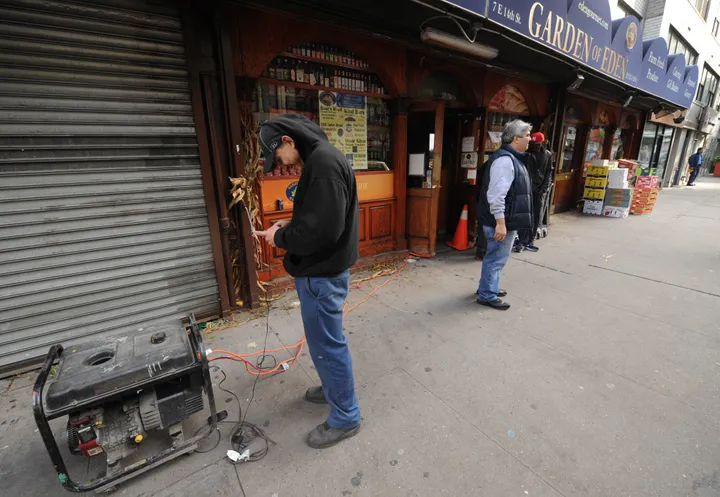
One key factor helps explain why communities ravaged by Hurricane Sandy could not use cell phones to call for help and communicate with the outside world: mobile telephone companies have for years lobbied to kill rules that would have forced them to maintain backup power at their cell phone towers.

After Hurricane Katrina knocked out communications along the Gulf Coast, federal regulators proposed that wireless companies have backup power at all cell towers.

But the wireless industry sued to block the requirement, saying it would be a financial burden and regulators didn't have authority to impose it. An appeals court later sided with the industry.

This week, as Sandy dealt a severe blow to the nation's most populous region, about one in four cell towers failed, leaving thousands of customers unable to make cell phone calls for days.

The outages exposed weaknesses in wireless communications during disasters and renewed questions of whether carriers should be required to make their networks more resilient.

“The biggest issue is they have not wanted to invest the money in hardening their networks sufficiently against a catastrophic event,” said Harold Feld, senior vice president at Public Knowledge, a public interest group.

To prepare for hurricanes, wireless carriers say they adhere to “voluntary, industry-based best practices," such as using portable cell towers on wheels, known as COWS, as temporary towers in areas without service. AT&T and T-Mobile allowed their customers this week to use each other's networks in New York and New Jersey until their networks were fully restored.

But there are almost no rules on how wireless companies should respond to severe weather. While they work closely with federal agencies during storms, they are not required to file detailed emergency plans with them beforehand.

"It's basically left up to the industry to decide whether to put plans in place," Feld said.

The reliability of wireless service in a disaster has become increasingly critical as more Americans ditch their landlines for cell phones. The percentage of cell phone-only households has risen from 18 percent in 2008 to 34 percent today, according to the National Center for Health Statistics.

Last year, the Federal Communications Comission sought public comments on how wireless providers should strengthen their systems, citing "the inadequacy of backup power" as a key reason for wireless failures during emergencies.

In comments filed with the FCC, the CTIA, which represents the wireless industry, urged regulators not to adopt regulations requiring back-up power at cell towers. Such requirements “would unnecessarily burden wireless carriers and potentially undermine the investments and network planning that have made their networks so successful."

Most cell towers -- but not all -- have backup battery power, ranging from several hours to a few days, according to Chris Guttman-McCabe, vice president of regulatory affairs for the CTIA. After Hurricane Sandy, the carriers relied on generators to keep the cell sites running, but expressed concern about fuel shortages.

Last fall, Connecticut State Sen. Andrew Roraback (R-Goshen), proposed a bill that would have required all cell towers in his state to be equipped with backup generators. He introduced the bill after a snowstorm knocked out power at towers near his home, leaving his cell phone useless.

"It's a real public-safety issue," Roraback said in an interview. "When you lose your landline in a storm, the last way you have to communicate is with your cell phone. When the cell tower goes out, you're left with no means of communication. You're stranded."

The industry opposed the bill. It was later modified to require state regulators to conduct a study on how to ensure cell coverage during severe storms.

During hurricanes, wireless networks depend on more than just cell towers. They also rely on fiber or copper wires -- known as "backhaul service" -- and switching centers to transmit calls between towers. This week, Verizon said that one of its key switching centers in lower Manhattan flooded, and its copper wires were damaged as well. Other wireless carriers also said their networks can become overloaded by sudden spikes in usage during emergencies.

As power returned to many areas over the weekend, wireless carriers reported that more than 95 percent of their cell towers in areas affected by the storm were working. But they remained vague about what areas still lacked cell service. And on Sunday, some customers were still begging for connectivity, six days after the storm.

"Please send a mobile cell tower and power linkup to Long Beach, NY," one Twitter user wrote Sunday. "It's been decimated by Sandy. No AT&T service there, lots of need."

For wireless customers, the question going forward is whether they can count on the industry to prevent such outages in the next hurricane, or whether regulators should create new rules to ensure that they do, Feld said.

“Are we just going leave it to the industry that in another one of these crises they’ll invent this stuff from scratch, or do we want to tell regulators they need to actually put some standards in place?" he said.

Related on HuffPost:

Loading Slideshow...
  • Long Island Residents, Many Still Without Power, Continue To Clean Up After Superstorm Sandy

    LONG BEACH, NY - NOVEMBER 09: A man walks past a destroyed section of the boardwalk at the base of Lincoln Boulevard as Long Islanders continue their clean up efforts in the aftermath of Superstorm Sandy on November 9, 2012 in Long Beach, New York. New York Gov. Andrew M. Cuomo has said that the economic loss and damage to homes and business caused by Sandy could total $33 billion in New York, according to published reports. (Photo by Bruce Bennett/Getty Images)

  • Storm-Damaged Communities On East Coast Hit By Nor'Easter

    NEW YORK, NY - NOVEMBER 08: Alex Vila, 2, carries a box of cereal after visiting an aid station for people affected by Superstorm Sandy on November 8, 2012 in the Brooklyn borough of New York City. Household supplies and groceries were distributed to Red Hook neighborhood residents by Catholic Charities at the Visitation of the Blessed Virgin Mary church. Meanwhile a nor'easter storm plunged temperatures to below freezing, bringing more misery to many Red Hook residents still without power, heat nor running water in their public housing apartments. (Photo by John Moore/Getty Images)

  • US-WEATHER-STORM-SANDY

    Boats and docks damaged by Hurricane Sandy are seen at the Mansion Marinia on the shores of the Great Kills community November 7, 2012 on Staten Island, New York. New York Mayor Michael Bloomberg on Tuesday announced a limited evacuation of some neighborhoods ahead of harsh weather barreling toward a city still recovering from superstorm Sandy. The national weather service forecast heavy rain and likely snow on Wednesday and Thursday, accompanied by gale force winds gusting as high as 43 mph (69 kmh). Though barely half the strength of Sandy, the autumn storm will lash already damaged buildings and bring lower temperatures for tens of thousands of people still struggling without electricity. Bloomberg told a news conference that parks and beaches would close. The worst-hit patches of waterfront neighborhoods, including Rockaways in the Queens borough, and in Staten Island, were being asked to evacuate again. AFP PHOTO/Paul J. Richards (Photo credit should read PAUL J. RICHARDS/AFP/Getty Images)

  • Storm-Damaged Communities On East Coast Hit By Nor'Easter

    LONG BRANCH, NJ - NOVEMBER 08: Debris from Superstorm Sandy is seen on a beach November 8, 2012 in Long Branch, New Jersey. Meanwhile a nor'easter storm plunged temperatures to below freezing, bringing more misery to many residents throughout New York and New Jersey still without power. (Photo by Allison Joyce/Getty Images)

  • Long Island Residents, Many Still Without Power, Continue To Clean Up After Superstorm Sandy

    OCEANSIDE, NY - NOVEMBER 09: (L-R) James Vouloukos and William Ferris sort through donated clothes at a site maintained by the Town of Hempstead in cooperation with FEMA at Oceanside Park during in the aftermath of Superstorm Sandy on November 9, 2012 in Oceanside, New York. New York Gov. Andrew M. Cuomo has said that the economic loss and damage to homes and businesses caused by Sandy could total $33 billion in New York, according to published reports. (Photo by Bruce Bennett/Getty Images)

  • Funeral Held in Brooklyn For Two Young Brothers Killed During Superstorm Sandy

    NEW YORK, NY - NOVEMBER 09: New York sanitation department workers watch as a hearse arrives with a casket carrying the bodies of two brothers killed during Superstorm Sandy for a funeral at the St. Rose of Lima Catholic church on November 9, 2012 in the Brooklyn borough of New York City. Brandon Moore, 2, and Connor Moore, 4, were swept away from the arms of their mother Glenda Moore as she fled Superstorm Sandy floodwaters in New York's Staten Island borough to seek safety with family in Brooklyn. She is married to New York Sanitation worker Damian Moore, and dozens of workers and officials from the sanitation department attended the funeral ceremony. (Photo by John Moore/Getty Images)

  • Long Island Residents, Many Still Without Power, Continue To Clean Up After Superstorm Sandy

    ISLAND PARK, NY - NOVEMBER 09: (L-R) Residents Paul and Donald Zezulinski and their dog 'Plywood' of Island Park show their appreciation to first responders during their clean up efforts in the aftermath of Superstorm Sandy on November 9, 2012 in Island Park, New York. New York Gov. Andrew M. Cuomo has said that the economic loss and damage to homes and business caused by Sandy could total $33 billion in New York, according to published reports. (Photo by Bruce Bennett/Getty Images)

  • FILE - In this Tuesday, Oct. 30, 2012 file photo, people stand next to a house collapsed from Superstorm Sandy in East Haven, Conn. While Connecticut was spared the destruction seen in New York and New Jersey, many communities along the shoreline, including some of the wealthiest towns in America, were struggling with one of the most severe storms in generations. (AP Photo/Jessica Hill, File)

  • Meg Dolan holds her dog "Nellie" during Sunday mass at St. Thomas More Catholic Church in Breezy Point, in the wake of Superstorm Sandy, Sunday, Nov. 4, 2012, in New York. With overnight temperatures sinking into the 30s and hundreds of thousands of homes and businesses still without electricity six days after Sandy howled through, people piled on layers of clothes, and New York City officials handed out blankets and urged victims to go to overnight shelters or daytime warming centers. (AP Photo/Kathy Willens)

  • A representative of the Salvation Army walks past homes destroyed by Superstorm Sandy in Breezy Point, Sunday, Nov. 4, 2012, in New York. The beachfront neighborhood heavy populated by firefighters and police officers was devastated during the storm when a fire pushed by Sandy's raging winds destroyed 100 or more homes and buildings. (AP Photo/Kathy Willens)

  • Ginny Flanagan, right, and her sister go through photographs and mementos that were recovered from Flanagan's flooded bungalow in Breezy Point, in the wake of Superstorm Sandy, Sunday, Nov. 4, 2012, in New York. The beachfront enclave heavy populated by firefighters and police officers was devastated during the storm when a fire pushed by Sandy's raging winds destroyed 100 or more homes and buildings. (AP Photo/Kathy Willens)

  • US-WEATHER-STORM-SANDY-MARATHON

    Runner Jonathan who would have run the ING New York City Marathon, spend the afternoon volunteering by unloading and organizing emergency supplies near Midland Beach as New York recovers from Hurricane Sandy on November 4, 2012 in Staten Island, New York. AFP PHOTO / Mehdi Taamallah (Photo credit should read MEHDI TAAMALLAH/AFP/Getty Images)

  • A woman with her groceries passes a group of National Guardsmen as they march up 1st Avenue towards the 69th Regiment Armory, Saturday, Nov. 3, 2012, in New York. National Guardsmen remain in Manhattan as the city begins to move towards normalcy following Superstorm Sandy earlier in the week. (AP Photo/ John Minchillo)

  • Patrons on foot carrying gas canisters line up for gasoline at a Hess station in the New Dorp section of the Staten Island borough of New York, Saturday, Nov. 3, 2012. Those on foot reported waits up to 40 minutes while motorists lined up for two hours as Staten Islanders fueled up to run their generators and automobiles in the wake of Superstorm Sandy. (AP Photo/Eileen AJ Connelly)

  • Girls hold hands during Sunday mass at St. Thomas More Catholic Church in Breezy Point, in the wake of Superstorm Sandy, Sunday, Nov. 4, 2012, in New York. With overnight temperatures sinking into the 30s and hundreds of thousands of homes and businesses still without electricity six days after Sandy howled through, people piled on layers of clothes, and New York City officials handed out blankets and urged victims to go to overnight shelters or daytime warming centers. (AP Photo/Kathy Willens)

  • Many streets in the Silver Lake section of Belmar, N.J., remain underwater Saturday, Nov. 3, 2012, Neighbors and volunteers clean out homes Saturday, Nov. 3, 2012, in Belmar, N.J., five days after the storm surge by superstorm Sandy. (AP Photo/Ben Nukols)

  • Water from superstorm Sandy is pumped from a flooded basement of an office building near New York's Battery Park, Friday, Nov. 2, 2012. The massive storm that started out as Hurricane Sandy slammed into the East Coast and morphed into a huge and problematic system, killing at least 96 people in the United States. The cost of the storm could exceed $18 billion in New York alone. (AP Photo/Richard Drew)

  • Cars that were uprighted and submerged by Superstorm Sandy remain at the entrance of a subterranean parking garage in New York's Financial District, as the water is pumped out, Friday, Nov. 2, 2012. . The cost of the storm could exceed $18 billion in New York alone. (AP Photo/Richard Drew)

  • National Guard in Lower Manhattan

    The National Guard 827th Engineer Company helps hand out MREs to Lower Manhattan residents at the Alfred Smith Playground on Friday Nov. 2, 2012. (Damon Dahlen, AOL)

  • National Guard in Lower Manhattan

    The National Guard 827th Engineer Company helps hand out MREs to Lower Manhattan residents at the Alfred Smith Playground on Friday Nov. 2, 2012. (Damon Dahlen, AOL)

  • Grand Central Terminal, New York City

    People walk through Grand Central Terminal as the sun rises during a subdued morning rush on Nov. 1, 2012 in New York City. Some trains are back up and running into Grand Central following shutdowns in the aftermath of Superstorm Sandy. Subway train service in the city is back in a limited capacity, but with much of lower Manhattan still with out power, trains are not running there and busses are replacing them.

  • Seaside Heights, N.J.

    A roller coaster sits in the Atlantic Ocean after the Fun Town pier it sat on was destroyed by Superstorm Sandy on Nov. 1, 2012 in Seaside Heights, New Jersey. With the death toll continuing to rise and millions of homes and businesses without power, the U.S. east coast is attempting to recover from the effects of floods, fires and power outages brought on by Superstorm Sandy.

  • National Guard in Lower Manhattan

    The National Guard 827th Engineer Company helps hand out MREs to Lower Manhattan residents at the Alfred Smith Playground on Friday Nov. 2, 2012. (Damon Dahlen, AOL)

  • Charging Station Provided By AT&T

    Phillip Melly charges the phones of Hurricane Sandy victims at Kimlau Square in Lower Manhattan on Friday Nov. 2, 2012. The generators used were brought in by AT&T to help out the residents of Lower Manhattan in New York City who currently have no power. (Damon Dahlen, AOL)

  • Stocking Up On Ice

    United City Ice Cube Company workers who refer to themselves as "Icemen" take in a shipment of ice into their 45th and 10th ave. store on Friday Nov. 2, 2012. The workers who asked not to be identified by name said there had been a run on ice purchases due to Hurricane Sandy and they were stocking up in anticipation of more demand in the coming days. (Damon Dahlen, AOL)

  • Car Crash Due To Power Outage

    The power outage in Lower Manhattan due to Hurricane Sandy has created a gauntlet of dangerous street intersections as can be seen by this car accident at the Houston and Varick Street crossing on Friday Nov. 2, 2012. (Damon Dahlen, AOL)

  • Car Crash Due To Power Outage

    The power outage in Lower Manhattan due to Hurricane Sandy has created a gauntlet of dangerous street intersections as can be seen by this car accident at the Houston and Varick Street crossing on Friday Nov. 2, 2012. (Damon Dahlen, AOL)

  • Clean Drinking Water

    Pedestrians fill up on water at a drinking station that had been setup at the corner of Centre and Canal Streets in Chinatown on Friday Nov. 2, 2012. The stations use water from fire hydrants and have been erected due to the blackout caused by Hurricane Sandy in Lower Manhattan. (Damon Dahlen, AOL)

  • Trash Picking In Chinatown

    A pedestrian looks through discarded food near a supermarket located at Henry and Market Streets in Chinatown New York on Friday Nov. 2, 2012.

  • Fort Lee, N.J.

    People wait in line for fuel at a Shell Oil station on Nov. 1, 2012 in Fort Lee, New Jersey. The US death toll from Hurricane Sandy rose to at least 85 as New York reported a major jump in fatalities caused by Monday's storm. Fuel shortages led to long lines of cars at gasoline stations in many states and the country faced a storm bill of tens of billions of dollars.

  • New York City

    Commuters ride the F train Nov. 1, 2012 in New York City. Limited public transit has returned to New York. With the death toll continuing to rise and millions of homes and businesses without power, the U.S. east coast is attempting to recover from the effects of floods, fires and power outages brought on by Superstorm Sandy.

  • Toms River, N.J.

    A gas station displays a "No Gas" sign on November 1, 2012 in Toms River, New Jersey. With the death toll continuing to rise and millions of homes and businesses without power, the U.S. east coast is attempting to recover from the effects of floods, fires and power outages brought on by Superstorm Sandy.

  • Fort Lee, N.J.

    Cars wait in line for fuel at a Gulf gas station on Nov.1, 2012 in Fort Lee, New Jersey. The US death toll from Hurricane Sandy rose to at least 85 as New York reported a major jump in fatalities caused by Monday's storm. Fuel shortages led to long lines of cars at gasoline stations in many states and the country faced a storm bill of tens of billions of dollars.

  • Brooklyn, N.Y.

    New Yorkers wait in traffic as they head into Manhattan from Brooklyn as the city continues to recover from superstorm Sandy on Nov.1, 2012, in New York, United States. Limited public transit has returned to New York and most major bridges have reopened but will require three occupants in the vehicle to pass. With the death toll currently over 70 and millions of homes and businesses without power, the US east coast is attempting to recover from the effects of floods, fires and power outages brought on by superstorm Sandy.

  • Hoboken, N.J.

    Mud and debris liiter a street on Nov.1, 2012 in Hoboken, New Jersey. Hurricane victims continue to recover from Hurricane Sandy, which made landfall along the New Jersey shore, and left parts of the state and the surrounding area flooded and without power.

  • Washington, D.C.

    Firefighters shoot water into a building in the 1200 block of 4th St., NE, near the recently opened Union Market, after responding to a blaze that broke out around 9pm Wednesday night.

  • Seaside Heights, N.J.

    Debris lies on the boardwalk in front of the Casino Pier, which was partially destroyed by Superstorm Sandy on Nov.1, 2012 in Seaside Heights, New Jersey. With the death toll continuing to rise and millions of homes and businesses without power, the U.S. east coast is attempting to recover from the effects of floods, fires and power outages brought on by Superstorm Sandy.

  • Brooklyn Battery Tunnel, N.Y.

    A New York City Police Department (NYPD) officer looks over flood waters at the entrance to the Brooklyn Battery tunnel in New York, U.S., on Nov. 1, 2012. The New York region is replacing a rail network built over a century with a patchwork constructed day-by-day to move its 8 million people again as it struggles back to life after Hurricane Sandy.

  • New York City

    Residents charge their cell phones and computers on the East River esplanade in New York, U.S., on Nov. 1, 2012. The New York region is replacing a rail network built over a century with a patchwork constructed day-by-day to move its 8 million people again as it struggles back to life after Hurricane Sandy.

  • Toms River, N.J.

    An American flag flies in front of a home damaged by Hurricane Sandy on Nov. 1, 2012 in Toms River, New Jersey. With the death toll continuing to rise and millions of homes and businesses without power, the U.S. east coast is attempting to recover from the effects of floods, fires and power outages brought on by superstorm Sandy.

  • Lower Manhattan

    Water is pumped on to the street in lower Manhattan in New York, U.S., on Thursday, Nov. 1, 2012. The New York region is replacing a rail network built over a century with a patchwork constructed day-by-day to move its 8 million people again as it struggles back to life after Hurricane Sandy.

  • North Bergen, New Jersey

    A woman leaves an Exxon gas station which was out of gas on Nov. 1, 2012 in North Bergen, New Jersey. The US death toll from Hurricane Sandy rose to at least 85 as New York reported a major jump in fatalities caused by Monday's storm. Fuel shortages led to long lines of cars at gasoline stations in many states and the country faced a storm bill of tens of billions of dollars.

  • Manhattan from Hoboken, N.J.

    People board the NY Waterways ferry with the Manhattan skyline in the background Nov.1, 2012 in Hoboken, New Jersey. Hurricane Sandy, which made landfall along the New Jersey shore, left parts of the state and the surrounding area without power including much of lower Manhattan south of 34th Street.

  • South Ferry 1 Train Station, New York City

    Joseph Leader, Metropolitan Tranportation Authority Vice President and Chief Maintenance Officer, shines a flashlight on standing water inside the South Ferry 1 train station in New York, N.Y., Wednesday, Oct. 31, 2012, in the wake of superstorm Sandy. The floodwaters that poured into New York's deepest subway tunnels may pose the biggest obstacle to the city's recovery from the worst natural disaster in the transit system's 108-year history.

  • Seaside Heights, N.J.

    John Okeefe walks on the beach as a rollercoaster that once sat on the Funtown Pier in Seaside Heights, N.J., rests in the ocean on Wednesday, Oct. 31, 2012 after the pier was washed away by superstorm Sandy which made landfall Monday evening.

  • Grand Central Terminal, New York City

    People exit a Metro-North train arriving in Grand Central Terminal during the morning rush on Nov. 1, 2012 in New York City. Some trains are back up and running into Grand Central following shutdowns in the aftermath of Superstorm Sandy. Subway train service in the city is back in a limited capacity, but with much of lower Manhattan still with out power, trains are not running there and busses are replacing them.

  • Brooklyn, N.Y.

    Pedestrians look over a fence at a pile of boats flooded inland at the Varuna Boat Club on Oct. 31, 2012, in the Brooklyn borough of New York. Sandy, the storm that made landfall Monday, caused multiple fatalities, halted mass transit and cut power to more than 6 million homes and businesses.

  • Queens, N.Y.

    People walk by a destroyed section of the Rockaway boardwalk in the heavily damaged Rockaway section of Queens after the historic boardwalk was washed away during Hurricane Sandy on Oct. 31, 2012 in the Queens borough of New York City. With the death toll currently at 55 and millions of homes and businesses without power, the US east coast is attempting to recover from the affects of floods, fires and power outages brought on by Hurricane Sandy. JFK airport in New York and Newark airport in New Jersey expect to resume flights on Wednesday morning and the New York Stock Exchange commenced trading after being closed for two days.

  • Queens, N.Y.

    Damage is viewed in the Rockaway neighborhood where the historic boardwalk was washed away during Hurricane Sandy on Oct. 31, 2012 in the Queens borough of New York City. With the death toll currently at 55 and millions of homes and businesses without power, the US east coast is attempting to recover from the affects of floods, fires and power outages brought on by Hurricane Sandy. JFK airport in New York and Newark airport in New Jersey expect to resume flights on Wednesday morning and the New York Stock Exchange commenced trading after being closed for two days.

  • Atlantic City, N.J.

    A damaged car is shown in the wake of superstorm Sandy, Wednesday, Oct. 31, 2012, in Atlantic City, N.J. Sandy was being blamed for at least six deaths across the state plus power outages that at their peak Monday affected 2.7 million residential and commercial customers.

  • Brooklyn, N.Y.

    A worker picks up debris outside of the damaged Tatiana Grill on the Brighton Beach boardwalk, on Oct. 31, 2012, in the Brooklyn borough of New York. Sandy, the storm that made landfall Monday, caused multiple fatalities, halted mass transit and cut power to more than 6 million homes and businesses.