iPhone app iPad app Android phone app Android tablet app More

Posted:

Messier 106: Four-Armed Galaxy Dazzles In New Hubble PHOTO

By: Clara Moskowitz
Published: 02/06/2013 05:31 PM EST on SPACE.com

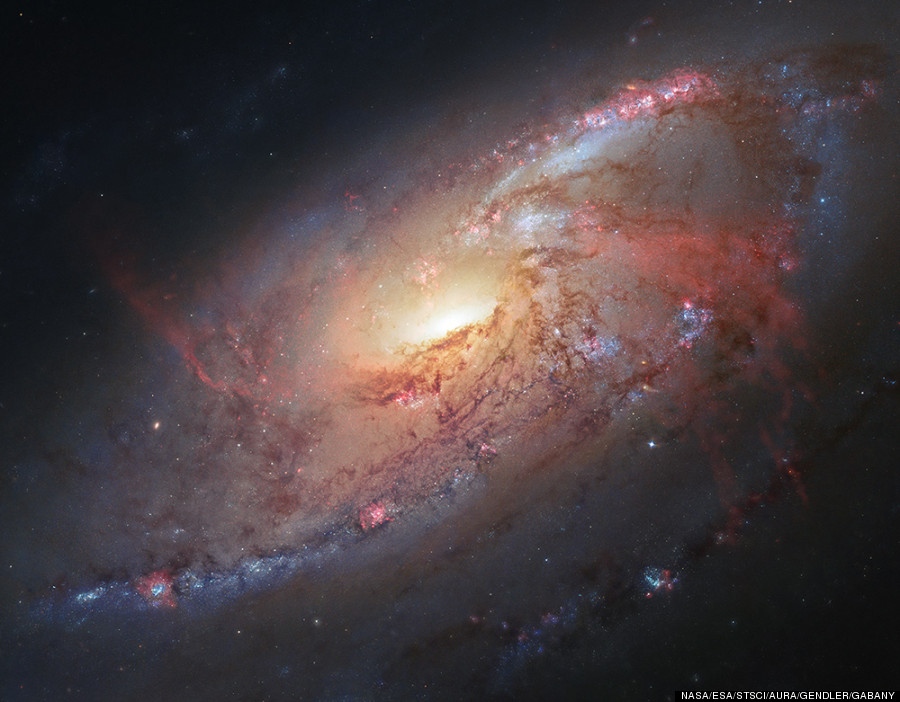
Where most spiral galaxies have two twisting arms, a neighbor of the Milky Way is a four-armed monster. A new photo snapped by the Hubble Space Telescope, combined with observations by amateur astronomers, reveals these arms in stunning detail (click for HUGE).

The galaxy Messier 106 lies about 20 million light-years from Earth in the constellation Ursa Major (the Great Bear). Hubble scientists released a video of the four-armed galaxy in addition to the new photo.
messier 106

Beneath its pretty pink appearance, Messier 106 is harboring a monster black hole that is hungrily gobbling up matter at the galaxy's center.

This black hole, scientists say, may be the key to the galaxy's mysterious extra arms. 

Spiral arms are bands of material that swirl out from the center of spiral galaxies. Most spiral galaxies have two, but Messier 106 has four. In addition to its prominent pair of main arms made of stars, this galaxy has two thinner wisps of reddish gas spiraling from its center.

These extra arms are thought to be a result of the galaxy's central black hole, which produces two jets of material ejecting from the cloud of matter falling into it. These jets, in turn, disrupt and heat up the gas in the galaxy, causing the denser gas in the galactic plane to shine brightly. At the center of the galaxy, where gas is tightly bound, the arms appear to be straight, but on the outskirts, where the gas is held more loosely, it is blown above or below the main plane of the galaxy's disk, and curves outward.

These arms appear bright pink in the new photo, which combines images captured by Hubble's Advanced Camera for Surveys, Wide Field Camera 3, and Wide Field and Planetary Camera 2, with ground-based observations taken by amateur astronomers Robert Gendlerand Jay GaBany. Gendler assembled his and GaBany's photos with archived Hubble Space Telescope data to create the new portrait.

Follow Clara Moskowitz on Twitter @ClaraMoskowitz or SPACE.com @Spacedotcom. We're also on Facebook & Google+. 

Copyright 2013 SPACE.com, a TechMediaNetwork company. All rights reserved. This material may not be published, broadcast, rewritten or redistributed.

Also on HuffPost:

Loading Slideshow...
  • 1a Supernova Remnant

    This undated photo shows a classic type 1a supernova remnant. Researchers Saul Perlmutter and Adam Riess of the United States and US-Australian Brian Schmidt won the 2011 Nobel Physics Prize on October 4, 2011 for their research on supernovae.

  • The silhouette of the space shuttle Endeavour, Feb 9, 2010

    The silhouette of the space shuttle Endeavour appears over Earth's colorful horizon in this image photographed by an Expedition 22 crew member on Feb. 9, 2010.

  • Flying V Galaxy

    "These tidal tails are thin, elongated streams of gas, dust and stars that extend away from a galaxy into space. They occur when galaxies gravitationally interact with one another, and material is sheared from the outer edges of each body and flung out into space in opposite directions, forming two tails. They almost always appear curved, so when they are seen to be relatively straight, as in this image, it is clear that we are viewing the galaxies side-on."

  • Transit Of Venus

    This image provided by NASA shows the Solar Dynamic Observatory's ultra-high-definition view of Venus, black dot at top center, passing in front of the sun on Tuesday, June 5, 2012. The next transit of Venus won't be for another 105 years. (NASA/Solar Dynamic Observatory/AP)

  • Transit of Venus

    This image provided by NASA shows the image captured by Hinode on June 5, 2012 of the transit of Venus -- the last instance of this rare phenomenon until 2117. Hinode is a joint JAXA/NASA mission to study the connections of the sun's surface magnetism, primarily in and around sunspots. NASA's Marshall Space Flight Center in Huntsville, Ala., manages Hinode. The Smithsonian Astrophysical Observatory in Cambridge, Mass., is the lead U.S. investigator for the X-ray Telescope. (JAXA NASA/AP)

  • Stars Brewing in Cygnus X

    A bubbling cauldron of star birth is highlighted in this image from NASA's Spitzer Space Telescope. Infrared light that we can't see with our eyes has been color-coded, such that the shortest wavelengths are shown in blue and the longest in red. The middle wavelength range is green. Massive stars have blown bubbles, or cavities, in the dust and gas--a violent process that triggers both the death and birth of stars. The brightest, yellow-white regions are warm centers of star formation. The green shows tendrils of dust, and red indicates other types of dust that may be cooler, in addition to ionized gas from nearby massive stars.

  • Dusty Space Cloud

    This image shows the Large Magellanic Cloud galaxy in infrared light as seen by the Herschel Space Observatory, a European Space Agency-led mission with important NASA contributions, and NASA's Spitzer Space Telescope. In the instruments' combined data, this nearby dwarf galaxy looks like a fiery, circular explosion. Rather than fire, however, those ribbons are actually giant ripples of dust spanning tens or hundreds of light-years. Significant fields of star formation are noticeable in the center, just left of center and at right. The brightest center-left region is called 30 Doradus, or the Tarantula Nebula, for its appearance in visible light.

  • Dunes in Noachis Terra Region of Mars

    This enhanced-color image shows sand dunes trapped in an impact crater in Noachis Terra, Mars. Dunes and sand ripples of various shapes and sizes display the natural beauty created by physical processes. The area covered in the image is about six-tenths of a mile (1 kilometer) across. Sand dunes are among the most widespread wind-formed features on Mars. Their distribution and shapes are affected by changes in wind direction and wind strength. Patterns of dune erosion and deposition provide insight into the sedimentary history of the surrounding terrain.

  • Viewing the South Pole of Vesta

    This image obtained by the framing camera on NASA's Dawn spacecraft shows the south pole of the giant asteroid Vesta. Scientists are discussing whether the circular structure that covers most of this image originated by a collision with another asteroid, or by internal processes early in the asteroid's history. Images in higher resolution from Dawn's lowered orbit might help answer that question. The image was recorded with the framing camera aboard NASA's Dawn spacecraft from a distance of about 1,700 miles (2,700 kilometers). The image resolution is about 260 meters per pixel.

  • In, Around, Beyond Rings

    A quartet of Saturn's moons, from tiny to huge, surround and are embedded within the planet's rings in this Cassini composition. Saturn's largest moon, Titan, is in the background of the image, and the moon's north polar hood is clearly visible. See PIA08137 to learn more about that feature on Titan (3,200 miles, or 5,150 kilometers across). Next, the wispy terrain on the trailing hemisphere of Dione (698 miles, or 1,123 kilometers across) can be seen on that moon which appears just above the rings at the center of the image. See PIA10560 and PIA06163 to learn more about Dione's wisps. Saturn's small moon Pandora (50 miles, or 81 kilometers across) orbits beyond the rings on the right of the image. Finally, Pan (17 miles, or 28 kilometers across) can be seen in the Encke Gap of the A ring on the left of the image. The image was taken in visible blue light with the Cassini spacecraft narrow-angle camera on Sept. 17, 2011. The view was obtained at a distance of approximately 1.3 million miles (2.1 million kilometers) from Dione and at a Sun-Dione-spacecraft, or phase, angle of 27 degrees. Image scale is 8 miles (13 kilometers) per pixel on Dione.

  • X-Ray image of Young Stars

    Combining almost opposite ends of the electromagnetic spectrum, this composite image of the Herschel in far-infrared and XMM-Newton's X-ray images obtained January 20, 2012, shows how the hot young stars detected by the X-ray observations are sculpting and interacting with the surrounding ultra-cool gas and dust, which, at only a few degrees above absolute zero, is the critical material for star formation itself. Both wavelengths would be blocked by Earth's atmosphere, so are critical to our understanding of the lifecycle of stars . (AFP / Getty Images)

  • Active Galaxy Centaurus A

    Resembling looming rain clouds on a stormy day, dark lanes of dust crisscross the giant elliptical galaxy Centaurus A. Hubble's panchromatic vision, stretching from ultraviolet through near-infrared wavelengths, reveals the vibrant glow of young, blue star clusters and a glimpse into regions normally obscured by the dust. (NASA / ESA / Hubble Heritage)

  • Ring of Fire

    This composite image shows the central region of the spiral galaxy NGC 4151. X-rays (blue) from the Chandra X-ray Observatory are combined with optical data (yellow) showing positively charged hydrogen (H II) from observations with the 1-meter Jacobus Kapteyn Telescope on La Palma. The red ring shows neutral hydrogen detected by radio observations with the NSF's Very Large Array. This neutral hydrogen is part of a structure near the center of NGC 4151 that has been distorted by gravitational interactions with the rest of the galaxy, and includes material falling towards the center of the galaxy. The yellow blobs around the red ellipse are regions where star formation has recently occurred. (NASA / CXC / CfA / J. Wang)

  • Festival of Lights

    WISE, NASA's Wide-field Infrared Survey Explorer, has a new view of Barnard 3, or IRAS Ring G159.6-18.5, that is awash in bright green and red dust clouds. Interstellar clouds like these are stellar nurseries, where baby stars are being born. (UCLA / JPL-Caltech / NASA)

  • Pacman Nebula

    In visible light, the star-forming cloud known as NGC 281 in the constellation of Cassiopeia appears to be chomping through the cosmos, earning it the nickname the "Pacman" nebula after the famous Pac-Man video game of the 1980s.

  • Remains of a Supernova.

    This undated handout image provide by NASA combines data from four different space telescopes to create a multi-wavelength view of all that remains of the oldest documented example of a supernova, called RCW 86. NASA announced the findings Monday, Oct. 24, 2011, and said the exploded star was observed by the ancient Chinese in the year 185, and visible for eight months.

  • View from above

    This image provided by NASA shows a night time image photographed by the Expedition 29 crew from the International Space Station on Oct. 16, 2011. It features airglow, Earth's terminator, Rocky Mountains, Denver-Colorado Springs (center-right), Santa Fe-Albuquerque (low-center-right), US Great Plains cities: Dallas-Oklahoma City, Kansas City and Chicago.

  • Messier 78

    Messier 78 Nebula brings into focus a murky region of star formation. NASA's Spitzer Space Telescope exposes the depths of this dusty nebula with its infrared vision, showing stellar infants that are lost behind dark clouds when viewed in visible light. Messier 78 is easily seen in small telescopes in the constellation of Orion

  • An image released on October 3, 2011 show the Antennae Galaxies (also known as NGC 4038 and 4039) are a pair of distorted colliding spiral galaxies about 70 million light-years away, in the constellation of Corvus (The Crow). This view combines Atacama large milllimetre/submillimetre array (ALMA) observations, made in three different wavelength ranges during the observatory's early testing phase, with visible-light observations from the NASA/ESA Hubble Space Telescope. Most of the ALMA test observations used to create this image were made using only twelve antennas working together -- far fewer than will be used for the first science observations. The first phase of operations at the ALMA complex in Chile's Atacama desert are underway on October 3, 2011 following ten years of construction. Alma's purpose is to study processes occurring a few hundred million years after the formation of the Universe when the first stars began to shine. Alma consists of an array of linked giant antennas on top of the highest plateau in the Atacama desert. AFP PHOTO/ALMA (ESO/NAOJ/NRAO) (Photo credit should read -/AFP/Getty Images)

  • North America Nebula

    A swirling a landscape of stars known as the North America Nebula. In visible light, the region resembles North America, but in this image infrared view from NASA's Spitzer Space Telescope, the continent disappears.

  • WISE Telescope

    In this undated image taken by the WISE telescope a massive star is shown plowing through space dust. The result is a brilliant bow shock, seen here as a yellow arc.

  • Mercury Messenger

    At 5:20 a.m. EDT on March 29,2011, the Messenger probe captured this historic image of Mercury. The image is the first ever obtained from a spacecraft in orbit of the solar system's innermost planet. (NASA)

  • SuperMoon

    The full moon rises near the Lincoln Memorial on March 19 in Washington. The full moon was called a "Super Perigee Moon" since it was at its closest to Earth in 2011. The last full moon so big and close to Earth occurred in March 1993. (Bill Ingalls, NASA / AFP / Getty Images)

  • Celestial Shamrock

    This image from NASA's Wide-field Infrared Survey Explorer, or WISE, features a region of star birth wrapped in a blanket of dust, colored green in this infrared view. Designated as LBN 149.02-00.13, this interstellar cloud is made up of a shell of ionized gas surrounding a void with an extremely hot, bright star in the middle. (UCLA / JPL-Caltech / NASA)

  • Martian Gullies

    This image from NASA's Mars Reconnaissance Orbiter shows portions of the Martian surface in unprecedented detail. The photo shows many channels from 1 meter to 10 meters wide (approximately 3 feet to 33 feet wide) on a scarp in the Hellas impact basin. Some larger channels on Mars that are sometimes called gullies are big enough to be called ravines on Earth. (NASA / AFP / Getty Images)

  • Cassini of Saturn/Titan

    Saturn's largest moon, Titan, center, is 3,200 miles in diameter. The smaller moon Enceladus, far right, just over 300 miles across, appears just below the rings. The image was taken with the Cassini spacecraft wide-angle camera at a distance of approximately 524,000 miles from Titan. (SSI / JPL / NASA)

  • Discovery from the ISS

    The space shuttle Discovery is seen from the International Space Station as the two orbital spacecraft accomplish their relative separation. During a post undocking fly-around, the crew of each vessel photographed the opposing craft. (NASA)

  • NGC 2841

    This NASA image shows what the Hubble Space Telescope revealed in a majestic disk of stars and dust lanes in the spiral galaxy NGC 2841. A bright cusp of starlight marks the galaxy's center. Spiraling outward are dust lanes that are silhouetted against the population of whitish middle-aged stars. Much younger blue stars trace the spiral arms. NGC 2841 lies 46 million light-years away in the constellation of Ursa Major (The Great Bear). (Hubble Heritage / ESA / NASA)

  • Tempel 1

    This image obtained by NASA's Stardust spacecraft shows Comet Tempel 1 at 11:39 p.m. EST on Feb. 14, 2011. The NASA spacecraft's flyby of the comet showed erosion on Tempel 1's surface since it skimmed by the sun in 2005 and revealed the first clear pictures of the crater made by a Deep Impact probe. (Cornell / JPL-Caltech / NASA)

  • Sun and Flares

    A pair of active regions on the sun were captured in extreme ultraviolet light from the Solar Dynamic Observatory spacecraft over a three-day period. The magnetic field lines above the regions produced fluttering arcs waving above them, as well as a couple of flares. Another pair of smaller active regions emerges and trails behind the larger ones. (Solar Dynamics Observatory / NASA)

  • North America Nebula -- Feb 16, 2011

    This view of the North America nebula combines both visible and infrared light observations, taken by the Digitized Sky Survey and NASA's Spitzer Space Telescope, respectively, into a single vivid picture. The nebula is named after its resemblance to the North American continent in visible light, which in this image is represented in blue hues. Infrared light, displayed here in red and green, can penetrate deep into the dust, revealing multitudes of hidden stars and dusty clouds.

  • Sun Eruptions -- Jan. 28, 2011

    This still caught the action in freeze-frame splendor when the sun popped off two events at once. A filament, left, became unstable and erupted, while an M-1 flare and a coronal mass ejection, right, blasted into space. Neither event was headed toward Earth.

  • M51 -- obtained Jan. 19, 2011

    This image shows a dramatic view of the spiral galaxy M51, dubbed the Whirlpool Galaxy. Seen in near-infrared light, most of the starlight has been removed, revealing the Whirlpool's skeletal dust structure. This image is the sharpest view of the dense dust in M51. The narrow lanes of dust revealed by Hubble reflect the galaxy's moniker, the Whirlpool Galaxy, as if they were swirling toward the galaxy's core.

  • Giant Supernova -- released on Jan. 14, 2011

    While searching the skies for black holes using NASA's Spitzer Space Telescope, astronomers discovered a giant supernova that was smothered in its own dust in this image released on Jan. 14. In this artist's rendering, an outer shell of gas and dust -- which erupted from the star hundreds of years ago -- obscures the supernova within. This event in a distant galaxy hints at one possible future for the brightest star system in our own Milky Way.

  • Mars' moons Phobos (large moon) and Deimos, released Dec. 11

    Mars' two moons have been photographed in the same frame for the first time. The European Space Agency's Mars Express orbiter snapped this image, which was released Dec. 11, 2009. The larger moon is Phobos. The much smaller one is Deimos.

  • Hubble photo of new galaxies (Tuesday=Dec. 8, 2009)

    Scientists said Dec. 8, 2009, that the Hubble Space Telescope spotted several thousand never-before-seen galaxies that were formed 600 million years after the Big Bang. Here, a photo shows some of them. They appear in the image as the faintest and reddest objects.

  • Central Milky Way Galaxy; image released on Nov. 10, 2009

    This is one of the most detailed images to date of the heart of the Milky Way. The galaxy's center is within the white spot near the right edge of the photo. NASA released the image Nov. 10 to mark the 400th anniversary of the telescope. It is a composite of images from three observatories: the Hubble and Spitzer space telescopes and the Chandra X-ray Observatory.

  • NGC 2623, the result of a galactic collision, added Oct. 13

    This Hubble Space Telescope image shows an object known as both NGC 2623 and Arp 243, which was formed by a collision of two galaxies. The galaxies' cores have merged into one; the tails streaming from the object are full of young stars. NGC 2623 is about 250 million light-years away in the constellation of Cancer.

  • Barnard's Galaxy, added Oct. 15, 2009

    This portrait of Barnard's Galaxy, one of the Milky Way's closest neighbors, was taken by a telescope at the European Southern Observatory in La Silla, Chile. The red features in the photo are nebulae where new stars are being born. The galaxy has about 10 million stars; the Milky Way has an estimated 400 billion.

  • Saturn during equinox in August 2009

    The Cassini spacecraft became the first to photograph an equinox on Saturn, a 15-year event that took place Aug. 11. This photo is a composite of images that Cassini shot over eight hours. New equinox images of the planet show strange formations in its rings and suggest that in some places, the rings are much thicker than expected.

  • Shadows in Saturn's A ring, August 2009

    Clumps of debris cast shadows that are visible in the middle of this image of Saturn's A ring. The shadows suggest that the clumps are about 2,000 feet tall. Scientists have believed for years that the rings were about 30 feet thick, but based on the new images, scientists now think that they're more than 2 miles deep in some spots. "Isn't that the most outrageous thing you could imagine? It truly is like something out of science fiction," said Carolyn Porco, leader of the Cassini imaging team.

  • Arp 147 composite black holes -- obtained Feb 15, 2011

    This composite image of Arp 147, a pair of interacting galaxies located about 430 million light-years from Earth, shows X-rays from the NASA's Chandra X-ray Observatory (pink) and optical data from the Hubble Space Telescope (red, green, blue) produced by the Space Telescope Science Institute. Arp 147 contains the remnant of a spiral galaxy, right, that collided with the elliptical galaxy on the left. This collision has produced an expanding wave of star formation that shows up as a blue ring containing an abundance of massive young stars. These stars race through their evolution in a few million years or less and explode as supernovas, leaving behind neutron stars and black holes.

  • Jupiter's Scar, July 25, 2009

    A new photo released in July from the Hubble Space Telescope is the clearest yet of what astronomers are calling a scar on the surface of Jupiter. An object, possibly a comet, struck the planet recently, creating the strange dark patch. It happened on the 15th anniversary of another comet strike.

  • Kohoutek 4-55 nebula, photographed May 4, 2009

    This planetary nebula, named Kohoutek 4-55, was photographed May 4 by the Hubble Space Telescope's Wide Field Planetary Camera 2. The nebula, dubbed a "giant eye," contains the outer layers of a red giant star that died. The camera, which is the size of a baby grand piano, has captured several memorable images since it was installed in 1993.

  • Black hole light show, added April 14

    In this sequence of photos released in April, a jet of gas spews from a massive black hole in the center of the M87 galaxy. The gas fades and brightens, with a peak that even outshines the galaxy's core. The outburst is coming from a blob of matter, dubbed HST-1, and scientists are so far at a loss to explain its weird behavior.

  • Galaxy Triplet ARP 274, Added April 6

    This photo was snapped by the Hubble Space Telescope after winning a public competition to determine what the next space portrait should be. It shows Arp 274, a system of three galaxies -- two larger ones on the right, and a smaller and less intact one on the far left.

  • Hubble pic of galaxy tug of war, story reported on March 3, 2009

    NASA's Hubble Space Telescope captured an image of three galaxies playing a game of gravitational tug-of-war that could destroy one of them. The galaxies -- NGC 7173, middle left, NGC 7174, middle right, and NGC 7176, lower right -- are about 100 million light-years away. The photo was released March 3.

  • Red Rectangle nebula added Feb. 10, 2009

    Our solar system is in the middle of a cosmic dust storm, and some astronomers said they've zeroed in on the possible source: the Red Rectangle nebula, which is 2,300 light-years away in the constellation Monoceros. A double star system there is spewing the dust, according to findings announced in February.

  • Galactic collision, Oct. 30, 2008

    After transmission problems on the Hubble Telescope weren fixed, NASA in October 2008 provided this undated photograph showing the aftermath of galaxies colliding. In the pair known as Arp 147, a reddish-colored galaxy has passed through an O-shaped galaxy glowing blue.

  • Mercury Volcanoes

    Photographs taken of Mercury by the spacecraft Messenger in January 2008 were analyzed in the journal Science seven months later. Images like the one above show that volcanic activity played a part in forming plains on the planet.

  • The Helix nebula

    Feel like you are being watched? This infrared image from NASA's Spitzer Space Telescope shows the Helix nebula, a cosmic starlet notable for its vivid colors and eerie resemblance to a giant eye.


FOLLOW SCIENCE

By: Clara Moskowitz Published: 02/06/2013 05:31 PM EST on SPACE.com Where most spiral galaxies have two twisting arms, a neighbor of the Milky Way is a four-armed monster. A new photo snapped by t...
Filed by Travis Korte  | 
 
 
  • Comments
  • 98
  • Pending Comments
  • 0
  • View FAQ
Post Comment Preview Comment
To reply to a Comment: Click "Reply" at the bottom of the comment; after being approved your comment will appear directly underneath the comment you replied to.
View All
Favorites
Recency  | 
Popularity
Page: 1 2  Next ›  Last »  (2 total)
05:26 PM on 02/11/2013
would one of you who are so anti-god explain to me why there absolutely could NOT be a "god"?iam not a fan of religion but no one has ever definatively said why a godlike presence is impossible.
photo
Marcusarilius
Marooned Star Traveler
08:37 PM on 02/11/2013
Because they don't believe in God, just like Christians DO believe in God. Not very scientific either way. Personally, I believe in God and I believe in science.
photo
HUFFPOST SUPER USER
CSDofNM
I speak lolcat
08:58 PM on 02/11/2013
Depends on how you limit your god.

If you believe in a meddling, prayer answering deity, remember that even scripture demands you not test it (probably because the test will fail and damage your faith).

Possibility and probability are two very different things. Is it possible that a god created the Universe? If you roll back any explanation far enough (big bang, multiverses, etc), you get to a place where our understanding is currently as limited as sheep herding slaves 6,000 years ago. We cannot explain that first instant of expansion from nothingness (some theories try). So there is a possibility of a god.

But probability is another thing altogether. Those seeking to assure you that they have divine inspiration, and that you must obey them because they are divinely entitled, don't really have that in mind, only your obedience to their rule. When we look at the Universe, we see billions upon billions of galaxies each with billions upon billions of stars. If life is anywhere near as easy to create as the Urey experiment demonstrates, then it is much more likely that an alien from an advanced civilization will whisk us away to a Mad Hatter's tea party in the near second after you read this, rather than "god" having any interest in you whatsoever. The matter you are composed of can neither be created nor destroyed, only changed in form. So you will live forever.

Gods are not impossible, just unlikely, probably disinterested in your personal outcomes.
HUFFPOST SUPER USER
rg9rts
Carpe Diem! This aint rehearsal
01:02 PM on 02/11/2013
You want to see the picture and that stupid share block is in it! I'm about ready to dump Huffy for good.
05:05 PM on 02/11/2013
I absolutely agree! Please get rid of that darned thing! I do not belong to any of those "social" groups, and they keep getting in the way of what I'm trying to read!
photo
uniqumm
Hot Snark served with relish
11:16 AM on 02/12/2013
I certainly have numerous bones to pick w/HP, but this one is something that seems specific with your browser.
What browser are you using?
HUFFPOST SUPER USER
rg9rts
Carpe Diem! This aint rehearsal
04:56 PM on 02/12/2013
Sorry to burst your bubble but its not just me.  explorer
HUFFPOST SUPER USER
rg9rts
Carpe Diem! This aint rehearsal
05:01 PM on 02/12/2013
Go to US and pick a story off the front page and watch the nonsense begin. As you scroll down the page the share box will begin to follow and there is no way to stop it. Not on UK but is in Canada too. Notifications? 5=0 in huffy land The new comment foremat leaves alot to be desired ,, want me to go on??
This user has chosen to opt out of the Badges program
photo
ProudToBeVeryLiberal
Science is the antidote to the poison of religion
05:57 PM on 02/09/2013
Because of the extra arms, we could rename it the Vishnu galaxy... ;)
This user has chosen to opt out of the Badges program
photo
ProudToBeVeryLiberal
Science is the antidote to the poison of religion
photo
Marcusarilius
Marooned Star Traveler
08:40 PM on 02/11/2013
Nice. Thanks!
This user has chosen to opt out of the Badges program
photo
ProudToBeVeryLiberal
Science is the antidote to the poison of religion
08:55 PM on 02/11/2013
I really don't understand why the HP never provides links to the original source. Oh wait, maybe it's because they want you to see the ads on space.com... ;)
photo
blackwind
Relax, nothing is under control
01:01 AM on 02/09/2013
Travelers from this galaxy have already visited earth.
They landed in India long ago, and were considered gods. . .
photo
HUFFPOST SUPER USER
jdl51
10:16 AM on 02/09/2013
And where are they when we need them?
photo
blackwind
Relax, nothing is under control
05:00 PM on 02/09/2013
Like so many gods do, they're just hanging out in Hindu temples taking it easy.
12:58 AM on 02/10/2013
They left after they got to know us better.
05:26 PM on 02/11/2013
Why India?
photo
blackwind
Relax, nothing is under control
04:35 PM on 02/12/2013
I don't know, but with all the four armed gods that hang out there, they must have a reason.
03:20 PM on 02/08/2013
My first impression when I looked at the photo was that the extra arms would seem to be the result of a galactic merger (two spirals coming together). That said, this hypothesis that these extra spirals arms are the result of black hole activity is interesting. Has this type of black hole activity been observed in other galaxies?
photo
HUFFPOST SUPER USER
jdl51
10:25 AM on 02/09/2013
With over 80 billion galaxies in the observed universe, I'm sure there are some more out there if we haven't seen them already.
10:04 PM on 02/10/2013
Most big galaxies have black holes at their centers, though they vary widely in mass.
01:45 PM on 02/08/2013
That's right. It shouldn't even exist...if evolution and the billions of years 'science' is true. But...it isn't true. Any evidence that goes against modern 'experts' opinions is dusted off as an unexplained anomaly, never mind that there are millions of them. It never occurs to them that the theory is wrong.

God Almighty created this world and then enlarged (stretched) it out. That's why those galaxies look so far away and yet so old at the same time.
06:12 PM on 02/08/2013
Yikes. Where to begin?

I guess I won't.
photo
HUFFPOST SUPER USER
coreten
06:30 PM on 02/08/2013
Good. You're learning. There are times when it's best not to begin.
photo
HUFFPOST SUPER USER
bigpapapuff425
07:44 PM on 02/08/2013
Never dispute a religious zealot.
photo
HUFFPOST SUPER USER
jdl51
10:26 AM on 02/09/2013
Glad to see you've got all the answers. Isn't there something about pride in that book you're supposed to follow?
photo
HUFFPOST SUPER USER
vobox3343
Each day is a new day - make the most of it
12:15 PM on 02/08/2013
Just amazing what goes on out there!
iam99
To know what you prefer...
12:14 PM on 02/08/2013
Can't a galaxy be a non-conformist? Who said they were extra arms?
11:52 AM on 02/08/2013
So what came first? the Black hole or the Galaxy? And to have a Galaxy, does it require a Black hole? And if so, eventually, will all galaxy's disappear into their creator?
photo
CoveredUp
Watch out, don't slip on my banana peels.
10:58 AM on 02/08/2013
I'd like to that astrophotography setup.
photo
HUFFPOST SUPER USER
PvtGripweed
09:56 AM on 02/08/2013
Could be the result of two or more galaxies merging.
HUFFPOST SUPER USER
bigbe
I can't remember the last time I forgot something.
12:36 PM on 02/08/2013
finally someone said what I thought
photo
HUFFPOST SUPER USER
jdl51
10:28 AM on 02/09/2013
Usually, they merge on different planes, but anything is possible.
HUFFPOST SUPER USER
Rich Cash
Enlisted in 1971 - Retired in 1996
09:18 PM on 02/07/2013
It must be a relatively young galaxy for the black hole at its center to still be absorbing enough matter to be detectable at that distance.
photo
HUFFPOST SUPER USER
The Knocker
a mind is a terrible thing to waste
01:14 AM on 02/08/2013
unless a star decided to wander too closely to its gravitational field.
HUFFPOST SUPER USER
Rich Cash
Enlisted in 1971 - Retired in 1996
01:28 AM on 02/08/2013
It would take a constant source of a large amount of matter for it to be detectable at that distance. It would have to be swallowing hundreds or thousands of stars every year. As galaxies age, the number of stars susceptible to being absorbed decrease and eventually the black hole stabilizes. The massive black hole at the center of the Milky Way achieved that stability a few billion years ago. That's why it was undetectable until just a few years ago.
photo
michelesda
My micro-bio is empty.
10:27 PM on 02/09/2013
The black hole may be choked up with too much matter and unable to suck up any more, leaving the excess star matter spinning wildly around its event horizon. When that happens, the spin can speed up over time to a speed approaching a significant fraction of the speed of light, causing the spinning gases to become extremely hot and bright.
HUFFPOST SUPER USER
Rich Cash
Enlisted in 1971 - Retired in 1996
10:50 PM on 02/09/2013
That's an interesting concept but I don't think a black hole can be "choked up with too much matter". To my knowledge, there's no theoretical limit to the amount of matter a black hole can absorb in a finite amount of time. Then again, I ain't no Stephen Hawking either, lol.
photo
HUFFPOST SUPER USER
Yoretha
My face may be foam, but THESE THINGS are REAL!
07:46 PM on 02/07/2013
I can't even think that big.
photo
HUFFPOST SUPER USER
jdl51
10:29 AM on 02/09/2013
We're just specks on a speck, floating in an endless ocean.
06:43 PM on 02/07/2013
Wow...that IS one big black hole...looks just like water spinning down a drain...