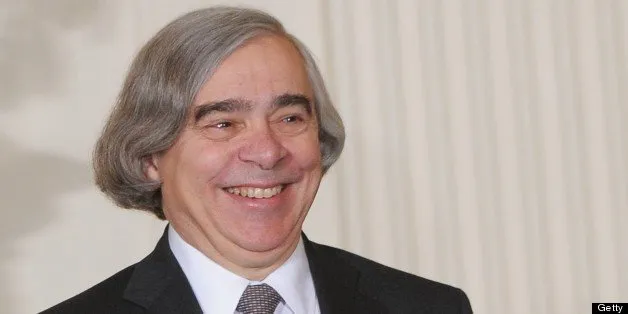
In a Monday morning announcement that was long anticipated but not widely welcomed by environmentalists, President Barack Obama tapped Ernest Moniz, director of the Energy Initiative at the Massachusetts Institute of Technology (MIT), as the nominee for the next secretary of energy.

“Ernie knows that we can produce more energy and grow our economy while still taking care of our air, our water and our climate," Obama said during a press conference on Monday morning announcing Moniz's nomination, along with his other picks, including Gina McCarthy to lead the Environmental Protection Agency.

While some environmental groups cheered the pending nomination, others have expressed deep concern over Moniz due to his outspoken support of hydraulic fracturing for shale gas, better known as fracking. Some critics have gone as far as to call him a "shill" for the shale gas industry.

A 2011 MIT study led by Moniz hailed natural gas as the "bridge to a low-carbon future." The research, as The Huffington Post reported last week, received financial support from oil and gas companies.

Anthony Ingraffea, a professor of civil and environmental engineering at Cornell University, said that the controversial report was just one example of what he calls "frackademia" -- pro-fracking studies coming out of institutions like SUNY Buffalo and the University of Texas at Austin that are later found to have been supported by industry. But MIT, being "the best tech institute in the country and the wellspring of many fantastic people," he said, seems to "get a pass."

Ingraffea's own fracking research comes to a starkly different conclusion -- that natural gas could be a bigger climate-changer than coal. It was largely funded by a foundation that has supported anti-fracking groups.

"No one is alleging that Moniz has personally financially gained directly from moneys from the oil and gas industry for fracking studies," said Ingraffea. However, he added, the study does raise concerns over whether or not any actions were taken that "benefited the people paying, despite knowing those actions were not in the best interest of the public, students, his university or the country."

"It's difficult," he added. "How do you determine that?"

Bill Snape of the Center for Biological Diversity shared similar disapproval with the possibility of a a Moniz-led Energy Department in a February statement.

"We're concerned that, as energy secretary, Ernest Moniz may take a politically expedient view of harmful fracking and divert resources from solar, geothermal and other renewable energy sources vital to avoiding climate disaster," said Snape. "We're also concerned that Moniz would be in a position to delay research into the dangers fracking poses to our air, water and climate."

"His appointment to the DOE could set renewable energy development back years," said a statement released by Food and Water Watch, which also circulated a petition opposing Moniz's nomination.

In addition to fracking, Moniz is also an ardent proponent of nuclear power -- another sticking point among some environmentalists.

Sen. Ron Wyden (D-Ore.) plans to question Moniz on the polluted Hanford nuclear site in Washington State, where waste tanks may be leaking 1,000 gallons of waste per year, reported The Hill. Moniz wrote in November 2011 that "it would be a mistake" to let "Fukushima cause governments to abandon nuclear power and its benefits."

"Nuclear power's track record of providing clean and reliable electricity compares favorably with other energy sources," Moniz wrote.

Still, many environmental experts and advocates have also highlighted Moniz's track record of concern for climate change and emphasis on renewable energy and innovation, and some were hopeful that the nominee's experience and track record would help him accomplish more in the secretary of energy position.

As Obama said on Monday, Moniz "already knows his way around the Department of Energy."

The physicist, well-known for his over-the-ears hairstyle, served as an undersecretary of energy during the Clinton administration. For the past four years, he has served on the President's Council of Advisors on Science and Technology (PCAST).

"Ernie is really a big-picture guy," Rosina Bierbaum, a fellow PCAST member and an environmental-policy expert at the University of Michigan at Ann Arbor, recently told Nature. "He can talk the details of science far better than most of us, but he never ever gets lost in the weeds."

The Natural Resource Defense Council also welcomed the nomination to replace Steven Chu, who plans to return to Stanford, as "good news."

"Professor Moniz has the hands-on experience and the expertise needed to help further the climate and energy goals our country urgently needs," Frances Beinecke, president of the group, said in a statement on Monday.

Moniz's hands may very well be full, and the pressure on him high, as the U.S. faces a series of important decisions that could affect the country's -- and the world's -- future economic, environmental and energy landscapes.

"I have a set of adjectives and nouns to describe the energy business -- it's a highly capitalized, multi-trillion dollar per year commodity business in the sense that when we flick the switch on, we don't see whether it came from a coal plant or solar panel," Moniz told the Switch Energy Project last year. "It serves every activity in society. It therefore does, and always will, invite extensive regulation and very complex politics."

Also on HuffPost:

Loading Slideshow...
  • State Lawmakers And Environmental Activists Express Opposition To Hydro Fracking

    NEW YORK, NY - JANUARY 11: Opponents of hydraulic fracturing in New York state attend a news conference and rally against hydraulic fracturing, also known as fracking, on January 11, 2012 in New York City. The event, which was held on the steps of City Hall, called for an end to the controversial gas drilling method as environmental groups increasingly warn about contamination of the state's aquifers that could poison its drinking water. (Photo by Spencer Platt/Getty Images)

  • State Lawmakers And Environmental Activists Express Opposition To Hydro Fracking

    NEW YORK, NY - JANUARY 11: Eric Weltman of Food & Water Watch attends a news conference and rally against hydraulic fracturing, also known as fracking, in New York State on January 11, 2012 in New York City. The event, which was held on the steps of City Hall, called for an end to the controversial gas drilling method as environmental groups increasingly warn about contamination of the state's aquifers that could poison its drinking water. (Photo by Spencer Platt/Getty Images)

  • Department Of Environmental Conservation Holds Hydro Fracking Hearing

    NEW YORK, NY - NOVEMBER 30: Opponents and supporters of gas-drilling, or fracking, walk into the last of four public hearings on proposed fracking regulations in upstate New York on November 30, 2011 in New York City. Fracking, a process that injects millions of gallons of chemical mixed water into a well in order to release gas, has become a contentious issue in New York as critics of the process belive it contaminates drinking water among other hazards. NewYork City gets much of its drinking water from upstate reservoirs. If the regulations are approved, drilling in the upstate New York Marcellus Shale could begin next year. (Photo by Spencer Platt/Getty Images)

  • Cuadrilla Shale Fracking Plant

    PRESTON, LANCASHIRE - OCTOBER 07: Engineers on the drilling platform of the Cuadrilla shale fracking facility on October 7, 2012 in Preston, Lancashire. The controversial method of extracting gas by pumping high pressure water and chemicals into shale formations deep underground has been blamed for two minor earthquakes in the surrounding region. Environmental campaigners are calling for a halt to the drilling of what Cuadrilla believe could be significant reserves of natural gas. (Photo by Matthew Lloyd/Getty Images)

  • Cuadrilla Shale Fracking Plant

    PRESTON, LANCASHIRE - OCTOBER 07: Engineers at work on the drilling platform of the Cuadrilla shale fracking facility on October 7, 2012 in Preston, Lancashire. The controversial method of extracting gas by pumping high pressure water and chemicals into shale formations deep underground has been blamed for two minor earthquakes in the surrounding region. Environmental campaigners are calling for a halt to the drilling of what Cuadrilla believe could be significant reserves of natural gas. (Photo by Matthew Lloyd/Getty Images)

  • Cuadrilla Shale Fracking Plant

    PRESTON, LANCASHIRE - OCTOBER 07: General views of the Cuadrilla shale fracking facility on October 7, 2012 in Preston, Lancashire. The controversial method of extracting gas by pumping high pressure water and chemicals into shale formations deep underground has been blamed for two minor earthquakes in the surrounding region. Environmental campaigners are calling for a halt to the drilling of what Cuadrilla believe could be significant reserves of natural gas. (Photo by Matthew Lloyd/Getty Images)

  • Cuadrilla Shale Fracking Plant

    PRESTON, LANCASHIRE - OCTOBER 07: Engineers look at the Cuadrilla shale fracking facility on October 7, 2012 in Preston, Lancashire. The controversial method of extracting gas by pumping high pressure water and chemicals into shale formations deep underground has been blamed for two minor earthquakes in the surrounding region. Environmental campaigners are calling for a halt to the drilling of what Cuadrilla believe could be significant reserves of natural gas. (Photo by Matthew Lloyd/Getty Images)

  • Cuadrilla Shale Fracking Plant

    PRESTON, LANCASHIRE - OCTOBER 07: A lump of shale rock on display at the Cuadrilla shale fracking facility on October 7, 2012 in Preston, Lancashire. The controversial method of extracting gas by pumping high pressure water and chemicals into shale formations deep underground has been blamed for two minor earthquakes in the surrounding region. Environmental campaigners are calling for a halt to the drilling of what Cuadrilla believe could be significant reserves of natural gas. (Photo by Matthew Lloyd/Getty Images)

  • Cuadrilla Shale Fracking Plant

    PRESTON, LANCASHIRE - OCTOBER 07: Engineers on the drilling platform of the Cuadrilla shale fracking facility on October 7, 2012 in Preston, Lancashire. The controversial method of extracting gas by pumping high pressure water and chemicals into shale formations deep underground has been blamed for two minor earthquakes in the surrounding region. Environmental campaigners are calling for a halt to the drilling of what Cuadrilla believe could be significant reserves of natural gas. (Photo by Matthew Lloyd/Getty Images)

  • Cuadrilla Shale Fracking Plant

    PRESTON, LANCASHIRE - OCTOBER 07: Engineers at work on the drilling platform of the Cuadrilla shale fracking facility on October 7, 2012 in Preston, Lancashire. The controversial method of extracting gas by pumping high pressure water and chemicals into shale formations deep underground has been blamed for two minor earthquakes in the surrounding region. Environmental campaigners are calling for a halt to the drilling of what Cuadrilla believe could be significant reserves of natural gas. (Photo by Matthew Lloyd/Getty Images)

  • Cuadrilla Shale Fracking Plant

    PRESTON, LANCASHIRE - OCTOBER 07: Drill heads on display at the entrance to the Cuadrilla shale fracking facility on October 7, 2012 in Preston, Lancashire. The controversial method of extracting gas by pumping high pressure water and chemicals into shale formations deep underground has been blamed for two minor earthquakes in the surrounding region. Environmental campaigners are calling for a halt to the drilling of what Cuadrilla believe could be significant reserves of natural gas. (Photo by Matthew Lloyd/Getty Images)

  • Cuadrilla Shale Fracking Plant

    PRESTON, LANCASHIRE - OCTOBER 07: An engineer displays a lump of shale rock at the Cuadrilla shale fracking facility on October 7, 2012 in Preston, Lancashire. The controversial method of extracting gas by pumping high pressure water and chemicals into shale formations deep underground has been blamed for two minor earthquakes in the surrounding region. Environmental campaigners are calling for a halt to the drilling of what Cuadrilla believe could be significant reserves of natural gas. (Photo by Matthew Lloyd/Getty Images)

  • Hydraulic Fracturing Prevention Press Conference

    NEW YORK, NY - APRIL 25: Actor/director Mark Ruffalo (C) speaks at the Hydraulic Fracturing prevention press conference urging the protection of the drinking water source of 15 million Americans at Foley Square on April 25, 2011 in New York City. (Photo by D Dipasupil/Getty Images)

  • Hydraulic Fracturing Prevention Press Conference

    NEW YORK, NY - APRIL 25: (L-R) Actor/director Mark Ruffalo, Denise Katzman, Wenonah Hauter, and Water Defense co-founder/campaign director Claire Sandberg attend the Hydraulic Fracturing prevention press conference urging the protection of the drinking water source of 15 million Americans at Foley Square on April 25, 2011 in New York City. (Photo by D Dipasupil/Getty Images)

  • Josh Fox on Obama, the EPA, and House Republicans Who Had Him Arrested

    HuffPost Green Editor Joanna Zelman talks to Josh Fox, director of the documentary 'Gasland,' about hydro-fracking, the EPA, and the House Republicans who had him arrested during a Congressional hearing.

  • Game Changer in Green: Mark Ruffalo

    The expertise and the grassroots zeal Mark Ruffalo has brought to the issue of fracking is changing the game in green.