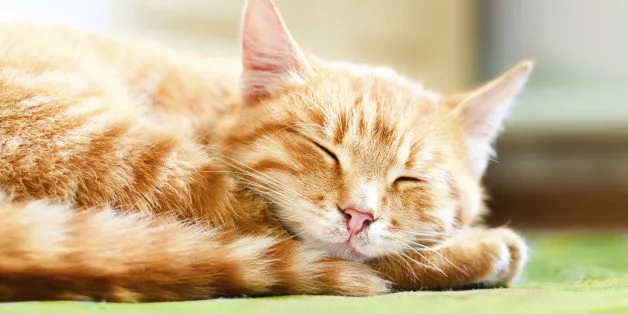
Forget feeling sluggish and wasting time cyber-loafing today. Instead, celebrate National Napping Day, an unofficial holiday -- really, a gift -- that acknowledges that, yes, we are all feeling a little sleepy today after turning the clocks forward this weekend.
We have Boston University professor William Anthony, Ph.D. and his wife Camille to thank for creating National Napping Day in 1999. "Our goal is to encourage folks to take a nap wherever they may be, at home, at the workplace or on vacation, and to make it a regular part of their healthy lifestyle," Anthony said in a statement. "It is a day when nappers all over the country need to lie down and be counted."
Of course, sleep in general has a wide range of health benefits, from protection against heart disease and obesity to stronger bones and memory. But napping has some particular perks all its own. Below are six healthy reasons to indulge in a siesta today. It doesn't have to be long -- even just 20 minutes of daytime shut-eye can make a world of difference.
Napping Boosts Alertness
Once you blink away those first few seconds of grogginess after a nap, you're likely to benefit from a boost of alertness. A NASA study found higher measures of alertness in pilots after a 40-minute snooze, compared to pilots who got no rest. Even just 20 minutes has been shown to perk up shift workers, according to Harvard Men's Health Watch. One very small study found that even after just a 10-minute nap, study participants reported at least feeling more alert.
Napping Improves Learning And Memory
It's the deeper rapid eye movement (REM) sleep that's been linked with the cognitive process, so it's no surprise that it takes a longer nap to reap real brain benefits. But if you can squeeze in an hour, or even 90 minutes, you may find your mental fatigue has vanished upon waking. A longer nap is likely to leave you slightly more groggy, but can have a longer benefit to brain power after the fact, according to a 2010 Australian study. In fact, fMRI scans have shown that brain activity remains higher in nappers all day compared to people who don't take a rest, according to a 2008 study.
Napping Increases Creativity
Ever woken up suddenly knowing the solution to what's bugging you? A team of researchers set about monitoring the brain to attempt to figure out why the lightbulb turns on after napping. They discovered a burst of activity in the right hemisphere, the side most strongly linked to creativity, Health.com reported. An earlier study found that longer naps that allowed sleepers to enter REM led to better performance on a series of creative word problems, National Geographic reported.
Napping Boosts Productivity
Experts agree that an afternoon nap is in fact the opposite of laziness in the workplace: That siesta can actually improve work output. A short power nap can be just the right pick-me-up for sleep deprived, worn-out employees, sleep researcher Sara Mednick told Businessweek, maybe even more so than an afternoon cup of coffee, Prevention reported.
Napping Lifts Your Spirits
Think back to the last time you were around a toddler who hadn't napped. It's not a pretty picture, is it? Sleepiness and the associated crankiness doesn't feel good, even as adults (we've just learned not to throw tantrums about it ... for the most part). A quick nap is a well-documented mood booster, not that you needed any scientific research to tell you so.
Napping Zaps Stress
Part of the reason a nap can get you smiling might be related to relaxation. The sheer luxury of escaping for a nap can be a great stress-reliever, even if you don't sleep for long (and as long as you don't let the stigma against napping get to you). The National Sleep Foundation recommends considering it "a mini-vacation." And don't stress if you can't actually doze off in your allotted 10 minutes: A 2007 study found that asleep or not, a short period spent resting in bed is just as relaxing.
Convinced? Here are some expert tips for how to take a nap at work from Dr. Lawrence Epstein and James Maas, Ph.D.:
Loading Slideshow
To Nap Or Not To Nap?
If you've got a big project you have to really focus on, or especially if you have to drive, hit the hay. If the rest of the workday looks like smooth sailing, or you often have trouble sleeping at night, skip the nap.
"Naps are sort of a double-edged sword," warns Dr. Epstein. "If you're indeed sleepy and it's going to interfere with your performance, the best way to get over that is to go to sleep. But if you have trouble sleeping at night, taking a nap can be a problem, because if you sleep in the daytime you won't sleep at night."
You've also got to be tired enough to fall asleep during the day. "Well-rested people don't have the ability to power nap and that's great," says Maas. "It's much better to get good nocturnal sleep and not be able to than to <em>have</em> to power nap. While we do have a natural dip in our circadian rhythms that usually occurs in the afternoon, that is exacerbated by not having good nocturnal sleep."
What's The Best Time For A Nap?
Because of the natural cycles of our circadian rhythms, we are at our most tired twice during a 24-hour period. One peak of sleepiness is usually in the middle of the night, so the other, 12 hours later, falls smack-dab in the middle of the afternoon. "It's not that [there's] a good time to get the nap, it's that's the time you're going to be sleepy," explains Dr. Epstein. "It's a physiologic basis for a siesta," he says, and also why so many of us feel a slump around that time and head for the coffeemaker.
If you get enough sleep at night, chances are you won't be bothered by the mid-afternoon peak of sleepiness. But if you're sleep-deprived, you'll feel that "sleep debt" greater in the afternoon, and be more inclined to nap.
Where Should You Nap?
"The more comfortable you can get, the easier it is to fall asleep," says Dr. Epstein. That could mean closing your office door and dimming the lights, or finding an unused conference room, parking yourself on a common area couch, or even just putting your head down on your desk, he says.
But sleep-chasers should also get creative. Many large companies, especially in their headquarters, have infirmaries or other first-aid offices. Maas suggests calling to see if they have any available beds. Or, in warm climates, lie down for a few minutes on a bench outdoors. Desperate? "Even restrooms give you an opportunity to sit for 10 minutes," he only half-jokes.
Better still, try heading out for a nap on your next "lunch" break -- no one has to know you're not actually eating! "A lot of workers are kind of sneaky in these naps, they'll go out to the parking lot and take a quick snooze," says Maas, but most are allowed (if not legally required) to take a break during the day. Or, head to a local spa that provides nap rooms for a fee. Locations are popping up <a href="http://money.cnn.com/2008/08/21/smallbusiness/naps_for_sale.fsb/index.htm" target="_hplink">in numerous cities</a>, reports CNN Money.
What Else Do You Need?
The same sleep hygiene rules apply to naps as to nighttime rest, namely that you want the environment to be quiet, dark and cool, says Maas. That might mean bringing an eye mask or ear plugs to work, he says, especially if you're opting for a nap on a communal couch.
How Long Should You Nap?
Maas's definition of the power nap calls for only 10 to 15 minutes of rest, but Dr. Epstein says even up to 30 can still be beneficial. However, sleep much longer than that and you'll enter deep sleep, leaving you feeling groggy when you wake up, warns Maas.
If you really need more than 15 minutes of shuteye, you're better off shooting for a full 90 to guarantee waking up feeling refreshed, as that's how long it takes your body to complete an entire REM cycle, he explains. So set a cell-phone alarm and then get back to business.
Should You Skip Caffeine?
"Caffeine acts as a way to avoid sleepiness, but it's not a replacement for sleep," says Dr. Epstein. If you have a big project to focus on in the afternoon, caffeine can help you power through the work, but it won't do anything to chip away at your sleep debt, he explains. Plus, if you resort to caffeine too late in the day you risk messing with your nighttime sleep.
As long as you're four to seven hours away from bedtime, there's no real need to skip your afternoon pick-me-up, even if you're going to steal away for some zzz's. In fact, <a href="http://www.sciencedaily.com/releases/2010/05/100511192248.htm" target="_hplink">caffeine can even improve your performance</a> later in the day. It takes some time for the caffeine to kick in, so some experts suggest what's been dubbed a "caffeine nap" -- drinking a cup of coffee before a 20-minute nap, then waking up to "maximum alertness," says Dr. Epstein.
Boss Won't Go For It?
Smart, educated companies are catching on to the fact that sleepy employees are bad for their bottom line and promoting short breaks as a potential solution.
If your boss is at the other end of the spectrum, presenting the facts might be a good idea. Many corporations are already promoting preventive health and wellness programs focused on exercise and nutrition, says Maas, so why not add sleep? "They've got to realize that there are three things that determine longevity: nutrition, exercise we're already doing a lot about, but we're totally ignoring the third component, which is sleep," says Maas. "Sleep is treated as a luxury in American society, and it's a necessity."
Related Video
Posted: 03/11/2013 8:37 am EDT | Updated: 03/11/2013 5:07 pm EDT