There is a strong
supporting the scientific Theory of Global Warming and these key points:
- There is warming.
- Humanity is contributing to that warming.
- This warming will create significant harm if left unchecked.
While scientific "debate" always continues and there are debates over many elements within and around climate science (How fast will the Arctic Ice melt? Is there a point of no-return where humanity will no longer be able to avert catastrophic climate chaos? Is Global Warming fostering more tornadoes? Etc ...), the scientific community has a very solid understanding of and agreement about the basics. That strength of agreement, if truly understood by the political elite and public, creates serious challenge for those seeking to forestall action to mitigate climate change. Thus, when hearing of "consensus," we often hear from
that there is great uncertainty and that we should
(
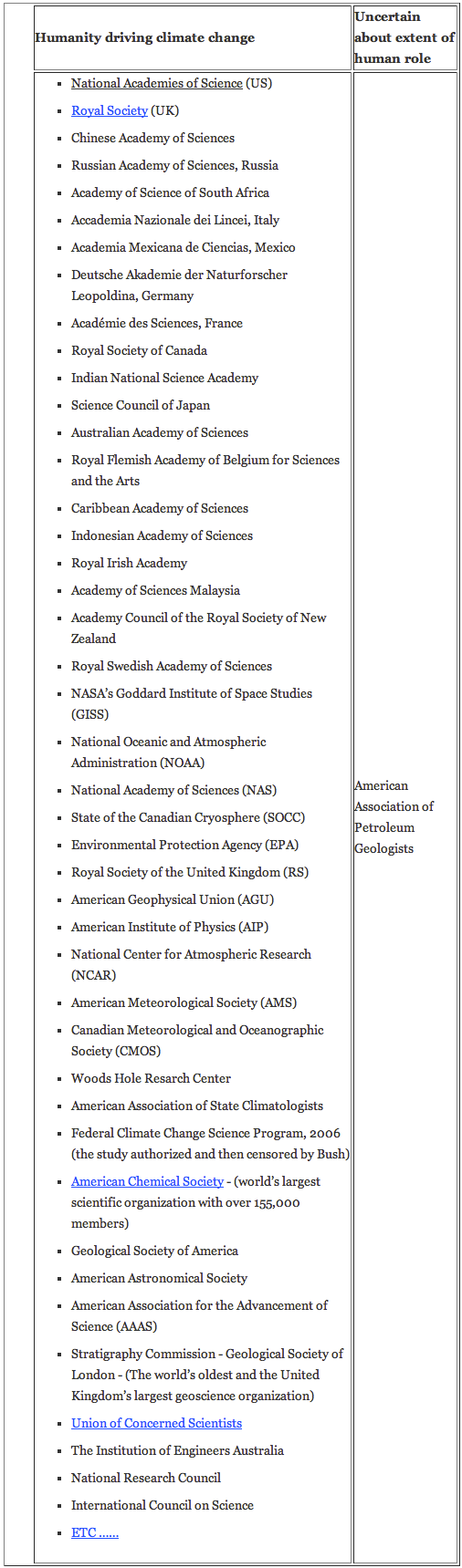
). Here is a rather simple table to use to consider the extent of that "debate."
Table 1: Professional Societies and Major Relevant Research Institutions on whether humanity is driving climate change
Consider a simple truth about the incredibly complexity of issues, interconnections, and feedback patterns/cycles in these interactions of energy and climate change issues:
anyone who asserts that they know everything about energy and climate change, definitively, and knows every single answer is, well, simply not someone worth listening to about these complex domains.
Thus, a critical skill set is developing a sense as to who to trust and who is untrustworthy for consideration.
And, this "skill set' can be used as a guide for where one might have uncertainty.
,
and author of the highly recommended
, laid a hierarchy of authorities for considering a difficult subject area where one might not be expert but where you wish to figure out an answer via the thoughts and opinions of others. Quite roughly, in order, you could have from high (implicit) to lower (need to be confirmed) trust as follows:
- Professional societies
- Government Reports
- University Research Programs
- Think Tanks
- Advocacy Organizations
- Individual Professionals
- Individual Lay People
And, if an institution speaks in a way that contradicts its normal bias (like a tobacco company stating that smoking tobacco causes cancer or a fossil-fuel company stating that CO2 is a major threat to humanity and we need to reduce the burning of fossil fuels), then it should be given stronger weight.
Craven lays out why professional organizations are at the top of the credibility spectrum:
professional societies are organizations that exist not to advance a particular agenda but to simply serve the communication and training needs of a particular profession. ... With these groups, bias and political leanings are going to be small as can be expected in any human endeavor.
The level of expertise is fairly high because these groups are made up of people who know more about the field than anyone else; furthermore, fur such an association to come out with a statement, most of the members would need to agree with it, so what you're getting is general agreement from a whole bunch of experts -- no small thing. And, the longer an organization has been around or the mroe prestigious it is, the bigger the reputation it has to protect. You can be fairly confident that an organization has been quite thorough in making sure it doesn't say something that later makes it look silly.
Now, "argument from authority" is a touchy subject. Just because the American Medical Association says today that X causes Y disease doesn't mean that it won't turn out that further research will uncover that X is unrelated to Y. Even so, when trying to figure out how to avoid Y disease, today, would we find it more likely that the AMA or a community glee club would have more relevant information and advice? "Authority" doesn't mean certainty but, as Craven lays out, there are reasons to give some credence to such perspectives.
To apply this hierarchy of credibility, the first section might be laid out like this:
Table 2: Structuring a Table re authorities re humanity have a role in driving climate change
Table 1 above is an attempt at filling in Table 2.
And, with that truly independent association of people who have zero interest in perpetuation of a fossil fuel economy standing out as a clear exception, how does the Association of American Petroleum Geologists (AAPG) introduce its recommendations about climate change?
In the last century, growth in human population has increased energy use. This has contributed additional carbon dioxide (CO2) and other gases to the atmosphere. Although the AAPG membership is divided on the degree of influence that anthropogenic CO2 has on recent and potential global temperature increases, AAPG believes that expansion of scientific climate research into the basic controls on climate is important.
And, for those who still are wondering 'but what about all those scientists who challenge that consensus,' spend a few moments with Peter Sinclair looking at 32,000 (pseudo-)scientists challenging those institutions in the first column:
MUST READ! Massively powerful LA Times editorial on climate science education.
Our 2024 Coverage Needs You
It's Another Trump-Biden Showdown — And We Need Your Help
The Future Of Democracy Is At Stake
Our 2024 Coverage Needs You
Your Loyalty Means The World To Us
As Americans head to the polls in 2024, the very future of our country is at stake. At HuffPost, we believe that a free press is critical to creating well-informed voters. That's why our journalism is free for everyone, even though other newsrooms retreat behind expensive paywalls.
Our journalists will continue to cover the twists and turns during this historic presidential election. With your help, we'll bring you hard-hitting investigations, well-researched analysis and timely takes you can't find elsewhere. Reporting in this current political climate is a responsibility we do not take lightly, and we thank you for your support.
Contribute as little as $2 to keep our news free for all.
Can't afford to donate? Support HuffPost by creating a free account and log in while you read.
The 2024 election is heating up, and women's rights, health care, voting rights, and the very future of democracy are all at stake. Donald Trump will face Joe Biden in the most consequential vote of our time. And HuffPost will be there, covering every twist and turn. America's future hangs in the balance. Would you consider contributing to support our journalism and keep it free for all during this critical season?
HuffPost believes news should be accessible to everyone, regardless of their ability to pay for it. We rely on readers like you to help fund our work. Any contribution you can make — even as little as $2 — goes directly toward supporting the impactful journalism that we will continue to produce this year. Thank you for being part of our story.
Can't afford to donate? Support HuffPost by creating a free account and log in while you read.
It's official: Donald Trump will face Joe Biden this fall in the presidential election. As we face the most consequential presidential election of our time, HuffPost is committed to bringing you up-to-date, accurate news about the 2024 race. While other outlets have retreated behind paywalls, you can trust our news will stay free.
But we can't do it without your help. Reader funding is one of the key ways we support our newsroom. Would you consider making a donation to help fund our news during this critical time? Your contributions are vital to supporting a free press.
Contribute as little as $2 to keep our journalism free and accessible to all.
Can't afford to donate? Support HuffPost by creating a free account and log in while you read.
As Americans head to the polls in 2024, the very future of our country is at stake. At HuffPost, we believe that a free press is critical to creating well-informed voters. That's why our journalism is free for everyone, even though other newsrooms retreat behind expensive paywalls.
Our journalists will continue to cover the twists and turns during this historic presidential election. With your help, we'll bring you hard-hitting investigations, well-researched analysis and timely takes you can't find elsewhere. Reporting in this current political climate is a responsibility we do not take lightly, and we thank you for your support.
Contribute as little as $2 to keep our news free for all.
Can't afford to donate? Support HuffPost by creating a free account and log in while you read.
Dear HuffPost Reader
Thank you for your past contribution to HuffPost. We are sincerely grateful for readers like you who help us ensure that we can keep our journalism free for everyone.
The stakes are high this year, and our 2024 coverage could use continued support. Would you consider becoming a regular HuffPost contributor?
Dear HuffPost Reader
Thank you for your past contribution to HuffPost. We are sincerely grateful for readers like you who help us ensure that we can keep our journalism free for everyone.
The stakes are high this year, and our 2024 coverage could use continued support. If circumstances have changed since you last contributed, we hope you'll consider contributing to HuffPost once more.
Already contributed? Log in to hide these messages.