USA Today reported today that the number of volunteers in America dropped by 600,000 from last year, bringing the national volunteering rate down by a half a percentage point, to 26.3%. The data was from Volunteering In America, a government website that tracks and reports on -- what else? -- volunteering in America. Last week, we got the new jobs numbers out, and although they weren't as cringe-inducingly dismal as expected, they still mean we have an unemployment rate at 9.1% This got me thinking, if more of us are unemployed, then shouldn't we have more spare time to do other things, like volunteering in our communities?
Volunteerism: it's not a function of spare time!
For a number of reasons, I don't really like to track the unemployment rate, but rather the civilian labor force participation rate. This is a measure of everyone of working age that is either actively employed or seeking employment. It doesn't include students, retired people, stay-at-home parents, people in prisons, informal workers, or people who have given up looking for work. According to the Bureau of Labor Statistics the current U.S. participation rate stands now at 63.9%. This is as low as it's been in the past 30 years. This means that more Americans (about 36% of us) are not working and not looking for work than anytime since the early 1980s. One might think that working-age Americans have more time on their hands than usual.
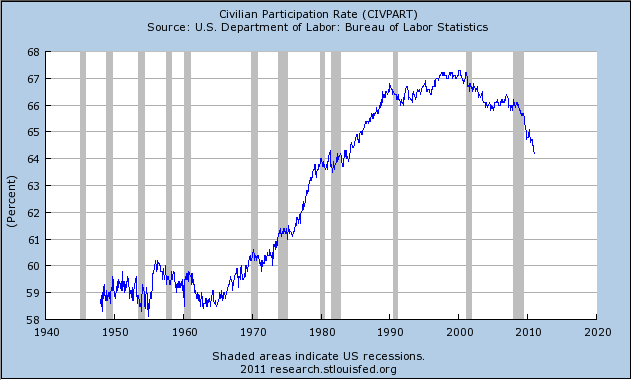
So, given that (1) there are a lot of Americans suffering in the current economy (2) both State and Federal governments are pulling back resources from social programs, and (3) it would appear that Americans have more time than usual to volunteer, shouldn't we expect to see rates of volunteerism up?
According to Volunteering In America, the national volunteer rate now stands at 26.3%. This is down from 28.8% in 2003, 2004, and 2005. In other words, there are over 2.5 million fewer Americans volunteering today than just six years ago. What's going on? Do people just volunteer less when they are unemployed?
According to the Bureau of Labor Statistics, that's exactly what's going on. In a report released earlier this year, between 2006 and 2010, employed people volunteered at a rate 6-7 percentage points more than unemployed people. So, we shouldn't be too surprised then that we see rates of volunteerism falling as unemployment rates increase.
If we were to graph unemployment rates and rates of volunteerism together, they'd make an "X", which reminds me, you should read my other post from today, "Generation X -- the heroes of volunteerism in America."
Follow Aaron Ausland on Twitter: www.twitter.com/AaronAusland
I wish I had the luxury. The places I used to volunteer and donate to really want no part of the unemployed/underemployed because we need the services now. There is major discrimination against both groups by volunteer agencies.
I'm afraid you've been unnecessarily offended. You raise a very important point, which is that those who are looking for work are in fact participating in the labor force, they just don't have a paying job yet. This is actually one of the main reasons I used the Civilian Labor Force Participation rate instead of the unemployment rate in my analysis. The CLFP rate includes both those who are working and those seeking work, while excluding a whole bunch of other people, (people not of working age, stay-at-home parents, people who've given up on looking, etc.) In other words, the issue you raise is taken into account by the data I used.
1. Many, many people have divested themselves from using the word "volunteer" in favor of other terms such as pro bono work, community service, etc. So respondents to surveys talking the language of "volunteer" often self-edit themselves out, even though they do many things in the community without pay (just consider where the Web would be without unpaid bloggers or open source programmers, for example). People do many things for their kids which help all kids in the neighborhood, such as youth sports coaching, but are likely to consider this good "parenting" rather than volunteering.
2. When we collect data on employment, we ask EMPLOYERS about their hires. But when we research volunteering, we ask INDIVIDUALS if they volunteer. The data from those surveys is never balanced with information from nonprofit and government agencies about how many volunteers they "have."
Anecdotally, I and most of my colleagues in volunteer leadership roles, have always seen an increase in volunteering during bad economic times. Look at this site for all the articles in the past year about how job seekers find volunteering a great thing to fill a gap on their resumes and to keep them active while looking for paying work.
As for your anecdotal evidence, well, statisticians and economists have all sorts of sayings for that, but none are as clever as the bikini, so I won't bother. But, you can imagine the point of them, you don't have to discount the truth of anyones experience, but discounting any extrapolation from a data set of n=1 is pretty standard fare, as compelling as the story may be.
That said, as a point of interest, what sort of volunteering are we talking about? And why do you think it bucks the trend (assuming the trend I presented here is true)?