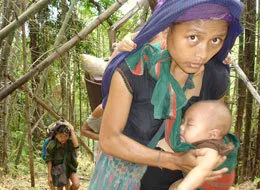
On its sixtieth anniversary, the Universal Declaration on Human Rights is still a distant dream for most of the world's girls and women. One in every three women in the world experiences violence in her lifetime just because she is a woman. In Africa, three million girls are at risk of female genital mutilation, and ten million girls worldwide face early and forced marriage each year.
While gender gaps in education have recently been closing, 70% of children not in school are girls, and sex discrimination pervades most other sectors. For example, only 16 % of parliamentarians worldwide are women.
Nowhere are violations of women's human rights greater than in the health sector. Half a million women die and 10-15 million are permanently disabled each year from entirely preventable causes related to pregnancy and childbirth. In Sub-Saharan Africa, the lifetime risk of dying in childbirth is more than 300 times higher than in rich countries. The health impacts of poverty and injustice are not distant challenges: the United States ranks 41st in the world in maternal mortality, behind Latvia, Portugal, and Poland. In Sub-Saharan Africa, over 60 percent of adults, and 75 percent of young people, living with HIV/AIDS are female.
Eleanor Roosevelt, architect of the Universal Declaration on Human Rights, understood that such daily violations of the rights to life, dignity, and equality are the core human rights challenge. In 1958 she said,
"Where, after all, do universal human rights begin? In small places, close to home... the neighborhood... the school... the factory, farm, or office... Unless these rights have meaning there, they have little meaning anywhere."
But countries and the international system have only paid lip service to Eleanor Roosevelt's wisdom. Over a dozen United Nations agreements have elaborated in detail the human rights of women and actions required to protect them. In 1979 the Convention on the Elimination of the Discrimination Against Women (CEDAW), a legally binding treaty, took effect and has been ratified by all but eight of the world's governments, including, unfortunately, the United States.
In 1993, the World Conference on Human Rights again recognized the human rights of women and of the girl child and said that they are "priority objectives of the international community." Two years later, at the Fourth World Conference on Women, First Lady Hillary Rodham Clinton nonetheless felt compelled to point out once more that "Women's rights are human rights."
So what is the way forward?
Based on decades of international work, we know that there will be no global peace or security until we secure every woman's right to a just and healthy life. Only healthy women whose human rights are protected can be fully productive workers and effective participants in their country's political processes. Only when women are healthy and empowered can they raise and educate healthy children. These are imperative in their own right, and also the building blocks of stable societies and growing economies.
How do we get there?
President-elect Barak Obama has the unique opportunity, and the profound responsibility, to reestablish U.S. credibility and global leadership on human rights for all. The first step is to help strengthen the United Nations as a vehicle to hold governments accountable for human rights protection and for meeting unfulfilled commitments to girls and women. Second, the United States can once again lead the world in making access to comprehensive reproductive health services a reality for women and young people here in the United States and globally.
Only when women are able to exercise control over their bodies are they able to fully realize other human right such access to education and employment, political participation and legal equality. Third, the new President should prioritize asking the Senate to ratify CEDAW. Finally, the United States, at home and abroad, can enable new generations to live the principles of the Universal Declaration on Human Rights. A key vehicle is comprehensive sexuality education, which teaches young people how to establish equality in relationships; respect the right to consent in both sex and marriage; and end sexual coercion and violence against women.
The next Administration will have the opportunity and the power to make these changes and to create a different kind of world for millions of girls and women, boys and men. It will take courage and vision to act boldly. The reward -- in lives saved and in our restored reputation as a global leader for social justice -- will be incalculable.