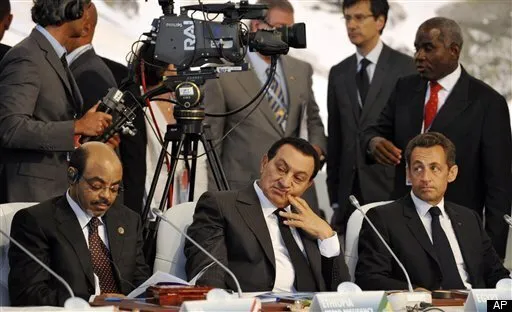
As President Mubarak is in a hospital in Germany with no apparent successor, Egyptian Americans call upon President Obama to re-evaluate American/Egyptian relations.
Today, Egypt is at dangerous crossroads. As Mr. Mubarak is in his 29th year in power and unfortunately, Egypt's future is more uncertain than ever.
There are serious concerns about the grave human rights abuses, rampant poverty leading to food riots, alarming unemployment figures, institutional corruption, and crushing inflation.
During Mubarak's rule, disparity between the classes increased leading to a small elite controlling power and the economy, while the majority of Egyptians are struggling to make ends meet. Hopeless Egyptian youth, more than 40 %, can neither afford to rent nor purchase an apartment, let alone marry. This dangerous phenomenon is at the roots of young men recruitment by violent fanatic groups.
Egyptian state media is rife with anti-Americanism. Former American ambassadors Edward Walker and Daniel Kurtzer warned against the duality of the Egyptian government that blames everything on the U.S.A. while claiming to be fighting extremism. The Egyptian government's cracking on all signs of dissent has led to a political void that is filled by extremist elements.
Mr. Mubarak and his ruling party cannot shirk accountability as they hold more than 90% of the seats in the Egyptian Parliament with nominal opposition. Unlike Nasser and Sadat, Mr. Mubarak refused to appoint a vice-president and is grooming his son Gamal to be his successor, a mockery of the Egyptian Republic system and democratic principles. If his son takes over, Egyptians fear he would continue his father's policy of enriching the elite, suppressing the poor, while ignoring effective reform. Under the Emergency Law, Mubarak turned Egypt into a police state and managed to rig every election.
In its 2009 Human Rights Report, the State Department criticized the Egyptian regime for lack of freedoms of press, association, and religion. The regime continues to restrict civil liberties, particularly freedom of speech, access to the Internet, and freedom of assembly, and stifling civil society.
In his inaugural speech, President Obama spoke against "those leaders who seek to sow conflict, or blame their society's ills on the West: and cling to power through corruption and deceit and the silencing of dissent". These words accurately describe the current Mubarak regime. The regime is on a similar crash course similar to Iran's Shah, the Philippines' Marcos and Indonesia's Suharto. The U.S. is facing looming dangers in the largest Arab country. President Obama should recognize that old allies of the U.S. should commit themselves to genuine reforms.