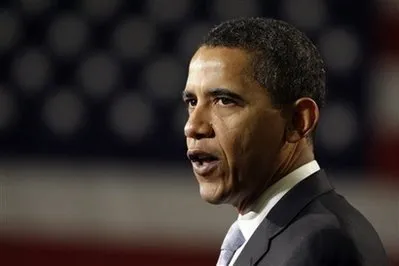
The United States and the world economy have been declining for the last year, with rising unemployment rates. It is widely believed the government must "do something." Many call for a "stimulus program", and President Obama just announced a $800 billion stimulus plan. Already staring at a $1.2 trillion dollar deficit for the year, about 8% of the entire U.S. economy, the resulting deficit would be twice as large as anything we have seen since World War II.
So it begs the question, what does "stimulus" mean and what does it really do?
Economist John Maynard Keynes posited a theory that the economy can be boosted if the government borrows money and spends it, circulating it through the economy and thus stimulating it back to life.
But this theory has a conspicuous logical fallacy. It ignores the fact government can't put money into the economy without first taking money out of the economy. Because the government needs to borrow the money it uses for the stimulus plan, it follows that rather than boosting national income, it merely redistributes it. This is analogous to taking water from the deep end of a pool and putting it into the shallow end. It creates busy work and the illusion of action, but actually produces nothing while sapping the economy of resources that would otherwise be used advantageously.
Furthermore, not just theory but the evidence also shows that Keynesianism does not work. Both Hoover and FDR increased spending and ran large deficits, yet the economy did not get better for more than a decade. In fact, in May 1939, Treasury Secretary Henry Morgenthau testified:
"We are spending more money than we have ever spent before, and it does not work. ... We have never made good on our promises. ...after eight years of this administration we have just as much unemployment as when we started ... and an enormous debt, to boot."
The Gerald Ford and George W. Bush administrations also tried ratcheting up government spending, to no avail. Similar methods were also tried in Japan during the 1990s, and caused Japan's lost decade.
Economic growth occurs when there is an increase in national income, not a redistribution of it. That is why lower marginal tax rates are the best strategy to achieve growth. Ronald Reagan cut taxes by 25%, and triggered the economic success of the '80's. The Kennedy tax cuts of the '60's were highly successful. Calvin Coolidge cut tax rates from almost 70% to 25%, and it created the prosperity of the '20's.
So if our government has money to spend, it is far better to suspend all personal income tax for six months. That will cost about $700 billion, less than Obama's stimulus plan, and create an unprecedented flurry of economic activity. And people will be spending their own money, rather than government bureaucrats doing it for them. That is more appropriate as a matter of principle, and more effective as a practical matter, as the money will surely be put to better use.
Ask yourself: If spending $800 billion would jump start the economy, why not spend ten times as much, and really get the economy going? It is obvious the logic is severely challenged here.
And ponder this: if you assume that about 100 people in Washington are going to have meaningful input in the decision on how to spend this enormous stimulus of $800 billion, then on average each person is responsible for spending about $8 billion of our money. Can anyone in government spend that much money, $8,000 from every US household, more wisely than the average American would spend it? I simply do not believe that, and I also reject the morally dubious concept of taking people's money and spending it on their behalf, supposedly for their own good.
It makes sense to rely on private enterprise and not on government as the engine of growth. The US always did best when the government shrank, and worst when it grew. If big government was the way to economic prosperity, than France should have been a financial powerhouse, and Hong Kong should have been a basket case. But of course it is exactly the opposite.
Spending is the problem that caused this crisis in the first place. We cannot fix the problem using more of its root cause. Other than that, the President unfortunately cannot do much, and shouldn't work himself into an unnecessary frenzy. As Michael Gerson eloquently put it in one of his Washington Post columns, "American presidents have few levers long enough to shift a continental economy. During an economic winter, they shovel the snow -- and then take credit for the spring."
Alan Schram is the Managing Partner of Wellcap Partners, a Los Angeles based investment firm. Email at aschram@wellcappartners.com.
|
|
Warren Buffett: US In "Economic Pearl Harbor"
OMAHA, Neb. — Billionaire investor Warren Buffett says the U.S. is engaged in an "economic Pearl Harbor." In an interview that aired Sunday on "Dateline...
|
|
|
Wall Street Falls Amid Fears Of Spreading Banking Crisis
NEW YORK — The dawn of the Obama presidency could not shake the stock market from its dejection over the rapidly deteriorating state of the...
|
I see this all over the internet.
Why would Morgenthau say this in 1939 if FDR didn't take office until 1933? Couldn't the Treasury Secretary subtract 33 from 39 and get 6?
Or is the quote a fabrication?
If you can get these 25% to work and do something productive through government spending, and all the stastical historical analysis proves this.
laissez-faire has failed, stopped trying to manipulate people with less economic understanding than yourself. I'm surprised you didn't try to push tax cuts for the rich...
My family still has a job, and could (realistically) afford to spend money. I haven't spent almost anything in over a year, and don't expect to do so in the future (regardless of whatever tax rebate you give me).
Only fools would spend any money they received from a tax cut. Unless there is some expectation that the govt will not only work to insure that people have jobs, but that unemploymnet, food stamps, etc., will be enough to keep your children from going hungry, why would you spend an extra dollar that you find in your paycheck? My husband's longevity pay "bonus" - in the bank. Any overtime money - in the bank.
And rich people don't care a whit about the economy that affects the rest of us. Give them a tax cut and they will simply go out and buy stocks because they are so cheap. That may increase stock prices, but no one - small business, major corporations, etc. - is going to hire anyone extra unless their products are selling. And again, regular people are not buying - products or your argument.
With a tax cut, most folks aren't necessarily going to buy more things. Some will, yes. But I think most people would save since so many folks have gotten caught short this time around or they might repay some debt.
In both cases, it would mean the banks would get the funds that they would then borrow to buy more banks which they aren't supposed to be doing now with gov't bailout funds.
A redistribution of wealth through increasing of taxes on the rich may be the best short term solution.
/quote
When you consider that money from the Treasury generally goes through the Fed, as *loans* to major banks; and when you consider that the largest industries are heavily subsidized whenever business is down -- think petroleum and agriculture -- the "redistribution" you mention is more like "restoration" of wealth to its rightful owners, those of us who created it by our productive work.
I think Krugman has the better arguements. But then, I lean progressive anyway.
The analogy that a stimulus package takes water from the deep end of the pool to put in the shallow end is absolutely correct. And that's the basis of every dam, water or irrigation project ever created. You take the water from where it is, and move it some to where it isn't.
And guess what? It works! These projects turn deserts into farms, allow cities to grow and prosper, and floods to be controlled.
An economic stimulus takes money from the deep pockets, like hedge fund managers, and puts in places where society as a whole will actually benefit from it .
Check a source from someone else's head. Assuming you know someone else.
They are always the 'smartest' people in the room,... excpet when they are not,...
The writer has to trim back the Hedge so he can see what's happening on the other side. I wonder how much his last office remodelling cost?
The problem with your argument is that you ignore your own reasonably modest definition of Keynesian stimulus. You think (ironically like some on the Left) that adherents believe it solves all the systemic problems with the free market. Government spending at the rate proposed is a crappy solution, I will concede, save for the possible exception of everything else.
Also, why do you completely ignore the mortgage securitization and leveraging in you diagnosis of our current malaise?
You maintain that spending caused this problem...and it did to an important extent, but HOW we spent over the last eight years is not addressed, and that is crucial. We spend billions on contractors who have outsourced their HQs and pay little or no taxes.
Your historical examples are very leaky, and the France/Hong Kong example proves nothing. What I understand least is why you are so reflectively antagonistic toward the government. The bottom line is that most developed, prosperous, market-based economies in this world have strong central governments as partners, who spend money on the right things at the right times. Private enterprise will not and should not do many difficult jobs. Private enterprise is insufficiently capitalized to do many others.
Please tell me how building/repairing bridges and running more power lines is going to help anyone not already in that business? By hiring the unemployed? Are you gonna move your family to work in a dangerous industry? Sell your house and move?
We have seen the rich put money away or invest only in get richer faster markets. Whereas the rest of us squirrel a little away, pay the bills and maybe treat ourselves to the occasional nicety like a move or dinner.
In the 50's and 60's, tax rates were extremely high compared to today's standards. The deficit remained stable and growth rates averaged 4.4%--a standard of growth we have not duplicated since.
Growth, as measured by GDP, dropped in the '70's due to an oil shortage and a spike in oil prices. Despite the account above, growth under Reagan was no better than during the '70's even though oil became plentiful and cheap.
George W. slashed taxes and growth during the first four years of his administration (the good four years) was an extremely anemic 2.4%.
More tax cuts anyone?
All booms must be followed by a bust.. The rupture in the derivatives and paper markets have caused the banks to be undercapitalized. It's all about risk, and risk was either undervalued or taken off the balance sheets to increase leverage. Since the rating was based on models of growth and asset appreciation, we are in a collapse. It is a crisis of both solvency and liquidity. Printing more money will end up being inflationary. Keynes thought that his policies would work best under the German regime in the 1933's because government control was almost total.
Meanwhile the "real economy" is dwarfed in comparison to the financial sector. The City of London was deregulated. Look at their banks there, they ar5e being nationalized.
-has left the building. Service superpower now.
http://www.truthandpolitics.org/top-rates.php
We should also have symmetrical import / export tariffs with every country. If they juggle their tariffs to prevent that, we should warn them once at most, then quit trading with them. That would help a lot with the under-priced Chinese garbage made by slave labor, which is increasingly all that Americans can afford.
pool is a complete fallacy. The reality is our economy is a series of separate pools all supplied by one water source ( total labor&creative recourses of our nation which equals GDP). The problem is that some people (wealthy) have figured out to siphon off water from other pools ( average working person)and fill their own pool. This results in some pools that are practically over flowing, and other pools that are almost empty and are basically patches of mud.
Some peoples pools are being over filled, while other peoples are being drained. Since there is a limited water source we need to restore the original natural flow of fresh water to each pool.
I think this analogy better describes what has actually happened to our economy.
This may partly be true, but I think it's important to keep in mind that many of the jobs created were either high paid jobs in the investment industry, or low paying service industry jobs. And maybe more importantly a lot of the money, that was siphoned off, was not used to create stable manufacturing jobs in this country, but to create jobs in low wage foreign countries. Also some of this money was simply put in offshore bank accounts. This all contributed to draining the pool of the average working person.
I think the idea that money flows thru the economy like it does thru one body of water is false. I think this type of thinking greatly contributed to this financial crisis. Money tends to collect in certain areas in the economy, much like separate pools of water. Thats why some redistribution of resources, or regulation of the financial system is necessary to make sure all areas of the economy have the recourses they need.
I hypothesize that one thing we'd find is that beyond a certain ratio, extreme wealth inequality is self-perpetuating, ie dominates all negative economic feedback mechanisms and is thereafter constrained only by political factors.
If I understand you right I agree with you. I think that's why the deregulation and tax cuts of the last 30 years has been so destructive. Even though they may have not always worked perfectly they were developed to keep and maintain a relative balance of income within our society. I think one these protection/balancing mechanisms were removed it definitely created, as you put it, "extreme wealth inequality (that) is self-perpetuating".
It failed.
Why? Because "in China, a shoe factory is surrounded by city-blocks of other factories that make shoe parts."
Let it be noticed: every one of those factories pays wages.
We thought that we could close-down our own productive capacity, and just "print money" and export it. We also thought that, since "war" makes so gush-darned much money, we really should be spending our time making, say, "brain-wave binoculars." (And BTW, I'm not making that one up.)
Right now, I see a nation of 305 million people, with a well-developed transportation network and thousands of well-placed factories ... factories that need upgrades, sure, but otherwise "that are merely closed." I see opportunities everywhere I look, to bring productivity back into this country so that, when the US trades with other nations in the future, it will do so properly ... as their economic equal.
Instead of "one swimming pool," a neighborhood full of them.
Instead of an exploitative and one-sided arrangement masquerading as "trade," and empty currency masquerading as "money" ... the REAL thing.