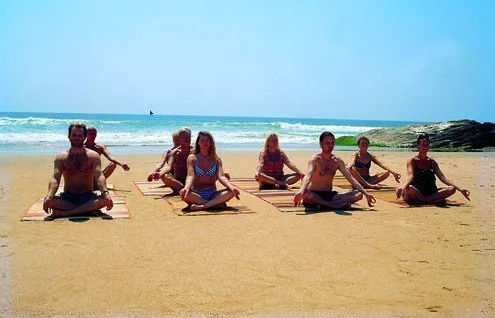
I wrote a book titled Myths of the Asanas. This was before I found out about the real myth of the asanas... that most all of the ones practiced these days are less than 100 years old. Not kidding. I've spent nearly half of my entire life studying yoga, and until just a few weeks ago, even I was under the impression that at least some of our beloved asana practice had its roots in at least a centuries-old tradition that used physical practices to incite profound internal transformation.
There is, of course, the Hatha Yoga Pradipika, which was written around the 15th century, that outlines a scant 15 postures. Fifteen. A friend recently pointed out the shocking point that asana practice is a relatively new development, particularly as it has exploded in Western culture in recent decades. This claim incited a crazy inquisition, which led me to Mark Singleton's book, Yoga Body: The Origins of Modern Posture Practice, as well as Krishnamacharya's Yoga Makaranda.
Singleton does a thorough job of researching the history, modernization and rising prominence of asana practice. He even reveals the mystery behind the obscure yogic text, The Yoga Korunta, which is said to have been the origin of the Ashtanga Series taught by revelatory 20th century master, Krishnamacharya, to Pattabhi Jois and other prominent students. Though many (including me) would like to believe the story that Krishnamacharya learned the text from his guru and passed it on to his own students, we must make room for the very real possibility that even luminaries like Krishnamacharya were responding to changing times and creating asanas to meet the demand of a more physical culture -- which was developing in India in the early 20th century, and of course remains strong here in the West.
Even if the Yoga Korunta existed, it is rumored to be a 14th century text (not that old), and it is well known that postures have been added, modified and evolved to the supposed structure it presented. For example, the first edition of Yoga Mala, by Pattabhi Jois, didn't include revolved side angle. That posture wasn't introduced until later. In fact, when the first western students learned the primary series from Sri K. Pattabhi Jois in the 1970s, there were no vinyasa transitions between the Janu Sirsasana variations and the Marichyasana variations. This reveals that there has been a very live, real-time, evolution of even the most venerated yoga practices.
Basically, we're all just making this shit up. Even in the decade that I've been teaching yoga, I've seen postures "appear." Most recently, additions like "falling star," "reverse warrior," and "flip the dog," weren't around even 10 short years ago. Actually, it feels like they've appeared over the past few weeks! We can even take a look at modern yoga schools and realize that most every type of practice we enjoy here in America has a fairly recent history. Beryl Bender Birch was a practitioner of Ashtanga Yoga, who boldly took it into the realm of innovation by creating power yoga, and from there we have most every branch of vinyasa evolving from this singular root. Thank you, Beryl, and Baron, and Brian and other fearless innovators of vinyasa yoga!
Despite the fact that our beloved asana has a relatively new existence, it still remains a powerful practice for about 16 million Americans. None of this news of newness of the tradition of asana is supposed to diminish it's importance or relevance in our world, but rather to create an awareness that it's up to us to verify it's validity. Many (myself included!) regard asana as a deeply spiritual practice, though the traditions of meditation and bhakti (devotional) yoga have far more historical precedent. If we, as Westerners, have developed and placed in prominence the practice of asana, then dammit, it's up to us to prove that it really works.
Yes, it works as a physical practice, sure. Cirque Du Soleil has done a good job of proving that, as it has gymnastics and aerobics that also feature many of the same shapes. We garner flexibility and strength through asana. Even studies can corroborate asana's healthful effect on the physical body (though, the infamous recent New York Times article also recounts it's detrimental effects). Either way, if we are reading more deeply into the traditions of yoga and reflecting on it's inherent philosophy, then we are revealing the opportunity to show that the way we have revolutionized the practice of asana can actually contribute to the goal of the practice.
It's no secret that yoga means union. Nearly every yoga book starts with that definition. A little inquiry into the type of union yoga indicates reveals that yoga is an awareness of one's intimate and inherent connection to a higher power, and practices of yoga help to create the condition for this realization to arise. That's pretty much it. If we don't automatically have a sustained experience of yoga -- the awareness of ourselves as inherently whole and complete -- then, we do certain practices to reveal that experience more readily and in a more sustained way. There are many proven practices that help to create this condition, meditation probably being the most tried-and-true method.
But, let's be honest. How many Americans are ready to sit their asses down and meditate? For, like, a long time? We are not even a culture who can sit on the floor in relative comfort. However, we love working hard on our bodies. Sometimes to the point that it becomes an obsession. Given these proclivities, it seems natural to develop a means of practice that utilizes and initially emphasizes the body as an entry point into the deeper awareness of yoga. Hail asana. Honestly, let's not knock it or diminish it, even though it is the baby of the modern yoga culture and the brainchild of yoga innovators of recent decades. Why wouldn't it work?
There's no proof it can't... but the onus is on us to prove that it can, that yoga asana practice is a valid and effective means for aligning the energetic body in such a way to allow for a sustained experience of the natural state of yoga. Otherwise, it will remain in the realm of gymnastics and aerobics. Gymnastics and aerobics are great forms of physical exercise, but what makes them different from a true yogic practice is that their focus is only on the body. What makes a true yogic practice unique is that it's focus is on a sustained feeling of freedom and wholeness. This sustained feeling has the very exciting potential to be brought about by new shapes like "airplane pose."
Really, who ever thought that was a millennia old asana? Anyway, we're all just making it up... hopefully with humbled intelligence and a deep understanding of the biology of the body and the philosophy of the practice in mind. Now, in order to make our beloved asana practices ready to sustain the test of time, we have to make it relevant by using these practices to create sustained freedom and joy... just as the history of yoga has intended.
For more by Alanna Kaivalya, click here.
For more on yoga, click here.
Follow Alanna Kaivalya on Twitter: www.twitter.com/AlannaKaivalya
Eva Norlyk Smith, Ph.D.: Practicing Safe Yoga -- 5 Tips to Avoid Injuries
Deepak Chopra: Weekly Health Tip: Yoga's Health Benefits
Elaine Gavalas: 4 Yoga Back Benefits
History of Yoga - A Complete Overview of the Yoga History
Yoga - Wikipedia, the free encyclopedia
Yoga Health Benefits, History, Types, Statistics, Equipment, Poses ...
"But, let's be honest. How many Americans are ready to sit their asses down and meditate?" I would argue a lot, Vipassana, Mindfulness, Zen, TM meditation practices are all firmly established. I argue in the link below that we have a stung tradition of contemplative practices in the west
http://grimmly2007.blogspot.co.uk/2012/05/am-i-missing-something-very-vital-in-my.html
http://grimmly2007.blogspot.co.uk/p/yogasanagalu-translation-project.html
Jois thought it was challenging so put it at the end until somebody had learned most of primary.
Re jump backs in between the postures etc. Re Nancy Gilgoff''s 'Ashtanga as it was' article, in a letter to me she clarifies when she and David Williams were in Mysore, she struggled with jump backs etc so didn't have to do them, David however had to do them between postures and sides (as described in Krishnamacharya's Yoga Makaranda 1934).
Krishnamacharya was adapting postures, coming up with variations to assist but the framework of all the ashtanga series is in Yogasangalu, the Iyengar/Krishnamacharya film (1938), Yoga Makaranda (1934). Jois mentions he was impressed by Krishnamacharya "jumping in and out of postures" in the 1920's, causing him to run off and take classes.
This beg's the question where Krishnamacharya learned his core practice, he claimed he learned asana and pranayama from his father, enough to want to run off all over the country finding out all he could about yoga. Either way we can go back the likes of the ancient Yogayajnavalkya Samhit to find enough asanas and pranayamas to suspect that yogi's were spending their lives exploring these kinds of practices. Postures follow logically one from the other, those old ascetics were coming up with all kinds of postures passing them along, losing and reinvented again and again.
Surtas have absolutley no connection to our Asana practice in USA that mostly originated from European Gymnastic tradition.
With the increased popularity that these physical postures bring to Yoga, there can only be an increased interest in its roots.
And yes, many of the terms we are seeing (unfortunately) nowadays - that are connected with Yoga - have been made up by charlatans, so-called "experts" of Yoga who took - what, like 2 classes and got themselves a freakin' certificate to teach - and this has been happening exponentially in the west. It's really sad. Have you heard of the term, "doga?" Well, it's supposed to be a "legitimate" form of Yoga - are you freakin' kidding me with this bs??!! Such bad people on this earth now.
" Oh, it is only a length of rope". He will accept this statement as a possibility because of his faith in his friends.
But however much he may try, he will not enjoy complete peace of mind unless he himself sees the rope as a rope. The moment he is led to the place of the incident and in a clear light, he discovers the rope for himself, the fear and anxiety, and the delusory snake and its bite all end. No amount of beating the rope in the darkness can kill the snake or finally bring peace, happiness and cheer to the individual. Even if the rope is burnt, he cannot find his balance again and take his mind away from the thoughts of fear and pain caused by the snake-bite, for he may still believe that he was bitten by a snake and it was the snake which was burnt to ashes.
So through karmas performed even for thousands of years,one cannot come to that joy of Self-Discovery, the only method for which is to treat the path of discriminative analysis. This example, famous in Vedantic literature, is given by Sankara only to remind us how and in what way correct thinking can blot out the miseries of life, which are only the outcome of our misunderstanding and ignorance of reality.
The fear and sorrow created by the delusory serpent on the rope can be ended only after fully ascertaining the truth of the rope which is available for recognition only through steady and balanced thinking.
Why the discovery of the Self is not possible through karma and how this is possible by means of right thinking is being explained here by the famous analogy of the serpent and the rope.In Vedanta, this example is often quoted to make the student understand how the names and forms created through the ignorance of Reality can end with the rediscovery of the Truth underlying them. It is never possible that one who has seen the rope as rope will ever have the fear and sorrow of a snake-bite. But in the gathering darkness of the dusk a traveller mistakes an innocent rope to be a snake. The serpent-delusion is created in the mind of the traveller because of his ignorance of the rope-reality.
Having thus been bitten by a delusory serpent, the individual, so long as he is under the delusion, suffers the agony of a snake-bite and,if left alone, will exhibit symptoms of blood-poisoning too. But the traveller is advised to make an enquiry into his delusion. Faithful friends or near and dear ones will approach the deluded one and exclaim, " Oh, it is only a length of rope".
Let me quote from Hatha Yoga Pradipika, a medieval period scripture on yoga by the sage Swatmarma.
"Asanas are as many as the number of species (8,400,000 according to the Vedic literature of ancient India.) Their innumerable varieties are known only to Maheshvara (god Shiva).
HYP 2.2
The rest is history as they say...
I was around before the most recent yoga boom - which is really only since the late 1990s, about a decade and a half. There were wonderful teachers, most of whom bailed out once they saw what was coming. Not sure what we have gained, compared to what we have lost
Zumba anyone?.
The sociology of yoga is killing this industry.
You are yoking these opposites, shall we say, mainly by implying that the mere "context" of yoga practice, presumably, the vague spiritual "intentionality" associated with it, somehow ensures that the value of even the physical asana rises above that of aerobics or other forms of exercise.
Well, that may be true of aerobics - maybe - but it wouldn't be true of say, a brisk nature walk, swimming (great pranayama) or the lovely bicycling I did just today. And my favorite meditations are often done in the morning over a cup of coffee, listening to the birds. I certainly wouldn't want to spoil any of these precious moments with something as dull, and unnecessarily distracting and calisthenic as an asana - even if it were "pigeon" pose.
In the final analysis, my biggest problem with yoga isn't that it's too asana based or too Hindu or too meditative. It is simply this: it's only one arrow in the quiver, one part of a comprehensive approach to "wellness" which includes dance and music, physical labor, a good healthy diet, friends and community involvement - and on occasion, therapy.
To know that asanas were devised by real people to deal with real aches and pains is a confidence builder. Yoga is, as you note, about yoking and I yoke myself to the body that I have, not the one that I see on the cover of yoga journal. I've had the great good fortune to work with yoga teachers-( a plug hear to the students of the late, great Vanda Scaravelli)who have encouraged me to approach asana practice in a very simple creative manner, based on the experience of my body right NOW. I'm deeply grateful.
@TedWSimon
http://tedsimon.authorsxpress.com