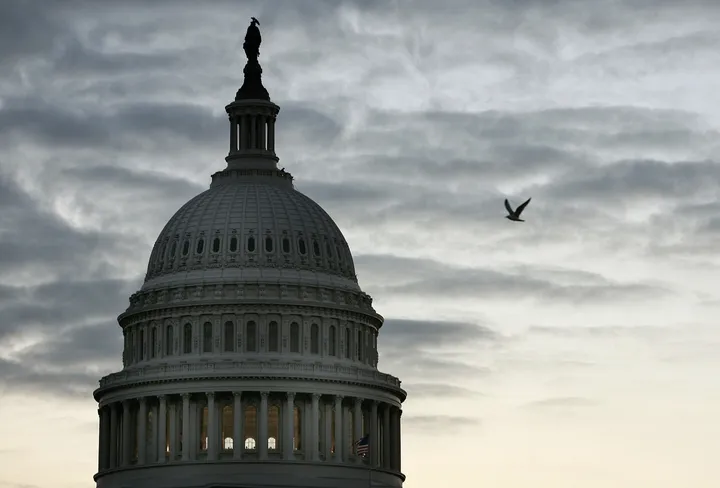
We have gone way beyond simple pay-to-play politics or even living in an oligarchy where the rich and powerful have a disproportionate influence over public policy. We are now at a point where the power of "We the People" that the Founders put in the driving seat of our democratic system no longer applies. Short of a few million dollars, don't even think about participating. We were promised that, if we played by the rules, we would enjoy the rewards of our efforts with good jobs, decent wages, and a steadily improving quality of life, not only for ourselves but, more importantly, for our children and grandchildren. If we invested our savings in a home, our own and our children's education, and for our retirement, we could sleep nights, confident that the much-vaunted American economic machine would deliver for us.
That has been a cruel joke. Many of us have been deprived of our livelihoods, savings, and homes while the perpetrators of this national and global calamity remain in charge and unpunished. Not only that, they continue to reap huge profits, salaries, and bonuses which they use to buy politicians and laws that further enrich them and insulate them from the type of reckoning that is essential.
This type of predatory behavior is not new, of course, but it is being conducted on a much larger scale and with more powerful tools -- and is, arguably, much more dangerous to the country -- than what occurred a hundred years ago during the Gilded Age and reoccurred in the 1930s, leading to the Great Depression. The damage caused to the economy and the democratic process by unregulated corporations and corrupt politicians led to reforms at the federal and state levels, including anti-trust laws and corporate, banking, stock market and workplace regulation.
These safeguards against corporate and other abuses were enforced for the next thirty years until "big money" took over the Republican Party in the 1970s and began a systematic assault on government at all levels, using vilification, distortion and outright lies to advance their cause. We are now experiencing the consequences of three decades of corporate deregulation, tax breaks for the wealthiest Americans, a complete disregard for the poor and vulnerable, and an all-out attack on working people and those who try to speak out for them.
All of this has been done in the name of supposedly well-established economic principles, originally laid out in the bible of the unfettered free-market capitalists, namely Adam Smith's 1776 book, Wealth of Nations. However, those who claim to be Smith's most ardent disciples have either never read it or been very selective in the lessons they have drawn from it. Smith would surely turn in his grave if he knew what was being done in his name. Far from advocating the completely unrestrained corporate behavior that is attributed to him by those who benefit most from that ethos, this long-time professor of Moral Philosophy (not Economics, Finance or Entrepreneurship, please note) sought to develop a comprehensive set of philosophical principles that would guide individuals in their quest to live virtuous lives and participate constructively in a variety of spheres in modern civilized societies, including commerce.
Smith's present-day acolytes should not only read Wealth of Nations more carefully but also its companion volume, The Theory of Moral Sentiments. As Nicholas Phillipson brilliantly sets forth in Adam Smith: An Enlightened Life, these two volumes were part of a long-term project of the Enlightenment to develop a comprehensive Science of Man, that included law, aesthetics, economics, history and ethics.
First and foremost, Smith believed that all constructive members of civilized societies needed to develop an internal moral compass -- what he called"the impartial spectator" -- that would enable them to do the right thing in their own as well as in other people's eyes. He illustrated how this principle would work:
"In the race for wealth, and honors, and preferments, (the individual) may run as hard as he can, and strain every nerve and every muscle, in order to outstrip all his competitors. But, if he should justle (sic), or throw down any of them, the indulgence of the spectators is entirely at an end. It is a violation of fair play which they cannot admit of."
These are hardly the words of a person who would encourage the type of predatory behavior by the crony capitalists that we have witnessed in recent years. On the contrary, rather than propound such self-serving chimeras as if we increase the wealth of the rich, it will trickle down to the rest of us, the market is self-correcting, or the wealthy are the job-creators, Smith explicitly identified labor as the source of all other wealth. As he put it, "The property which every man has in his own labor, as it is the original foundation of all other property, so it is the most sacred and inviolable."
Smith condemned those merchants and manufacturers of his day who argued that their nation's wealth and power flowed from expanding overseas trade. They "knew perfectly well in what manner it enriched themselves. It was their business to know it. But in what manner it enriches the country was no part of their business." Doesn't this sound familiar? Have we not been repeatedly witness to and victims of the self-enriching behavior that Smith decries but is advocated by the professed disciples of his economic principles? In fact, he goes even further in his condemnation of the merchant classes whom he viewed as frequently ruthless in their pursuit of wealth. "It comes from an order of men whose interest is never exactly the same with that of the public, who have generally an interest to deceive and even to oppress the public, and who accordingly have, upon many occasions, both deceived and oppressed."
Smith would be appalled by the behavior of those who justify their selfish actions by citing his name and the economic rules that he supposedly espoused. While it is true that he thought that markets worked best when laborers, artisans, farmers, merchants and others were freed from the control of feudal masters and royally-sanctioned monopolies, that did not mean that these folks should engage in cut-throat, race-to-the-bottom, survival-of-the-fittest competition with each other. On the contrary, in his view, "commerce... ought naturally to be... a bond of union and friendship."
The constraints on the free flow of goods and services that he was arguing against were those government-supported monopolies (royally-sanctioned, at that time) and the empire-building trade wars that they engaged in. In his view, promoting internal commerce would always be more beneficial to the public as a whole than foreign adventures, motivated by "the mean rapacity, the monopolizing spirit of merchants and manufacturers who neither are nor ought to be the rulers of mankind" but whose actions have, "during the present and preceding century, been... fatal to the repose of Europe." Instead of destructive international competition for power and resources, Smith believed that trade among nations - like that within the domestic economy -- should also be based on "a bond of union and friendship."
Not only do we need to revisit and apply, in updated form, the real versus the corrupted version of Smith's principles in order to set the country straight economically, we must also attend to the warnings of the Founders regarding the corrupting effect of money on the democratic process.