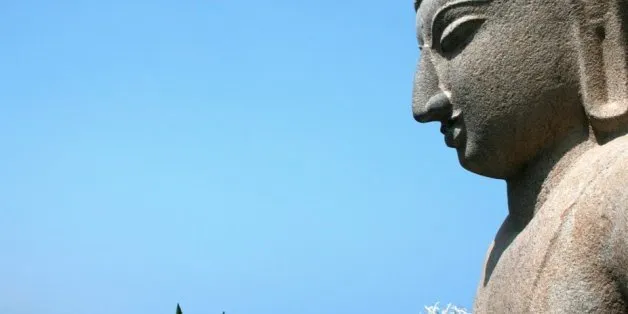
I have been thinking a lot about Buddhism lately. Perhaps I am trying to cultivate greater peace in a household with two highly active, destructive and lovable toddlers. Or, it could be the recent photo I came across of a college friend who traded in his legendary libido for the shaved head and brown robes worn at the Buddhist monastery he now calls home.
Whatever the reason, Buddhism is on the brain. And since my brain cross-pollinates, it has naturally asked the question -- what can Buddhism teach us about college admissions?
Let me introduce you to the Buddha as admissions officer. He sits at a circular table, jolly and big-bellied, a fellow officer next to him, a stack of fat applications before him. The other casts a raised eyebrow in the direction of the Buddha's exposed midriff, and waits for him to speak.
The Buddha opens the first application. He scans the list of perfect scores and extra-curriculars, and erupts in laughter.
"Is something funny?" asks the other admissions officer.
"This student is telling me how intelligent she is. If her head is so full of knowledge, how will she ever be able to empty it when she gets here?"
"Why would she want to do that?"
"To find truth." Seeing a blank stare, the Buddha explains, "It is only with a beginner's mind, free of preconceptions, that we can see the truth."
"Well, we can't reject a student for working too hard."
"Why use this word 'work'? I look at this application and see unlimited joy. The joy of scientific discovery, speaking a new language, helping the community and being part of a team. Even this application process of yours, there is such joy in it -- meeting new people, traveling to interesting places, even the joy of finding the right words to express yourself in a personal essay. How could you ever call that work?"
"I'm not sure our applicants would agree. For them, joy means being accepted."
"That will not bring them joy."
"Excuse me? You don't think our applicants are happy to be accepted?"
"They certainly think they are, but if they are chasing happiness they will not find it here. They must stop chasing, and find it within. Then they can take their happiness with them wherever they go to college. We are irrelevant to their happiness, actually. Isn't that wonderful?"
"Buddha, these students have worked so hard for years to be accepted at our college. Is there no joy in the act of accomplishing a goal?"
"Not if they missed the joy present in every moment along the way."
"Well, we need to make a decision on this applicant."
"What is the rush? We have months before the fall semester arrives. Why force these students to live in the future? Let them enjoy the precious present with their family, friends and teachers."
"Then what should we tell her?"
"Tell her to sit with herself, listen, and be at ease with whatever comes."
"Hmmm... we usually go with accept, reject, or waitlist."
"Then reject her. Reject them all."
"But Buddha, you teach about alleviating suffering, not causing it. Why do you want these students to suffer?"
"It is just the opposite. I am shaking them free of their attachment. That is how we Buddhists end suffering."
Now, I am a novice when it comes to Buddhism, and apologize if I have misrepresented its teachings. I only share this cross-pollination experiment because when it comes to college admissions, we can all use a little enlightenment.
Our 2024 Coverage Needs You
It's Another Trump-Biden Showdown — And We Need Your Help
The Future Of Democracy Is At Stake
Our 2024 Coverage Needs You
Your Loyalty Means The World To Us
As Americans head to the polls in 2024, the very future of our country is at stake. At HuffPost, we believe that a free press is critical to creating well-informed voters. That's why our journalism is free for everyone, even though other newsrooms retreat behind expensive paywalls.
Our journalists will continue to cover the twists and turns during this historic presidential election. With your help, we'll bring you hard-hitting investigations, well-researched analysis and timely takes you can't find elsewhere. Reporting in this current political climate is a responsibility we do not take lightly, and we thank you for your support.
Contribute as little as $2 to keep our news free for all.
Can't afford to donate? Support HuffPost by creating a free account and log in while you read.
The 2024 election is heating up, and women's rights, health care, voting rights, and the very future of democracy are all at stake. Donald Trump will face Joe Biden in the most consequential vote of our time. And HuffPost will be there, covering every twist and turn. America's future hangs in the balance. Would you consider contributing to support our journalism and keep it free for all during this critical season?
HuffPost believes news should be accessible to everyone, regardless of their ability to pay for it. We rely on readers like you to help fund our work. Any contribution you can make — even as little as $2 — goes directly toward supporting the impactful journalism that we will continue to produce this year. Thank you for being part of our story.
Can't afford to donate? Support HuffPost by creating a free account and log in while you read.
It's official: Donald Trump will face Joe Biden this fall in the presidential election. As we face the most consequential presidential election of our time, HuffPost is committed to bringing you up-to-date, accurate news about the 2024 race. While other outlets have retreated behind paywalls, you can trust our news will stay free.
But we can't do it without your help. Reader funding is one of the key ways we support our newsroom. Would you consider making a donation to help fund our news during this critical time? Your contributions are vital to supporting a free press.
Contribute as little as $2 to keep our journalism free and accessible to all.
Can't afford to donate? Support HuffPost by creating a free account and log in while you read.
As Americans head to the polls in 2024, the very future of our country is at stake. At HuffPost, we believe that a free press is critical to creating well-informed voters. That's why our journalism is free for everyone, even though other newsrooms retreat behind expensive paywalls.
Our journalists will continue to cover the twists and turns during this historic presidential election. With your help, we'll bring you hard-hitting investigations, well-researched analysis and timely takes you can't find elsewhere. Reporting in this current political climate is a responsibility we do not take lightly, and we thank you for your support.
Contribute as little as $2 to keep our news free for all.
Can't afford to donate? Support HuffPost by creating a free account and log in while you read.
Dear HuffPost Reader
Thank you for your past contribution to HuffPost. We are sincerely grateful for readers like you who help us ensure that we can keep our journalism free for everyone.
The stakes are high this year, and our 2024 coverage could use continued support. Would you consider becoming a regular HuffPost contributor?
Dear HuffPost Reader
Thank you for your past contribution to HuffPost. We are sincerely grateful for readers like you who help us ensure that we can keep our journalism free for everyone.
The stakes are high this year, and our 2024 coverage could use continued support. If circumstances have changed since you last contributed, we hope you'll consider contributing to HuffPost once more.
Already contributed? Log in to hide these messages.