
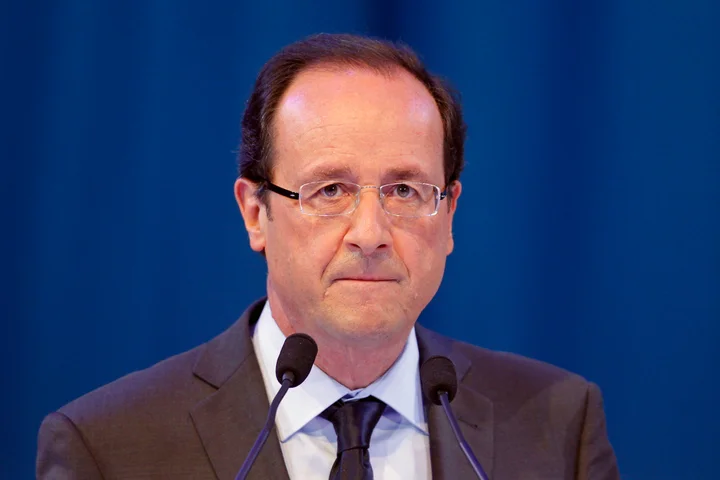
Admittedly, I am an unabashed Francophile and will miss Nicholas Sarkozy for purely selfish foreign policy reasons. Sarkozy has been a steadfast U.S. ally and reliable trans-Atlantic partner no matter his shortcomings at home.
So with the vote tally completed last evening in Paris, Francois Hollande will ride triumphantly into the Élysée Presidential Palace as the first Socialist president in over 24 years with a mandate to end German-style austerity force fed by the European Union's paymasters. Hollande faces many hurdles: he must reverse an unemployment rate rocketing north of 10% that is 50% higher than Germany's at 5% yet fulfill a campaign pledge not to mess with France's social safety net by cutting government spending. Tall orders for the callow Hollande, who built his winning margin on a promise to bring the French "change you can believe in." But delivering change requires Hollande to tackle France's mounting fiscal challenges, which he can only do by jettisoning the eurozone bailout pact Germany's Chancellor Angela Merkel force fed on France and its EU partners. That will require Hollande to devise a magic formula to rein in France's deficit without torching any hope for economic growth.
Convincing Germany to let up on the austerity brakes may not be as politically difficult as it may sound. With the eurozone hanging in the balance, the European Union's leaders face a growing populist rebellion throughout the southern tier of the continent driven by the bleak austerity-driven policies imposed by Brussels at Berlin's insistence. Deutsche-driven austerity may make economists and bondholders relieved, but it has perversely tricked down to Europe's voters as an unproven eurozone cure that is killing the patient rather than cure the disease.
Consequently, Hollande faces many an inconvenient truth in the days ahead. France's public spending is 56% of GDP as compared to an OECD average of @43%. The reason France's spending is so out of kilter when compared to its growth is simple. Sarkozy and his predecessors were determined to build a lavish social entitlement system, but never instituted the means to pay for it. The sad truth facing France is that it simply cannot afford its social largess because of its stagnating growth rate and the erosion of France's ability to compete around the world. France is borrowing beyond its means without taking the steps necessary to generate jobs and increase competitive exports to fund its cherished social entitlements. These are hard truths that kept getting lost in the harsh campaign rhetorica of the past two weeks.
But French voters are no different than others. They do not want to pay the price for economic mismangement... the burden for error should fall on someone else or something else.
Yet the election was principally about which candidate could maintain that lavish social safety net while finding more funds to spur economic growth to reduce unemployment. In the end Sarkozy fell into a trap of his own making. He simply could not credibly assure the French that his economic policies would let them have their cake and eat it, too. But the mild-mannered Hollande is no financial Houdini, either. The incoming president will be shackled not only by a reluctant Chancellor Merkel who has her green eyeshade on when poring over France's economic balance sheet, but also by a loss of confidence in France's ability to pay for its spiraling debt. Never mind that Hollande is a core socialist who believes the cure to France's ills lies in more, not less government spending. But the creditors are having none of this, and when France forfeited its cherished AAA credit rating a few months ago, it fell on Sarkozy's reelection chances like a ton of bricks. Nothing that Hollande campaigned on will automatically reset the credit rating clock.
Restoring French economic strength and vitality is of great interest across the pond here in Washington. A tottering France equals a weak global ally and this is not a good time in world affairs for France to become globally myopic because of Hollande's singular fixation to find a cheap cure for economic travails when one does not exist.
Whether or not the Euro goes by way of the dodo, nothing good can come if France's economic challenges spill across the Atlantic -- that contagion would make Greece's pale in comparison. All the more reason why Washington should be encouraging its German ally to read the tea leaves out of Paris and not make it that much harder for Hollande to sell a financial fix to his fellow citoyens. That is about all Washington can do; it is up to the French to decide whether something's gotta give before it is taken away.
However one cuts it, Messr. Hollande faces the same hard choices as does his defeated predecessor. Does he impose crushing new taxes on the wealthy or does he impose new taxes on everyone to help achieve revenue targets needed to help offset France's deficit? But making that choice reflects only one side of the deficit coin. No targeted or across the board draconian tax increase alone will work to improve France's financial integrity and competitive deficit without some cuts in France's public spending. But Hollande has taken the Grover Norquist pledge on raising taxes and turned it on its head, i.e., he has vowed not to reduce government spending and, to the contrary, has promised to double down and dramatically spend more on education and other potential job creation programs. By anyone's reckoning, his campaign platform would cost the French economy another Eur 20 billion. Would this further spending reverse every economic principle known to man? Who am I to say... the proof will be in the souffle.
Why would anyone expect Hollande to break with his own Socialist party principals and be compelled to pay the piper given what he has pledged not to do?
Simpson/Bowles à la Hollandaise anyone?