

A 1968 issue of the New York Times magazine carries a picture of yours truly waving a finger at a mass of students at Columbia University. The picture accompanies an article I wrote on my experience, called "confessions of a professor caught in a revolution." 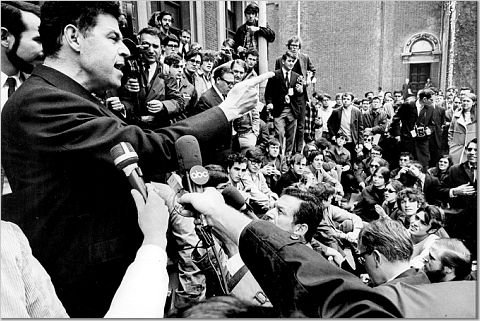 At the time, left-leaning students had occupied several buildings on campus after the university's president ignored their repeated requests to discuss their grievances. Right-wing students sought to rush the buildings and drive out the occupying students. I belonged to a group of faculty that formed a cordon between the two groups, to prevent a confrontation sure to turn violent. We succeeded.
Columbia, along with most other American colleges and universities, has come a long way from 1968. True, some still have stuck up presidents, and some still follow policies that give grief to anyone with a social consciousness. However, the fortieth anniversary of the student uprising at Columbia is a good time to note how far things have come. Doing so gives hope to those of us who continue to campaign for change on the societal level as well as in the university system.
•In 1968, all professors in my department were white males. At meetings of the admissions committee for graduate students, faculty often scrutinized photos of the candidates (required as part of the application in those days) and preference was sometimes given to those applicants found to be good looking by the faculty (many of whom had student mistresses). These days faculties are diverse; perhaps not as much as they ought to be, but a long way from what they used to be. Also, colleges have adopted strict policies on intimate relations between professors and students, although these are not always enforced.
•Grayson L. Kirk, president of Columbia University in 1968, paid little mind not only to the preferences and views of students but also those of the faculty. He did not survive the 1968 uprising, and was unceremoniously retired. The new president, Andrew W. Cordier was much more accessible. Today you do still find presidents who pursue their own lights, but they tend to end up like Harvard's former President Larry Summers--looking for another job.
•In 1968, Columbia University was expanding, paying little mind to the needs of its mostly lower income, mostly African American neighbors at the edge of Harlem. Today, many worry it is doing the same with its controversial plans for a new campus in Manhattanville. Although, to be sure, it is proceeding much more cautiously and somewhat more openly than in 1968. Since then, the relationships between Town and Gown have continued to be complex and tense, in colleges from Yale to UCLA. Still universities tend to pay more attention to the needs of their neighbors, especially if these are poor or members of minorities, than they did forty years ago.
•Columbia University prided itself in 1968 on its 'core curriculum'--a series of courses (required for all undergraduates) on the history, philosophy, and culture of Western Civilization, with a strong emphasis on the classics. Since then, partially in response to criticism that a curriculum dominated exclusively by 'dead white men' hardly amounted to adequate preparation for 'contemporary civilization,' the required curriculum has expanded to include numerous courses in non-western cultures, as well as more female and non-white author who write in the Western tradition. In effect, currently there are some who believe that Columbia and other universities have gone too far in trying to be multicultural, and have lost their role as institutions dedicated to transmitting the core of Western culture.
•The least amount of change since 1968 has occurred in the academic pecking order. Columbia and other high prestige universities still tend to scoff at "applied" disciplines such as criminology, education and social work, even business and engineering and tend to extol abstract subjects such as pure math, economic theory, and scientific models. The fact that applied and abstract disciplines have a lot to give each other--that applied ones serve as important corrective to blue yonder theories, and abstract theories can provide strong underpinning and drive new insights in applied ones--is not much better understood today than in 1968. Maybe it will take another forty years to bridge this gap. Given that colleges did make substantial albeit insufficient progress on the other fronts, hope springs eternal.
Amitai Etzioni was Professor of Sociology at Columbia University from 1958 to 1978. He is University Professor at The George Washington University and author of My Brothers Keeper: a Memoir and a Message. Email: comnet@gwu.edu