iPhone app iPad app Android phone app Android tablet app More

Featuring fresh takes and real-time analysis from HuffPost's signature lineup of contributors
Andrew Bacevich

GET UPDATES FROM Andrew Bacevich
 

The Golden Age of Special Operations

Posted: 05/29/2012 10:44 am

Globalizing the Global War on Terror

Cross-posted with TomDispatch.com

As he campaigns for reelection, President Obama periodically reminds audiences of his success in terminating the deeply unpopular Iraq War.  With fingers crossed for luck, he vows to do the same with the equally unpopular war in Afghanistan.  If not exactly a peacemaker, our Nobel Peace Prize-winning president can (with some justification) at least claim credit for being a war-ender.

Yet when it comes to military policy, the Obama administration’s success in shutting down wars conducted in plain sight tells only half the story, and the lesser half at that.  More significant has been this president’s enthusiasm for instigating or expanding secret wars, those conducted out of sight and by commandos.

President Franklin Roosevelt may not have invented the airplane, but during World War II he transformed strategic bombing into one of the principal emblems of the reigning American way of war.  General Dwight D. Eisenhower had nothing to do with the Manhattan Project that developed the atomic bomb.  Yet, as president, Ike’s strategy of Massive Retaliation made nukes the centerpiece of U.S. national security policy.

So, too, with Barack Obama and special operations forces.  The U.S. Special Operations Command (USSOCOM) with its constituent operating forces -- Green Berets, Army Rangers, Navy SEALs, and the like -- predated his presidency by decades.  Yet it is only on Obama’s watch that these secret warriors have reached the pinnacle of the U.S. military’s prestige hierarchy.

John F. Kennedy famously gave the Green Berets their distinctive headgear.  Obama has endowed the whole special operations “community” with something less decorative but far more important: privileged status that provides special operators with maximum autonomy while insulating them from the vagaries of politics, budgetary or otherwise.  Congress may yet require the Pentagon to undertake some (very modest) belt-tightening, but one thing’s for sure: no one is going to tell USSOCOM to go on a diet.  What the special ops types want, they will get, with few questions asked -- and virtually none of those few posed in public.

Since 9/11, USSOCOM’s budget has quadrupled. The special operations order of battle has expanded accordingly.  At present, there are an estimated 66,000 uniformed and civilian personnel on the rolls, a doubling in size since 2001 with further growth projected. Yet this expansion had already begun under Obama’s predecessor.  His essential contribution has been to broaden the special ops mandate.  As one observer put it, the Obama White House let Special Operations Command “off the leash.”

As a consequence, USSOCOM assets today go more places and undertake more missions while enjoying greater freedom of action than ever before.  After a decade in which Iraq and Afghanistan absorbed the lion’s share of the attention, hitherto neglected swaths of Africa, Asia, and Latin America are receiving greater scrutiny. Already operating in dozens of countries around the world -- as many as 120 by the end of this year -- special operators engage in activities that range from reconnaissance and counterterrorism to humanitarian assistance and “direct action.” The traditional motto of the Army special forces is “De Oppresso Liber” (“To Free the Oppressed”).  A more apt slogan for special operations forces as a whole might be “Coming soon to a Third World country near you!”

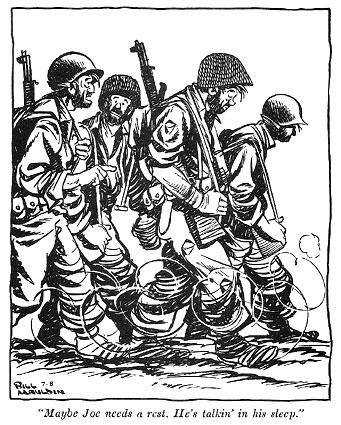
The displacement of conventional forces by special operations forces as the preferred U.S. military instrument -- the “force of choice” according to the head of USSOCOM, Admiral William McRaven -- marks the completion of a decades-long cultural repositioning of the American soldier.  The G.I., once represented by the likes of cartoonist Bill Mauldin’s iconic Willie and Joe, is no more, his place taken by today’s elite warrior professional.  Mauldin’s creations were heroes, but not superheroes.  The nameless, lionized SEALs who killed Osama bin Laden are flesh-and blood Avengers.  Willie and Joe were "us."  SEALs are anything but "us."  They occupy a pedestal well above mere mortals.  Couch potato America stands in awe of their skill and bravery.
This cultural transformation has important political implications.  It represents the ultimate manifestation of the abyss now separating the military and society. Nominally bemoaned by some, including former Secretary of Defense Robert Gates and former Joint Chiefs Chairman Admiral Mike Mullen, this civilian-military gap has only grown over the course of decades and is now widely accepted as the norm.  As one consequence, the American people have forfeited owner’s rights over their army, having less control over the employment of U.S. forces than New Yorkers have over the management of the Knicks or Yankees.

As admiring spectators, we may take at face value the testimony of experts (even if such testimony is seldom disinterested) who assure us that the SEALs, Rangers, Green Berets, etc. are the best of the best, and that they stand ready to deploy at a moment's notice so that Americans can sleep soundly in their beds.  If the United States is indeed engaged, as Admiral McRaven has said, in "a generational struggle," we will surely want these guys in our corner.

Even so, allowing war in the shadows to become the new American way of war is not without a downside.  Here are three reasons why we should think twice before turning global security over to Admiral McRaven and his associates.

Goodbye accountability.  Autonomy and accountability exist in inverse proportion to one another.  Indulge the former and kiss the latter goodbye.  In practice, the only thing the public knows about special ops activities is what the national security apparatus chooses to reveal.  Can you rely on those who speak for that apparatus in Washington to tell the truth?  No more than you can rely on JPMorgan Chase to manage your money prudently.  Granted, out there in the field, most troops will do the right thing most of the time.  On occasion, however, even members of an elite force will stray off the straight-and-narrow.  (Until just a few weeks ago, most Americans considered White House Secret Service agents part of an elite force.)  Americans have a strong inclination to trust the military.  Yet as a famous Republican once said: trust but verify.  There's no verifying things that remain secret.  Unleashing USSOCOM is a recipe for mischief.

Hello imperial presidency.  From a president’s point of view, one of the appealing things about special forces is that he can send them wherever he wants to do whatever he directs.  There’s no need to ask permission or to explain.  Employing USSOCOM as your own private military means never having to say you’re sorry.  When President Clinton intervened in Bosnia or Kosovo, when President Bush invaded Afghanistan and Iraq, they at least went on television to clue the rest of us in.  However perfunctory the consultations may have been, the White House at least talked things over with the leaders on Capitol Hill.  Once in a while, members of Congress even cast votes to indicate approval or disapproval of some military action.  With special ops, no such notification or consultation is necessary.  The president and his minions have a free hand.  Building on the precedents set by Obama, stupid and reckless presidents will enjoy this prerogative no less than shrewd and well-intentioned ones.

And then what...?  As U.S. special ops forces roam the world slaying evildoers, the famous question posed by David Petraeus as the invasion of Iraq began -- "Tell me how this ends" -- rises to the level of Talmudic conundrum.  There are certainly plenty of evildoers who wish us ill (primarily but not necessarily in the Greater Middle East).  How many will USSOCOM have to liquidate before the job is done?  Answering that question becomes all the more difficult given that some of the killing has the effect of adding new recruits to the ranks of the non-well-wishers.

In short, handing war to the special operators severs an already too tenuous link between war and politics; it becomes war for its own sake.  Remember George W. Bush’s “Global War on Terror”?  Actually, his war was never truly global.  War waged in a special-operations-first world just might become truly global -- and never-ending.  In that case, Admiral McRaven’s "generational struggle" is likely to become a self-fulfilling prophecy.

Andrew J. Bacevich is professor of history and international relations at Boston University and a TomDispatch regular.  He is editor of the new book The Short American Century, just published by Harvard University Press. To listen to Timothy MacBain's latest Tomcast audio interview in which Bacevich discusses what we don’t know about special operations forces, click here or download it to your iPod here.

Follow TomDispatch on Twitter @TomDispatch and join us on Facebook.

To stay on top of important articles like these, sign up to receive the latest updates from TomDispatch.com here.


FOLLOW WORLD
 
 
  • Comments
  • 143
  • Pending Comments
  • 0
  • View FAQ
Comments are closed for this entry
View All
Favorites
Bloggers
Recency  | 
Popularity
Page: 1 2 3 4  Next ›  Last »  (4 total)
06:21 PM on 06/04/2012
Feudalism is manifesting on a larger scale and in different form.
07:02 PM on 06/03/2012
Based on experiential observations, I'm concerned with this so-called "Golden Age" of Special Operations Forces for multiple reasons, including, but not limited to, the following:

1) As Bacevich pointed/alluded to, policymakers' precipitative preferences for SOF employment is partly due to political expediency; less oversight, less accountability, less signature, less expenditures, less casualties, and less clamoring from the electorate. Meeting strategic objectives and securing national interests have become almost secondary.

2) SOF assets, NCS elements, combinatorial matrices, etcetera are neither organized nor capable of winning a "generational struggle" (e.g., defeating terr0r groups that are entrenched in manifold areas). This is one reason why McRaven supported population-centric COIN and its requisite GPF 'surge' during deliberations in 2009. Furthermore, the gravitational pull towards using SOF in GPF-oriented roles/capacities enables a monumental misappropriation of finite resources.

3) Increasing SOF workloads or crafting SOF-led missions -- such as what the Obama Administration is considering/contemplating post-2014 in Afghanistan -- will ultimately necessitate additional community expansions and/or the inclusion of more conventional types in compartmentalized task forces. This will have a negative effect on quality, efficacy, and security.
04:53 PM on 06/03/2012
I don't think there is an answer to this any time in the near future. You have one political party that is all about bombing places, committing troops, etc. And you have the other that does the same exact thing to show that they aren't wussies because they are afraid of what Fox News will say about them. Just like the majority of them were too scared to opposed Bush's foolishness in entering Iraq.

The only difference really is this with the Spec Ops community. Obama is using them I think more intelligently than Bush did. But really for the same purpose. I don't think in the near future we will ever get anyone even close to understanding the problem into office. Because people like Mr. Bacevich tend to stay out of politics. And smartly so.

I don't see any answer to the problems Mr. Bacevich has brought forth with his books and with his articles in the near future. I think we would have to reconfigure the whole election dynamic and toss intelligent people into government probably kicking and screaming. Because the people that should be in government naturally will want to avoid it.
02:21 PM on 06/03/2012
What a pile of dog stuff. MACVSOG was under Johnson and Nixon.
HUFFPOST SUPER USER
William50
12:38 PM on 06/03/2012
It has long been known that a single shot killing a single man can stop many wars. It is also known that a large attack on the leadership of a group or nation can allow more moderate voices into that government. Why this has not been used is the real fear that other nations, poor nations with wealthy backers might train special groups to do the same.
In the broad USA these groups would not have to hit the government in Washington DC. With the movement of the elected officials and with the known programs of those in office and wanting office it would not be hard for special teams to set up who will be in office or even in the Supreme Court.
Speaking, as fiction of course, and it should scare the hell out of you, teams can come into the USA as easily as do drugs and sex slaves them move around the county....I will let your thoughts grow on this.
photo
HUFFPOST SUPER USER
Kurt Mundt
Interesting world we live in, eh?
12:29 PM on 06/03/2012
This is how it ends - in secret, with no accountability.
This user has chosen to opt out of the Badges program
03:06 AM on 06/03/2012
This is actually a much superior way for the US to engage with its enemies, but
1. it has to be kept under civilian control
2. there are huge blow back dangers
3. it doesn't lead to big procurement budgets, so it won't be popular
This user has chosen to opt out of the Badges program
03:37 PM on 06/03/2012
nr 1 never has been working, nr 2 blow back dangers are sure, nr 3 money never was a problem, its tax
photo
HUFFPOST SUPER USER
Stoopid American
Trooth, justice, and the American way ...
12:55 AM on 06/03/2012
America has always employed special forces. This is nothing new. The big concern is that we must maintain civilian oversight over the military. But I would suggest that we extend that concern to other areas of the government, such as CIA and Justice, who can also engage in unsupervised operations. The problem of special forces is just one specific part of a problem of lack of transparency.

And didn't Obama promise more transparency? What happened to that, Mr. President?
02:24 PM on 06/03/2012
We had 11 men receive CMH's in MACVSOG. This Obama did it is a pile of dung.
This user has chosen to opt out of the Badges program
visitr on a small planet
card carrying iconoclast
12:53 AM on 06/03/2012
what's with this ever- escalating addiction to war? signature drone strikes, special ops, military contractors all acting in concert to assure that the u.s will continue to claim the prize for most hated country status. is that what we really want? for each drone strike, many more "terrorists/freedom fighters" will be created. makes a lot of sense, doesn't it?
photo
HUFFPOST SUPER USER
Kurt Mundt
Interesting world we live in, eh?
12:30 PM on 06/03/2012
Job security, of a kind...
11:43 AM on 06/01/2012
To answer Petraeus and all: "Sohphisticated, limited, surgical and effective police action. This is the forseeable future. No end in sight."

This addresses Clauswitz's question, "what is the nature of the war"...which is the first, most fundamental and important question the leader must resolve. And Obama now has.

We now need to extract the wrong forces from the wrong mission(s) and press on with enhanced intelligence collection, employment of all the tools of statecraft and, when needed, this new strategy and capability which can most effectively address the realities of the world "as it is" not the world "as it was".
HUFFPOST SUPER USER
Phyllis Kunz
05:02 PM on 05/30/2012
President Putin snubbed President Obama at the G8 Summit but is coming to see him in
June and hopefully both men will accomodate each other for the good of Syria.
01:58 PM on 05/30/2012
Just as many economic activities across the globe are becoming more and more a one-to-one venture (think technology, marketing, education, etc.) so is war. It becomes a much more efficient, effective and targeted way of applying a product where it can do the most good. Not to mention, the ongoing issues arising from the enormous task of running a military machine - even as it continues to become a social experiment - are diluting the effectiveness of what was once the greatest military might on earth. Now our military environment is being weakened by the attention paid to issues of gender equality, socioeconomic woes and more. Why shouldn't well trained, singularly focused, highly motivated supersoldiers take the biggest bite out of the initial conflict, and enable the gear in the rear group to come in and continue to establish infrastructure and stability? It's a brilliant, sustainable and economically feasible strategy.
11:54 AM on 06/11/2012
We have no supersoldiers. Our troops and SPECOPS are riding up and down roads/MSR's in armored vehicles. Hell, the VC and NVA would have blown us away had we done so. The Gens are idiots.
12:25 PM on 05/30/2012
Shouldn`t we be focusing on world relation`s instead of war refinement`s?
HUFFPOST SUPER USER
jstrate
11:36 AM on 05/30/2012
It would seem that there's a great danger of failing to set limits on what tasks will be undertaken. There's no shortage of terrorists and terrorist organizations. There's no shortage of leaders who are despots, sociopaths, and kleptocrats. There's no shortage of failed states. It's nice to play Dudley Doright but what are the limits? There are calls for special operations involvement in Syria. Most Americans, however, don't care all that much if the Syrian government is murdering its own citizens. It's terrible, but why is it our problem?
11:31 AM on 05/30/2012
I agree that the 'special' forces are 'special'. So far, their result of their specialties is to 'legitimize' , and increase, so-called 'legal' Al Qaeda operations throughout the World. Presently the Muslim Brotherhood terrorist Organization ( an Al Qaeda wing ) is about to 'legally' come into power in Egypt. This means they can 'legally' use Egyptian taxes to fund Al Qaeda terrorist operations throughout the World. The so-called 'legal' anti terrorist governments of the world apparently approve of this purposeful democratic spreading of terrorism. Go figure.
HUFFPOST SUPER USER
ajscease
02:01 PM on 06/03/2012
Your ignorance is astounding. The Muslim Brotherhood predates Al Qaeda by some decades. Some Al Qaeda leaders did indeed come out of the Muslim Brotherhood, but there is a high degree of enmity between these groups due to their differing tactics. The idea of the Brotherhood giving money to Al Qaeda is laughable. That being said, the Muslim Brotherhood is a bad thing for the hopes of a more western oriented Egypt. U.S. support for authoritarian rulers in Egypt only served to weaken democratically-minded groups that would have served as a counterpoint to the Brotherhood. Turn off the Glenn Beck.
11:56 AM on 06/11/2012
Thanks to Obama and the French.