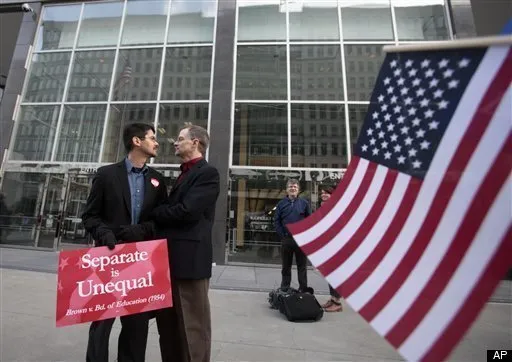
Unlike the debate over abortion, which raises truly complex and irresolvable moral issues, I believe that my children and grandchildren will not be voting in elections haunted by the specter of same-sex marriage. This is both for legal and psychological reasons. It seems likely that even conservative judges will find it impossible to accept as legitimate the arguments put forward by opponents of same-sex marriage for denying equality to all citizens. Similarly, like with race and gender, sexual orientation seems to be an issue where most citizens eventually learn that their previous beliefs were just habits of prejudice and not reflections of any deeper moral truth. Even the pious will come to appreciate that they are not harmed in any real way by homosexuality -- gay sex (and marriage) is not sex done unto them. (Cue the Ted Haggard jokes.) Poll after poll shows that the arc of history is bending towards increased acceptance of homosexuality and thus of same-sex marriage.
Personally, I am impatient for the day when every state in the Union must recognize same-sex marriage rights. But what if the most justifiable policy on liberal-constitutional grounds is not the institution of "marriage" increasingly opening to new constituent relationships, but rather a universal institution of "civil union" which fulfills the social and moral aims behind subsidizing the family but is entirely neutral not only to the gender or even to the numbers of the partners, but also to the emotional content of domestic life and the purposes behind contracting domestic partnerships?
The argument for gay marriage beyond mere civil unions is the argument from equality and recognition. The state treats homosexuals unfairly when it denies them access to the same social goods and benefits open to heterosexual couples and fails to treat them fully as equals when it offers them a different public status, even one with the identical package of objective goods and benefits. In fact, conferring a "civil union" status short of marriage publicly marks the unwillingness to extend to homosexuals recognition of them as equal to heterosexuals and is thus a form of stigmatization. Therefore, the only just policy is to level up all the way to full marriage rights.
Well, another way of handling the problem of recognition and status is to "level down." Why not treat "marriage" the way we treat religion: as something protected and possibly subsidized in moderate ways by the state but which the state is not in the business of defining, regulating, honoring or distributing other than for reasons of individual rights and legitimate public interests? Religion is left to persons and communities to define and defend. Questions of fairness or recognition between religions or conceptions of religiosity arise in this arrangement only rarely and at the margins. (Of course, questions of secular vs. religious authority arise all the time, but rarely is the question the state's obligation to recognize a minority religion as a religion but rather the state's right to trump religion, or disagreement on the status of secular or minority religious values.) Similarly, if all the state offered to anyone was legal status as a civil union, then there could be no complaint of unfairness or disrespect by those offered a status less than marriage.
Furthermore, removing the symbolic good of the word "marriage" from the authority of the state may also appeal to conservatives or the religious, as well as some gays troubled by the historical baggage bound up in the institution of "marriage." At least part of what troubles the religious about gay marriage is precisely the collective, public bestowal of recognition on homosexual relationships as the same thing as heterosexual ones. Leveling down, which is essentially the privatization of the commodity of "marriage" as an emotionally and symbolically invested concept, solves this problem. This symbolic commodity can now be the monopoly of every group that wants it. The state doesn't baptize; why should it "marry"? More accurately, the state doesn't say who can be baptized; why should it say who can be "married"? Conservatives and the religious can keep the institution of "marriage" (better yet, "privatize" it!) and merely have to suffer the knowledge that homosexuals can confer social and economic benefits on one another. And if neither side is satisfied by this (i.e., gays and their allies still want the public bestowal by the state of "marriage" as an act of recognition, and conservatives still want to monopolize decision-making over the question of whom the state extends primary social goods to), then liberals can, with a good conscience, claim that they are both demanding something the state does not necessarily have to give them.
Difference Between Civil Union and Marriage - Civil Unions vs. Gay ...
Unfortunately, the word marriage is a loaded one for many who think of it solely as a religious union. Thus, all those who claim that civil unions would be acceptable for gays while marriages would not are confused. They fail to understand that the battle is really over civil, i.e., state-sanctioned, unions, commonly called marriages. Any roadblocks imposed by religions are an entirely separate issue.
In my hope that your intentions here are possibly not nefarious, please consider the fact that most religious discourse--the world over--is conducted IN THE LANGUAGE OF THE PLACE WHERE THAT RELIGION IS PRACTICED. This notion that it would somehow be too confusing for society to function if some words are not used entirely within the context of religion is, therefore, RIDICULOUS. There are all sorts of words that we humans are able to use in different contexts--without losing our ability to function.
Take, for instance, the word "reconciliation." In Christian didache, "reconciliation" is an official rite of forgiveness and a reunion with God. To official IRS accountants, "reconciliation" is the a matching of a taxpayer's ending bank account balance to the ending balance in his/her books. To feuding spouses, "reconciliation" is a term used to describe the healing that occurs after a long and heated argument.
The term "marriage" is no different. As humans, we are beings capable of higher-order brain function, and there is no CRISIS in the fact that our secular governments define and use the term "marriage" in a way that differs from the way the Roman Catholics, the Metropolitan Community Church, or even Britney Spears might use that term.
Stop tilting at windmills!
Our various governments CAN and DO define what marriage is--in different contexts. Christian gave the example of the Federal government defining marriage as used in the specific context of immigration. Right now that definition (thanks to DOMA) is unjust, and gays who fall in love abroad cannot sponsor their partners for US residency--while straights ARE freely allowed to do so. The SOLUTION to this problem is to CHANGE THE DEFINITION--IN THAT CONTEXT--to allow gays the same right to marry and to sponsor their foreign loved ones for citizenship. What is ridiculous is this notion that the government can't use and define the term "marriage" in specific ways in specific contexts. Human beings are perfectly capable of understanding and operating within different contexts.
Another problem Christian highlights is that certain sham "marriages" are not marriages at all. Rather they are a form of prostitution. The solution to this particular problem has nothing to do with whether the government defines or uses the word "marriage" in the context of immigration. Rather, the solution to this problem is to prosecute the persons MISUSING marriage (in this SPECIFIC CONTEXT of immigration) as criminal prostitutes and pimps.
Some Americans think prostitution should be legalized, but isn't it nice to USE OUR LANGUAGE INTELLIGENTLY--to get the the heart of the matter rather than pointlessly advocating for the creation of new words to deal with old problems.
We have too many problems to be reinventing the wheel every day!
We're two years into the Obama administration. The President has said there should be civil unions for same-sex couples (I disagree with him). Where's the bill? Why haven't we seen a civil unions bill before Congress? Why has President Obama not called upon Congress to pass this bill and put it on his desk?
Unless we start seeing serious work on creating this, the best interests of the gay community still lie in going for the existing status, marriage, instead of a fantasy of civil unions.
First you pass a law requiring all states and the federal government to recognize only this new "civil union" thing. You want a level playing field, then you'd better start by leveling it.
After all, what's the urgency with creating a new status and rewriting thousands of laws (which would get tied up in committees) if opposite-sex couples are still getting benefits. Cancel it all.
Not that any of this would happen. The main flaw here is that whenever someone says that they're against marriage for same-sex couples, they really mean that they're against any rights for same-sex couples. It's just that such naked bigotry no longer plays well, so you have to soften it with a pretended reverence for tradition.
There is only one just solution: same-sex marriage for all. "Civil unions for all" is, alas, a feel-good fantasy that could never be implemented.
That's not true in my case, and I doubt it's true in most cases. Speaking for myself, I think same-sex couples should have every right of marriage except the right to conceive offspring together by combining their genes. I think Civil Unions should be defined by every state as "marriage minus conception rights" so that every state treats them the same way and doesn't have to re-write any laws, and the only difference would be that marriages had a right to combine their genes to procreate offspring together.
So why not recognize these two distinct concepts as such and separate them into two distinct things? Then, couples could choose to engage in either or both, as they see fit. The legal side of things--insurance, inheritance rights, etc.--would be under the auspices of the civil union (whether it ultimately be called marriage, civil union, or something else), and the spiritual side under that of the religious union (again, the word for it isn't the most important aspect, and any group could call it whatever they wanted, anyway, because their would be no legal aspect to it.)
Such a solution would ensure that the government is not infringing on religious freedom as it pertains to marriage, while also keeping the religious views of the majority from being imposed upon those who don't share them.
This notion that marriage is a religious institution is flawed. If marriage is a religious institution then try going back to your church or synagogue to get a divorce? You can't because it is a state contract that needs to be nullified by the state. Clergy always say "by the powers vested in me by the state of" that is because they are performing a marriage on behalf of the state. Actually officiates do not marry couples. The two people marry each other and the officiate is the witness to the marriage. Besides which about 50% of the population who marry, marry in a civil non religious marriage.
We in the U.S. are one of the few countries in the world that allow Clergy to solemnize marriages. In 90% of the countries you must get married by a government official for your marriage to be legal and then you can have your religious ceremony concurrently or afterwards.
Marriage has always evolved over time. It was about property and dowry its only since the late 1800's it was about love.
I argue that
Because there are some unethical pairings as far as conceiving offspring goes, and the state should protect people from being created in unethical ways. Marriage always approves of the conception of children and should continue to. When I marry, I want to feel the public approval and official finality that we are allowed to go and have sex and create offspring together, and no one, in any religion, can say we don't have the right to conceive children together. I'm not religious, and other people are of various different religions, so getting a certain religion's approval means nothing, I want the legal approval, the right to conceive with my spouse.
Mostly, buddy, its none of your damn business....
We should outlaw that stuff because it would be really expensive and wasteful and unethical to create people that way. It wouldn't be ME preventing others it would be the government acting on the will of the people who make a rational decision that preserving natural conception for all is more prudent and sustainable and equal than allowing labs to start creating human beings in artificial ways.
As to the old chestnut, there is no requirement that marriages conceive children, but there is a requirement that the couple be eligible to conceive children together, that they are allowed to conceive children together. Couples that are prohibited from procreating together are not and should not be allowed to marry, because marriage should always affirm and approve of the couple creating offspring from their own genes, no marriages should ever be prohibited from doing that.
Consider also the bureaucratic nightmare of changing EVERY reference ANYWHERE from "marriage" to "civil union," and for what? To appease a faction of religious folks who will still oppose our right to be in civil unions (especially if that term is applied equally to all)? At this point, the government is far more entrenched in the "marriage" business than any religion, so perhaps it's time to suggest to the religiously-motivated opponents of SSM that they find a new and special term for their unions (take a page from the Mormons, who are "sealed" together in the temple).
Avoid all the battles and just have government withdraw from both the marriage business and the civil union business.
Marriage is not a religious institution.It is a legal one.
-- but a dangerous distraction from the fight for equality
If you don't get this, imagine having 3 kids -- 2 can get married, but one has to settle for a "civil union"
People want to get MARRIED
People who advocate the term "civil union" have yet to offer up (equally ridiculous) substitutes for the word "marriage" as a VERB and all of its tenses.
We all get "MARRIED". Some marriages involve "HOLY MATRIMONY", some not so much. But my husband is a Christian and goes to an open and affirming Christian Church, so I guess we will also use "HOLY MATRIMONY" (despite my Buddhist leanings!). After all, not ALL of us are non-Christian.
The fact that the word "marriage" also is used for certain religious relationships does NOT change this fact. Every minister, rabbi, priest, whatever, who performs a legal marriage, does so as an agent of the government, and can only do so according to government set criteria.