As public interest in ethically produced food continues to flourish even in such difficult economic times, it's perhaps somewhat inevitable that food businesses jump on the "grassfed" bandwagon.
We've seen it happen with organic, where some of the rules that farmers and food manufacturers must follow in order to use the coveted organic label have been watered down or manipulated. This has happened to such an extent that many well-meaning organic consumers would now struggle to differentiate between some larger 'organic' operations and their industrial cousins. The same thing is now happening with the term "grassfed." While the range of products, labels and brands that make grassfed claims grows day by day, the sad reality is that some of the grassfed meat, milk and cheese you can buy probably shouldn't be labeled grassfed at all.
Fortunately, Animal Welfare Approved has just published an 18-page booklet called The Grassfed Primer to cut through the confusion surrounding the term "grassfed" and to help the public to understand the wide benefits that real grassfed farming systems can have for the environment, for farm animal welfare, and for our health.
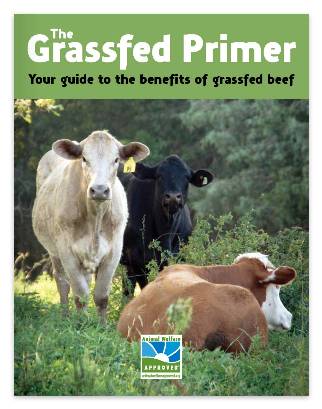 The good news is that people across the U.S. are waking up to the hidden costs of cheap, industrialized meat production and the damaging impact that intensive farming is having on the environment, on animal welfare, and on our health. Growing numbers of consumers are voting with their wallets and seeking out truly sustainable alternatives -- including grassfed meat and dairy products.
And they would be right to do so: Scientists have shown that grass-based farming systems, where livestock eat a diet of 100 percent grass or other forage throughout their lives and have constant access to pasture or range, are far better for animal welfare and are less likely to cause environmental pollution. We know that grassfed farming has the potential to significantly reduce greenhouse gas emissions. As cattle and other ruminants graze pasture they stimulate the growth of grass, which absorbs CO2 from the atmosphere through its leaves and stores it in a mass of roots under the ground in a far more stable form of carbon -- a process called carbon sequestration. Indeed, scientists now think that grazing cattle on pastures and restoring grasslands could play a vital role in slowing the global warming process. We also know that grassfed meat and dairy products offer real human health benefits in terms of higher levels of omega-3s, CLAs and vitamin E, as well as reducing the risk of E. coli food poisoning and the development of other antibiotic resistant bacterial diseases associated with intensive farming systems.
However, the bad news is that despite the apparent assurances that a grassfed label might offer, some of the so-called grassfed systems out there actually fall well short of our expectations because the requirements for keeping animals on pasture can vary significantly among the different grassfed labels.
When you ask most people to explain what "grassfed farming" means, they will almost always describe a pastoral farming scene with animals grazing outdoors on pasture, rather than in intensive feedlots. The truth is that a number of the grassfed labels which have recently sprung up may actually hide farming systems that still allow farmers to confine cattle in feedlots for at least part of the animals' lives.
For example, some well-known supermarket retailers have set up their own grass-based beef standards which require participating farmers to ensure their animals spend at least two thirds of their lives on pasture. This sounds great. But when you realize that this could mean that the cattle may actually spend a third of their lives in barren confinement on a feedlot system, the bucolic "grassfed" image of this label starts to fade, and you start to wonder if this beef should really be labeled grassfed at all.
What about the United States Department of Agriculture (USDA) definition of grassfed, which was introduced in 2007 to protect consumer and farmer interests? Unfortunately, the USDA's voluntary grassfed standards only require farmers to ensure their animals have access to the outdoors during the grass growing season. This means that farmers in some states could confine animals for as much as six months of the year in what is essentially a feedlot -- yet still label products as grassfed -- provided animals are fed trucked-in cut grass or forage.
Even more shocking is that the USDA also allows these grassfed farmers to feed a grain supplement to their cattle. In fact, the USDA sets no limit whatsoever on the amount of grain supplementation that is allowed, as long as the percentage of grain fed is stated somewhere on the grassfed label. Of course, this percentage could appear in much smaller print on the back of the packaging. Some of these grassfed labeling programs also permit highly questionable farming practices such as the routine use of antibiotics and do little to address other problem areas, such as environmental pollution.
So how can you be sure that the grassfed beef you are about to spend your hard-earned cash on really does meet your expectations? When you see the Animal Welfare Approved and the American Grassfed Association logos together on a label, you can be absolutely confident that the animal was raised according to the highest welfare standards, and lived its life on pasture eating a natural diet of 100 percent grass and forage. Animal Welfare Approved certifies truly free-range systems. No feedlot or confinement operation may use the AWA logo to sell its products -- and that's a guarantee.
We published The Grassfed Primer to help people to identify and purchase meat and dairy products from real grassfed farms. We hope that it helps to explain the problems with feedlot farming systems, but also the significant solutions that real grassfed farming can offer, and why it is important to choose a "grassfed" label that really means what it says.
Find out more about real grassfed farming and Animal Welfare Approved: download The Grassfed Primer here.