Ralph Nader helped conclude a cutting-edge energy conference Oct. 9 in Washington, DC by describing what the public must do to reduce predicted new job losses and similar hardship.
"Deal with public sentiment," he told a rapt audience at the annual convention of Association for the Study of Peak Oil & Gas, USA (ASPO-USA) in urging steps to achieve better-informed voters and consumers. "Half the population doesn't believe in global warming."
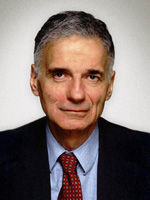
Create a "purposeful Congress," was his next theme. "It's the most powerful branch of government [in the Constitution], except it doesn't like to use its power," Nader said. "It likes to send it to the White House."
His final suggestion is drawn from his latest book "Only the Super-Rich Can Save Us!" In a novel-like stretch of imagination, he portrays how real-life billionaires could help preserve the world's economic systems and ecology.
Nader spoke on the last day of a three-day event convening 325 peak oil researchers and other interested parties for the first ASPO-USA convention in the nation's capital. The group argues that after 150 years of oil extraction most major oil exporting nations are well past their supply peaks, defined by scientists as "Peak Oil." The concept also encompasses exports, not simply production peaks.
During the conference kick-off, former CIBC chief economist Jeff Rubin predicted oil production declines soon ranging from 2 to 6% annually. This, he said, will double or triple oil prices on the market, creating further economic slow-downs and job losses beyond those of the recent recession. His wrote a Toronto Globe and Mail column last week on this, "We have run out of oil we can afford to burn."
Conference headliners included former Nixon and Ford administration Defense Secretary James Schlesinger, who was also the nation's first Energy Department secretary under the Carter administration. Earlier, he had been CIA director and chairman of the Atomic Energy Commission under President Nixon. He is now chairman of Mitre Corp., a major government contractor.
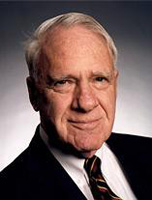
Dr. Schlesinger, above, wrote the forward to the newly released, "The Impending World Energy Mess ─ What It Is and What It Means to You!"
"This is an important book," he said. "Yet despite the importance of the message it will not be a welcome book because its message is unpalatable."
The three co-authors, Dr. Robert Hirsch, Dr. Roger Bezdek and Robert Wendling, use their more than 100 years combined experience in energy and economics to describe peak oil themes, building on a pioneering research paper they co-authored in 2005. But they illustrate also divisions even in the environmental community by skepticism about the possibility of solving global warming, or its causation by humans.
Regarding issues more specific to oil production, several speakers cited a U.S. Department of Defense study that predicts worldwide peak oil in 2015. In general, the concept of peak oil has found more support among the military and intelligence communities, which need fuel for mobility, than among politicians. The latter, of course, are more vulnerable to short-term election pressures from the vast array of lobbyists with narrow and often short-term or selfish concerns.
Thus, the only federal politician on the speaker program was U.S. Rep. Roscoe Bartlett of a Maryland, the second-ranking Republican on the House Armed Services Committee. The only elected state official scheduled was Connecticut Assistant House Majority Leader Terry Backer, a Democrat from Stratford who sent regrets because of illness.
ASPO-USA seeks to change this by ramping up its efforts in Washington. This includes its decision to locate in the nation's capital, and open the convention with a Capitol Hill briefing. That session attracted a standing-room-only crowd of 150, primarily congressional staffers and reporters.
ASPO-USA President Jim Baldauf is a Texas oilman in what he calls "a very small way" and a lifelong environmentalist. "Peak Oil will affect every aspect of our life," Baldauf says, as quoted in my HuffPo column last week at the start of the convention. E&E TV's Monica Trauzi interviewed Baldauf on such points, with their dialogue available on video, with a transcript.
"Just about everyone understands peak oil now, from major oil companies to academics to the environmental community," Baldauf said. "It's an endowment of energy that has taken hundreds of millions of years to accumulate and we've ripped through about half of it in 150 years."
But some are eager to pronounce the peak oil group's momentum over, even before most consumers and voters have even become acquainted with supporting data.
After the pioneering researcher Matt Simmons died suddenly this summer, for example, the Wall Street Journal published a blog entitled, "Without Matt Simmons: Has Peak Oil, Well, Peaked?"
As noted above, differences of opinion coexist even within the core group. The range is illustrated further by the major discussion of the BP Gulf of Mexico disaster.
The moderator was Dr. Tad Patzek, chairman of the department of energy and geosystems engineering at the University of Texas at Austin. Despite widespread suspicions in the environmental movement about the disaster's causes and clean-up, his panel was balanced and technically oriented. It was far from a bash-BP session.
The diverse interests relevant to the peak oil debate were illustrated also by the conference's impressive total of 40 supporting organizations and publications, far beyond what most energy and communications conventions obtain.
Bianca Jagger provided a non-technical message based on her three decades of prominent human rights advocacy. She and others sought to prepare the public for the risks that could come from $150+ a barrel oil (up from today's price of about $83). Some predicted gas lines similar to those in the 1970s after OPEC embargos but of much longer duration, along with further U.S. job losses as companies reduced production.
Predictions for the rest of the world included warnings that emerging economies in China and India would use their funding for a larger share of the available fuel ramping up gas-station prices in the U.S. to world levels of $7 a gallon and higher, and that have-not Third World nations would face desperate food-production and other calamities.
Against this backdrop, Nader praised what he called as $132 billion in U.S. stimulus funds helping to address such problems here. "There's never been anything like that out of Washington," he said. But he added that too much of the funding money would inevitably be "wasted" because the spending was pushed out to stem a recession, and hasn't been coordinated by the kind of long-term, expert planning needed for optimal efficiency.
As for the mid-term elections? Nader attacked what he called, "The complete absence of any serious debate between the candidates" on what he regards as the most relevant energy issues. "I can hardly tell the difference between the Republican and Democratic candidates."
Nader blamed the corporate-owned media, especially TV. "Ninety percent of that is entertainment and ads," he said. As for journalists at the major newspapers, he alleged, "They don't like to work on weekends."
Zeroing in on TV programming, Nader said, "I hear they're preparing a 'Chimpanzee Channel,' where they'd dress them up, and have them prance around."
"We don't even have a channel for humans."