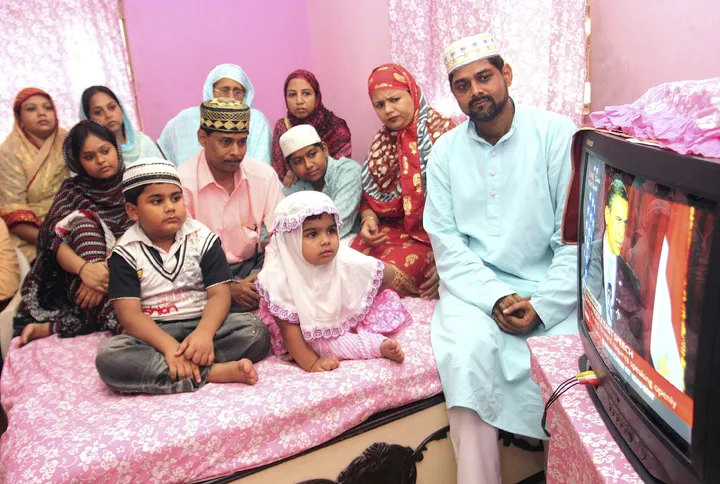
NEW DELHI -- In his Cairo speech, President Obama made reference to seventeen Muslim-majority countries. He also spent a lot of time discussing a country where Muslims are a minority: his own. But he did not mention, at least not by name, one nation that Muslims have called home for centuries; a nation whose Muslim population exceeds that of the entire Persian Gulf; a nation where some of the Muslims best known to Americans were born, from Fareed Zakaria to Aasif Mandvi to Jamal Malik.
How could Obama forget about India?
That was a popular question at the American Center in Delhi, where the U.S. Embassy hosted a screening of Obama's speech. In a panel discussion afterward, a professor cited, approvingly, a long-winded column arguing that the speech should have been held in New Delhi. An audience member asked, with a quivering voice, "What is the Muslim world if it does not include India?"
But this cry of nationalism was taken up mostly by liberal Hindus. The Delhiite Muslims I spoke to were less interested in what Obama left out than in what he said.
Bushra Saeed, who recently finished a master's in biotechnology, was "relieved" to hear Obama affirm a woman's right to wear the hijab. "I mean, you see me," she said, referring to her own headscarf. "I'm studying. But still, a Muslim woman faces two things: it's her choice to wear the hijab, but the modern people stop her from wearing the hijab; or it's her right to study, but the traditional people stop her from studying. If education is a woman's choice, then clothes too [should be] a woman's choice."
Arif Ali Khan, a Muslim student at Jawaharlal Nehru University, was convinced that Obama won major points with Indian Muslims, even if he did not mention them explicitly. "Right now, the average Indian Muslim thinks that Saudia Arabia is one of the biggest funders of the Taliban. If anything, this is the problem Indian Muslims will have with the U.S.: 'Why are you funding these Saudi guys?' So the fact that [Obama] has stood up against corrupt Arab governments--I think Indian Muslims will be encouraged by this."
Shahnawaz Ali Rehan, Secretary of the Students Islamic Organization of India (SIO), failed to suppress his proud grin as he recounted Obama's biography: Harvard Law Review editor, accomplished author. "Obama is a powerful writer, powerful orator...He also addressed the emotion of individuals, like how we must pick a straight path, not the easiest path. The way he spoke...it was like a good mosaic. A good combination of data, good eloquent power, analysis, everything."
Suhail K. K., President of the SIO, said simply: "This speech was something that touched all of our hearts."
Of course, love for Obama does not always imply love for the United States. Suhail, for one, is as cynical about America as he is hopeful about its new President. "Obama is personally against the policy of imposing great power; but as a representative of the United States, he must represent the cause of war. The very existence of the United States is by killing, by imposing, starting with the discovery of America, starting with [Columbus]...When we see into the past, the U.S. has no moral right to preach about democracy. They're actually against all democratically elected governments they don't like: Cuba, Vietnam, Hamas."
Indeed, every Muslim I talked to, no matter how admiring of Obama, uttered some variation on the same meme: actions speak louder than words. "It's a very nice speech," Bushra said, "but we expect some actions in the future."
This is especially true, it seems, when it comes to Palestine.
According to Shahnawaz, "Palestine is the one thing all of the Muslims will be watching...This is a big move forward, that the U.S. president is saying that [Israeli] settlements must be stopped. This is a big achievement...but will it happen?"
Back inside the air-conditioned auditorium at the American Center, the post-speech debate raged on. A Hindu fundamentalist rose from his seat to declare that the Koran advocated violence, and he was promptly shouted down. The next audience speaker waxed poetic about what he called "the Gospel of Obama," to which the man next to me grumbled, in English, "useless fellow."
Restless, Arif and I wandered outside for a chai. "The old understanding of 'Americans are arrogant, they just want to eat a lot and have microwave ovens'--I think this is starting to change," Arif said, as much to himself as to me. "I think people will now be more able to see the complexities."
One can only hope.