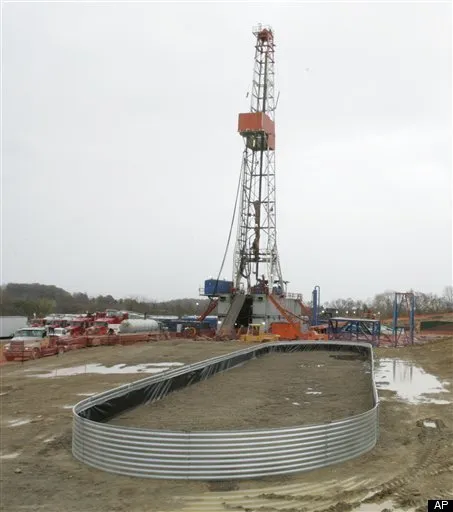
Cooperstown, NY: Gas drilling and the forces behind it are massed to exploit the rich gas deposits of upstate New York, in the process trampling on the basic idea of government in America.
That idea, of course, is that governments are created to protect us from each other, and especially the weak from the strong -- that the fundamental test of a society is how it treats its most vulnerable. Yet in this case the powers that be seem perfectly willing to pretend to be protecting the rights of the weakest, while, predictably, throwing them to the dogs.
In this case, New York State seems perfectly prepared to risk making broad swaths of pristine rural countryside more or less uninhabitable by poisoning their water supplies, in return for new tax revenues.
The goal is to wean ourselves from foreign oil and segue toward renewable sources of energy. A noble goal, of course: Natural gas recovered in America could fuel our homes, cities and vehicles with half the carbon emissions of oil -- and, especially, coal -- and wipe out OPEC's leverage over our economy. It's the cornerstone of American energy policy and would be a large, new source of tax revenue to a state that needs one.
The problem: The gas deposits in view are trapped in shale formations, and freeing them requires so-called "fracking" -- fracturing a horizonally-drilled well with water, sand, and poisons like benzene, tolulene, diesel oil, and other compounds -- all pumped in at very high pressure.
Under the best circumstances about 40 percent of the fracking fluid used in any one well is left behind, free, over time, to migrate through underground formations and possibly contaminate local water sources. Little provision exists to deal with the liquids that are pumped out. And accidents during drilling are anything but unheard of; reports from Pennsylvania, where drilling has already begun apace, confirm the fears of New York's drilling opponents.
Industry sources like to insist such migrations haven't been proven; but considering these formations are often a mile down, and fracking has only been in use for about forty years, it's reasonable to consider that it would take at least that long for these poisons to declare themselves, and that underground water supplies can't be cleaned up like oil-soaked beaches.
That likelihood of contamination is strong enough that New York City, whose main water supply comes from reservoirs likely to be affected by the drilling, recently hinted it would sue the state if drilling is allowed near the watershed feeding those vast lakes. The New York Times even printed an editorial pounding the table for the idea -- but only for New York City.
Safe water for 8 million people is nothing to sneeze at; but lost in the satisfaction of protecting it is the fate of safe water for the many fewer Upstate residents who get their water from private wells on their own property -- few of whom have New York City's legal clout, if push comes to shove.
Meanwhile, the state's recently released draft generic environmental impact statement (DGEIS) demands drillers disclose the chemicals they use in fracking, and so does a recently-proposed law languishing in Congress; but all these laws do is give small-holders the right to sue giant energy companies for damages -- one of those masterpieces of prestidigitation that inspired Mark Twain to comment that America has no native criminal class -- except Congressmen.
The DGEIS, meanwhile, was praised by the main industry groups as a fine basis for drilling regulation -- an ominous sign if there ever was one to people hoping to protect the public's right to live in a safe environment.
The document would force drillers to act like adults, and clean up after themselves if they contaminate local wells; but somebody has to prove they did it first, and even the state's Department of Environmental Protection admits it only has 16 inspectors, statewide, to regulate what will be thousands of gas wells spread across hundreds of square miles.
Left unaddressed was the fact that the Upstate economy is built on tourism, agriculture, and vacation homes, all of which will be badly damaged by modern gas field exploitation, with its dense concentration of wells, huge trucks using roads meant for pickup trucks and tractors, and 24/7 factory-level noise during drilling and, especially, fracking; it's hard to imagine city folk, for instance, paying good money to tour, or live in, operating gas fields -- or come back when the drilling's over.
Also, and typically unmentioned by drilling advocates, is that properties with gas leases are virtually unsaleable; banks won't finance sales of such properties. And thanks to a perfectly legal provision called compulsory integration, property owners who don't want their property included in a gas field are out of luck -- they can be forced to allow it.
At the same time, though, those larger national and state goals -- energy independence, reducing global warming, transitioning to renewable energy sources, and new revenue sources -- are good things. We need to wean ourselves from OPEC. We need to stop poisoning our air. We need to get on the path to a sustainable energy future.
Like it or not, natural gas provides a good, if imperfect, vehicle to reach those goals. This means that permitting some sort of gas drilling in New York has the force of a long freight train -- and that in the end, anybody trying to stop it by lying on the tracks will just be a wet spot.
So while a drilling ban is very appealing, an all-or-nothing approach is not practical, even if one idea -- leaving New York un-drilled, as a sort of strategic gas reserve -- seems an attractive alternative. What's necessary instead is a serious regulatory structure with teeth -- one that can prevent contamination, not just deal with it later, and one that throws responsibility for clean-up on industry; the current structure privatizes the profits of drilling, but socializes the costs -- just like last year's bank bailouts.
We can at least hope the widespread citizen's groups organized against gas drilling in New York get some traction in the public debate; because what's shaping up so far is a smug, "I've got mine" posture by New York's strongest, while apparently, as far as they're concerned, the devil can take the hindmost.
(Full disclosure; the writer lives in Otsego County, New York, where gas companies have signed a number of drilling leases -- two within a mile of his farm).