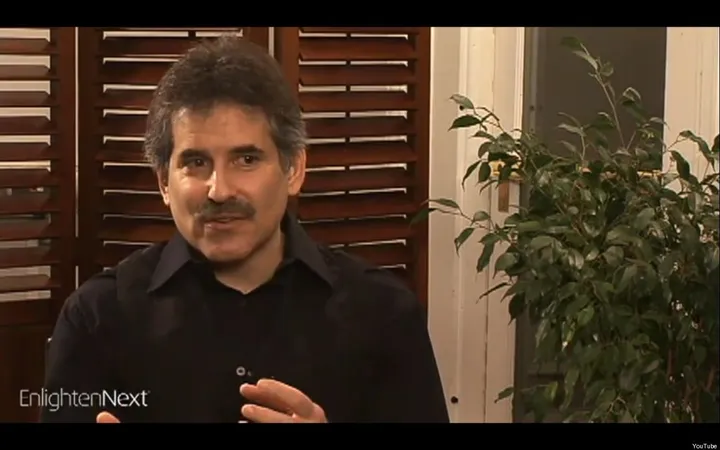
An Introduction to Evolutionary Enlightenment
My teachings are about spiritual enlightenment -- both what we could call traditional enlightenment, and also what I call the new enlightenment, or Evolutionary Enlightenment. Traditional enlightenment is what I learned from my teacher, but Evolutionary Enlightenment is what I have discovered and created in my own work over the last almost quarter of a century. During this time, I have discovered a new source of emotional, psychological and spiritual liberation that easily exists within anyone's reach, anyone who has the eyes to recognize it and the heart to desire it. To put it simply, enlightenment is evolving. It is no longer found only in the bliss of timeless Being; it is found also in the ecstatic urgency of evolutionary Becoming.
It was only after many years of deep introspection, dialogue with masters and thinkers from all traditions and committed work with thousands of spiritual seekers throughout the world that I began to understand what this new enlightenment is all about, why it is so different from what has come before, and why, as I believe, it holds the key not only to our personal development but to our cultural evolution. In the passage that follows, I will briefly share with you the journey I took from the old enlightenment to the new enlightenment.
I became a spiritual teacher in 1986 after a powerful awakening irrevocably transformed my life. My own teacher, H.W.L. Poonja came from the Advaita Vedanta tradition, and it was the timeless simplicity of this ancient teaching that catalyzed my awakening. The essence of my realization was simple: everything IS as it is. It was a classic satori, or enlightenment, experience -- seeing through the illusion of time directly into timelessness, awakening to the eternal Now, the mystical, absolute, nondual, nonrelative Ground of Being. My teacher taught me -- as he'd been taught by his teacher, the great saint Ramana Maharshi -- that the freedom I was looking for was already present as the very ground of my own awareness.
That ground, the deepest dimension of who we all are, always already exists prior to time and the creative process. That is why mystics throughout the ages have told us that there is nowhere to go and nothing to do except to realize THAT. After my own awakening to this timeless truth, I initially taught in the same way that I had been taught. My spontaneous response to those who came to me in the first few years of my teaching career was simply this: Realize and surrender. Realize and discover that mystery that cannot be understood by the mind, and surrender to that and that alone. Realize that you were never born. Surrender to the fact that you were never unfree. Realize that there was never a problem and never back down from that realization. Surrender to that and that alone. I was convinced beyond doubt by my own experience that there was nowhere to go, nothing to do, and no one to be or become. In fact, in those days, I was so sure about this view that I questioned the authenticity of any spiritual teaching that implied that there was anything in the future to become other than who we always already are.
This teaching is not new. It has been the precious jewel that has passed from Master to disciple for thousands of years. The perennial goal it points to is essentially transcendence -- a dramatic release or escape from time, mind and world that is found when one awakens to the timeless, formless domain of Being. In most traditional mystical teachings, this other-worldly emphasis on transcendence as the goal of enlightenment hasn't changed since the Buddha preached the dharma in ancient India 2,500 years ago or since Adi Shankara wrote his Crest-Jewel of Discrimination in the eighth century. And for us postmodernists, it also hasn't changed since the glory days of the 1960s when Harvard psychologist-turned-psychedelic-rebel Richard Alpert, a.k.a Ram Dass, published his groundbreaking spiritual manifesto and call-to-arms, Be Here Now. Almost 40 years later, spiritual bestsellers are still proclaiming the same message: Transcend the mind and time. Rest in the "now," in the infinity of the present moment. All else is a temporary illusion.
From this perspective, the world and all of manifestation is a mere "play" of consciousness, or lila, as it's called in Vedanta: What happens here is not ultimately real. Only the Absolute, unchanging, timeless, formless, unmanifest Ground is real. Therefore, nothing needs to change in this manifest world, and true freedom is found in escaping from it altogether. Why entertain an illusion? Why try and improve that which is not real in the first place? But as powerful and as liberating as this perspective was at the time of my own awakening, as a spiritual teaching in our day and age I soon began to find it problematic. I observed that many who came to me in those early years found themselves plunged into the same miraculous state of liberated consciousness that I had discovered, but the effect of this powerful experience was generally not the same. It seemed that, in most individuals, awakening to the bliss of Being did not automatically lead to radical transformation. Many individuals had great difficulty letting go of doubt, even in the face of their own ecstatic flights into enlightened awareness. They were reluctant to accept and stand for the liberating truth of what they had seen with their own minds and hearts. To me it always appeared obvious that the power and significance of that which is Absolute was given validation only through our willingness to stand for and embody its glory as ourselves -- through action, through choice, through the way we lived in the world of time and form.
As I began to engage more deeply with those around me, I discovered that the state of the individual's soul -- their capacity for integrity, authenticity and higher conscience -- always played a critical role in determining how ready they were to embody their own deepest realization. So I began to put more and more of my attention on the all-important question: How can we cultivate the ability and readiness to express the beauty, perfection and wholeness discovered in spiritual revelation? This was the beginning of a radical divergence from the path and perspective I had been taught. Slowly, over a 10-year period, my teaching became more and more about the transformation of the individual and the world; whereas in the traditional teaching the emphasis was really on liberation from self and world.
The differences in the way I was now seeing were based upon an emerging new way of interpreting what enlightenment meant. In the traditional Eastern metaphysical perspective, the world isn't real, it's only an ephemeral appearance, an illusion, a mere insubstantial, transient dream in the mind of God. I felt differently. To me, the world was certainly real and, in fact, was an inherent and all-important dimension of what God always is. For millennia, this question has been the spark of an ongoing metaphysical argument among sages, seers and philosophers. And it is a significant one. If the world isn't real, then nothing needs to be done about the way things are. But if the world is real, then it soon becomes apparent to us that there is real work to be done. This work was what my life was now devoted to. I was wholeheartedly committed to the transformation of the world -- to bringing the power of enlightened awareness into the world through rational action, through moral being, and through engaging with the process of time in the most deliberate and creative way.
From the very beginning, since my early days as a seeker, I had always been convinced that enlightenment had to make sense. It gradually dawned on me that I was going to have to figure out for myself how to translate the profound shift of perspective I was experiencing into a form that would make deep sense to the world I was living and working in. I needed new ways to interpret the meaning and purpose of enlightenment as it traveled from its roots in the traditional East to its new home in the postmodern West. I knew that the questions I needed to answer in order to find my way forward were important beyond just my own experience. But I could never have predicted where they would lead me.
As the years passed, my emphasis that enlightenment is an action and not merely a higher state emerged more and more powerfully in my teaching. I remember one particular morning many years ago during a retreat in India. I was giving a talk and an unbridled passion poured through me spontaneously. I didn't know where it came from, but it was calling for this miracle, this mystery beyond time, to become manifest in the world of time and form as ourselves. I found myself imploring those around me not only to awaken to their true Self as timeless Being but to dare to respond to the urgent call to express that liberation in the world of Becoming.
Over time it became clear to me that this awakening passion was really a passion for much more than enlightenment in the traditional sense. The spiritual energy that was running through my veins was calling me to a new, active and creative expression of enlightenment. It was an enlightenment that by its very nature could never be content with the way things were in the past, no matter how glorious that past may have been. It was an enlightenment that could also never be content with how things were in the present moment, even at those rare instances when everything seems like it couldn't be more perfect. It was an enlightenment that was defined by a ceaseless and ecstatic reaching forth toward an as yet unborn and unmanifest potential, a constant stretching toward a future perfection that would always lie just beyond one's fingertips. My inner eye and heart were focused on the freedom of that mysterious place between the immediacy of the present moment and the endless thrill of the possible.
Slowly but surely, in my quest to redefine enlightenment, I began to connect it to the most important emergent narrative of recent cultural history: the discovery of evolution. Seeing our presence in this world from the vantage point of a 14-billion-year process powerfully recontextualizes the spiritual impulse in a thrilling, rational and deeply meaningful framework. In this context, we realize that awakening to timeless Being, the perennial goal of Eastern enlightenment, is only half of the picture -- half of the totality of reality. The other half of the picture is the world of form, the process of Becoming -- the universal creative impulse, that explosion-in-motion that is the entire evolutionary process that we are all part of. If enlightenment is the discovery of what IS, then it must embrace the ultimate nature of all things: seen and unseen, known and unknown, form and formlessness, both Being and Becoming. Being is that timeless void out of which the cosmos was born, the empty ground from which everything arises and to which everything ultimately returns. Becoming is the something that emerged out of nothing and is still emerging in this moment. Becoming is Eros, the evolutionary impulse, the first cause, that original spark of light and energy that created the entire universe. And I realized that it was that very same creative spark that was now awakening in my own heart and mind as a sense of ecstatic urgency to evolve. This is why I began to reenvision the very goal of the spiritual path, seeing the purpose of enlightenment as not merely to transcend the world, as I had been taught, but to transform the world through becoming an agent of evolution itself. Enlightenment was not the end of the path. It was the beginning.
In the East, they believe that enlightenment is a final endpoint, a monumental attainment that marks the end of becoming for the individual. Someone who is enlightened has liberated him or herself from identification with anything that exists in time. And this conclusion makes sense when you consider the cultural context in which it first emerged. In ancient India, they had not yet discovered evolution. Like most of the world at that point, they had not yet discerned that time had a beginning and moved in a straight line from the past to the present to the future. They believed that time, like life and death, was a repetitive process that was constantly going through the same cycle and would for eternity. As a matter of fact, many Hindus in modern-day India still prefer to see our cosmic origins through the lens of their ancient Vedic science, rather than accepting the findings of Western science and modern cosmology. And if reality is seen through this particular cultural lens, it would make sense that one would soon grow weary of the eternal tedium of cyclical existence and hunger for a final release. That's why the traditions say that the individual who is "fully enlightened," who has gone all the way, is that rare one who has finally achieved emancipation from the endless repetition of birth and death on the wheel of endless becoming.
It's important to remember that up until very recently in human history, we didn't know what we know today: that we are all part of that developmental process that had a beginning in time and that is going somewhere. It's only been in the last couple of hundred years that we discovered evolution, and only in the 20th century that we came upon what is known as "deep time" -- the incomprehensible span of 14 billion years since the universe burst into being. When we apply the perspective of evolution to the nature of enlightenment, it changes everything.
From the perspective of the eternal timeless ground, the traditional teachers are right. The highest spiritual truth is that nothing ever happened, you and I were never born and the big bang never occurred. That's enlightenment, that's liberation, that's samadhi, that's satori. But from the perspective of evolution, the entire picture changes. Modern science and cosmology have clearly revealed that time doesn't move in predictable cycles that return again and again to the same point, but is, in fact, a linear process. Fourteen billion years of development have produced all of manifestation -- the entire known universe and everything that's contained within it -- including its greatest mystery: the capacity for consciousness itself. The arrow of time is a creative process and that capacity for creativity and novelty is the most extraordinary part of the whole dramatic unfolding from the big bang to the present moment. This is not just another repetition of an endless cycle. This hasn't all happened before. Where we are going is not predestined.
The most exciting part of this realization is that we discover, if we look deeply into our own experience, that our own emerging desire for spiritual freedom is not separate from the impulse that is driving the entire process. I call this the Evolutionary Impulse. When we awaken to this impulse, we discover something miraculous: that that dynamic and ever-evolving creative principle is none other than our own Authentic Self. This is the new source of spiritual liberation in the teaching I have come to call Evolutionary Enlightenment. It's not just about awakening to timeless being -- it's about awakening to eternal, ecstatic Becoming.
Evolutionary Enlightenment calls on us to awaken to both the timeless peace of Being and the relentless passion of the Evolutionary Impulse.
The reason that the Evolutionary Impulse is the source of the New Enlightenment is because of its future-oriented directionality. And this is the important distinction: the old traditional enlightenment is not future-oriented; it is not time-oriented at all. Traditional enlightenment points us beyond the world, beyond time and space, toward what has been, at least until now, the perennial source of spiritual freedom and mystical liberation: the Ground of Being. But those of us in the 21st century who are looking toward the future urgently need a mystical spirituality and source of soul liberation that points us not away from the world but to that big next step we need to take in our world. That next step will not emerge by itself -- it must be consciously created by human beings who have awakened to the same impulse that is driving the process. As we awaken to this vast perspective, an overwhelming and profound truth becomes clear: At this point in evolution, the process is dependent upon us. The evolutionary process desperately needs our conscious and committed participation. This has become the defining theme and ultimate purpose of Evolutionary Enlightenment over the last 10 years. The old enlightenment, with all its power to free the human mind and heart from suffering, can only lift us beyond the world. But when we realize that the world needs our engaged and enlightened action, it becomes urgent that we find a spiritual path, practice and philosophy that empowers us to courageously and passionately participate in the fast-changing process that we are in the midst of.
This liberating spiritual perspective on the human experience is contemporary and inherently creative. It's a spiritual teaching for our own time because its central tenet is that a more enlightened future for our world depends on one thing and one thing alone -- our higher development. The world around us changes for the better as much as we are willing to change ourselves. The world we occupy and cocreate begins to transform as we do. The old model of enlightenment was one in which the individual was liberated but the world remained the same. In the new enlightenment, the point is no longer merely the liberation of the individual; it's the evolution of self, culture and cosmos through the individual. That's Evolutionary Enlightenment.
***
Andrew Cohen will be speaking about Evolutionary Enlightenment this Saturday on a free global conference call. Click here for more information and to register.
***