Here are two interesting points: electric motors are inherently more efficient (and simpler) than internal combustion engines (ICE), and it is far easier to produce green electrons than it is to produce green gallons of liquid fuel. Both augur well for an increasingly electrified transportation system.
The first point is incontrovertible: electric motors can easily reach an energy conversion efficiency of 90%, while ICE's have an efficiency of around 20%. Simply put, that means that for a given unit of energy, an electric motor will produce more power. What's more, electric drive trains are far simpler, requiring 1/10th as many parts as a gas car (no spark plugs, fuel tank, transmission, muffler, etc.).
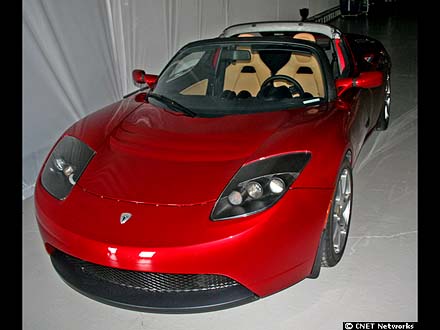
The second point, however, is less obvious. Politicians, venture capitalists and even automakers and oil companies have placed their bets on biofuels to both lower greenhouse gas (GHG) emissions and wean America off foreign oil. Unfortunately, so-called advanced biofuels, such as cellulosic ethanol, have yet to be made commercially available, and first-generation biofuels like corn-based ethanol have shown only modest GHG benefits, while contributing to significant social unrest and pollution of land and water. All this had led the European Union to ban the import of some biofuel crops. But the biggest drawback with biofuels is that they rely on biomass, a resource that is limited and competes with other uses (food, compost, etc).
Creating green electrons can be done without creating social and environmental problems. For one thing, there are so many clean ways to produce electricity, and unlike land or oil wells, no one owns the sun. Aside from the well known solar photovoltaics (PV) and wind turbines, there are also solar concentrating plants, solar towers, geothermal plants, and wave energy plants, to name a few examples. A recent article in Scientific American titled 'A Grand Plan for Solar' showed how much of America's power needs could be met with massive solar PV and solar concentrating plants in the Southwest, as well as decentralized solar power plants scattered throughout the country. Provided that we make a tremendous investment in energy infrastructure to bring the power from where it is produced to where it is needed (something we need to do anyway), there is no reason why we cannot power our homes, businesses and vehicles with the same clean fuel: electricity.
So what will the future of transportation look like? Most likely, we will see lots of plug-in hybrid type vehicles until the cost and weight of battery packs comes down more. These vehicles can go 40 miles or more on a battery pack, at which point the car returns to performing like a normal hybrid. This is the technology behind the Chevy Volt, as well as the Aptera Typ-1, and we can expect to see it in everything from buses, to trains to delivery trucks. And if another alternative fuel--say, hydrogen or advanced biofuels--comes to prominence, it can easily be paired with an electric motor to power the vehicle. Finally, Israel has begun investing heavily in the infrastructure and partnerships needed to put 100,000 electric cars on Israeli roads by the end of 2010.
$4 a gallon gasoline is severely impacting our economy, and carbon emissions from dirty power plants and transportation are rising. Switching to a renewably-powered, electrified transportation system can cost-effectively free us from global oil markets, slash emissions, create quieter roadways, and encourage the kind of clean energy investments that we desperately need.
More on Electric Vehicles:
::Pop Quiz: Electric Car; A Modern Star?
::More Cities Jumping on the Hybrid Bus Bandwagon
::Tesla Motors: Affordable Electric Cars are Coming
More on Biofuels
::Green Basics: Ethanol
::Earth Policy Institute: Lester Brown on Food-Based Fuels
::Ethanol vs. Biodiesel: Just the Facts
More on Renewable Energy
::How the Economics of Renewable Energy Have Been Validated
::Spain: Renewable Energy Powerhouse
::How Does Solar Energy Work?
Want to reply to a comment? Hint: Click "Reply" at the bottom of the comment; after being approved your comment will appear directly underneath the comment you replied to
i completely take issue with that baloney about the Scientific American article and the prospects for these giant, centralized power plants! you try to sound all progressive with your electric car then you regress into the 19th century model of remote (environmentally devastating) generation and lengthy (wasteful, dangerous) transmission lines? sorry, consider the sniff test FAILED.
unless these projects (and all other "green" projects) are fueled by power that sits lightly on the land (as in, power that is generated at point of use on previously developed lands), then they ain't green at all. those solar plants suck tens of millions of gallons of scarce desert groundwater each year for mirror rinsing and water-cooling. they permanently obliterate 10,000 acres of pristine wilderness apiece.
you think the deserts are blighted wastelands? come on out to joshua tree and i'll teach you a thing or two about blighted wastelands (hint - los angeles resembles one much more than joshua tree does). Do NOT think you can throw away entire ecosystems in some misguided greewash boasting about saving the planet. we have burned the reefs, deforested the rainforests, paved over the wetlands and melted the glaciers. you want to kill the deserts next?
insane.
Andy: Your two major points are incontrovertible. However, there is a third overwhelming point that counters both of them: current battery technology cannot match the density or convenience of liquid fuel. A tank full of gasoline is much lighter and smaller than a battery packing the same amount of energy. A gasoline tank can be filled in minutes; a battery for an electric car takes hours. This makes the technology unfeasible for those who lack garages, as well as putting a hard limit on unplanned or emergency travel. Advances in nanotechnology promise to solve these problems, providing batteries and capacitors that charge in seconds and hold far more energy than current batteries, but that's still many years away from commercial use. In the meantime though, I agree that plug-in hybrids are the best near-term solution as they offer the best of both worlds.
Amen.
Build nuclear reactors on shuttered army bases so that the US reaches or exceeds France's 80 per cent of its electricity from nuclear generation and use that new electrical supply to fuel the electric cars of the future -- air pollution and CO2 free (to say nothing of being quieter!)
I was just at the airport, and as I was standing there waiting for my shuttle bus to pick me up and take me to my parked car, I watched as bus after bus drove by for each rental car company and hotel, round and round every five or ten minutes, and thought about how much was gas being used every hour of every day for these gigantic, extra-wide gas guzzlers. All they do is drive around in a loop, 24/7.
If each of those vehicles was electric, think of how much fuel would be saved, multiplied by all the airports across the country.
What we really need is to do is electrify the interstate system so that electric vehicles can travel the long hauls on external power and only carry around enough storage capacity for the local roads. A step further would be "hybrid" electric train/cars that drive right onto an electric rail system for long hauls.
Transportation is an extremely broad issue. It's not just about technology.
Do we ever stop to ask ourselves, why are we getting in a car to go somewhere? A century ago, travel was a big deal. Now, NOT traveling is a big deal. We design our cities with the assumption that huge numbers of heavy, fast-moving cars will drive through them -- instead of asking how we might reduce or eliminate the need for those cars.
Having spent some time wondering how much powered vehicles represent unquestioning, wasted motion on the part of the human race, I will say that I believe that cars will be with us for several decades to come -- and that, despite some limitations in the current technology, the smart money is on electrification.
Unlike hydrogen, fuel cells, or many biofuels, "half-measure" electric vehicles are easy to create, using plug-in hybrids. If battery technology doesn't yet allow you an affordable, quick-charging vehicle with a 300-mile range, no matter. Build whatever plug-in hybrid is economical using the current technology. Toyota has already shown a modified Prius which gets seven miles of all-electric travel before starting the gas engine. It should cost about $3,000 more than a regular Prius. I'd buy that.
I am a regular reader and participant of the web site greencarcongress.com. Those of you who are really interested in the finer details of greener automotive technology might enjoy Green Car Congress as well.
There's supposed to be a decent quality hybrid vehicle--reasonable mileage on electric, motorcycle engine, to give you around 300 miles on both and it goes like a bat out of hell--not available yet, of course. And the last time I heard from them they wanted to know what I thought of their "cool factor." Probably not a good sign.
All I want is something to go to town (my choice of ten, fifteen or fifty miles each way for the towns I go to most often) and carry a reasonable amount stuff home with me. Safety and the ability to drive on limited access roads safely mean a lot more to me than styling. It's a genuine, enclosed, three-wheeler, single wheel in front. Also a bit off-putting.
http://en.wikipedia.org/wiki/VentureOne Plenty of links on tthat page.
But something like this is coming. And for those of us no longer young, who live in an area without a reasonable transit system, something like this may be a better idea than a horse or mule. Bicycles are wonderful--when we're healthy. But they don't carry a whole bunch.
Very misleading post. Look hard at the economics and viability of renewable power for a functional auto. It doesn't work.
NON-renewable power, of all kinds, is heavily subsidized. Unless you account for those subsidies, you will get a grossly unfair picture of the economic viability of renewable energy.
Back in the 1990's, before Gulf War II, even the super-conservative Cato Institute issued a report which stated that America's hidden subsidies to the petroleum industry amounted to $50 billion/year. Other studies, which take future damage from global warming seriously, put the figure much higher. And again, that was all before Iraq.
A number of years Scientific American looked at the efficiency of modes of transportation, and
steel wheels on rails, and high pressure bicycle tires, won hands down, over any other mode
of transportation.
Limited power output and capacity of batteries, weight of the batteries, as well as environmental concerns regarding disposal of batteries are major problems that will need to be overcome. It seems to me that we have this all backward. Why not a national program to place the power in the roadways instead, with vehicles tapping into the power supply much like "bumper cars" at amusement parks. This would provide the necessary power, would allow one to drive from the Atlantic Ocean to the Pacific Ocean without recharging batteries, would reduce the power required since the vehicles would be much lighter without having to carry the weight of the batteries, and would eliminate disposal issues.
I believe we are working past the problem of batteries using capacitors and other devices that will not entail the weight and disposal issues. What about each of us having a small pod that slides onto the type of transport system we need that day? We could conceivable travel between sites in pneumatically operated tubes. This was planned for New York City subways - in the 1870s.
I was recently looking at purchasing a scooter, either electric or gas powered, and the experience really opened my eyes. It’s clear to me that electric vehicles have a LONG way to go before they are acceptable to the average consumer.
A gas powered scooter gets 75 MPG, lots of torque, and can be filled up at any gas station in minutes.
An electric gets 12 miles per charge, a comparatively anemic motor, and takes hours to charge back up (four hours charging to go 12 more miles).
I did eventually decide on the electric, but only because I live 2 miles from work. Average consumers don’t, and thus such vehicles won’t appeal to them. Electrics are nice, but aren’t even close to meeting the needs of most people.
We love this post!
The best part is when people hook up their electric vehicles to solar panels, creating one heck of a clean running alternative!
http://www.youtube.com/watch?v=atG1tWvfMhQ
This is a perfect example, Zap Electric cars running off of Akeena Solar panels
That would be cool. The plug-in-recharge-unit is only as clean as the source of electricity into which you plug. In the midwest, where much electricity is produced from coal, an electric plug in is not so green; all you're doing is changing the location at which the pollution is produced.
This issue has been debated for many years, so the non-profit Electric Power Research Institute (EPRI) decided to study it. Their report was issued last year.
Their conclusion: even if you live in a part of the country which depends heavily on coal for power, a PHEV power train will be cleaner than the best available self-contained combustion power train. The folks over at CalCars wrote a summary of the findings and linked to the full EPRI study if you want to read it:
http://calcars.org/vehicles.html#2
Having said that, I went solar three years ago. I have room to expand my photovoltaic system, as soon as a plug-in hybrid becomes available to me.
I'm going to make this as simple as possible.
Green Car= Big Lie.
America's expanding ranks of working poor aren't going to run out and trade in their trusty ICE vehicles for a $40,000 hynrid anytime soon.
Those $3500 Tatta's that India will be flooding it's roads with won't be electric.
Neither are the 2000 cars the Chinese are adding every day.
Its time to start thinking about moving beyond auto dependence.
The time to start is NOW.
http://www.worldcarfree.net/resources/free.php
I'm going to make this as simple as I can.
Green Car=Big Lie
America's expanding ranks of working poor are not going to run out and buy a $30,000 hybrid.
Those $3500 Tata's that the Indians are going to be flooding the roads with WILL NOT BE ELECTRIC.
The same goes for the 2000 cars the Chinese are adding every day.
Its time to chart a future beyond auto-dependence.
http://www.worldcarfree.net/resources/free.php
An excellent post.
You illustrate the tension between government policy and free market. It seems obvious that the electrification of our transportation infrastructure is the ultimate consequence of diminishing oil discovery.
But our government policy looks for a liquid replacement.
To what degree should the government be picking winners and loosers? Would aggressive cafe standards reduce our standard of living and delay the introduction of electrified vehicles? Will the U.S. ultimately reach an electrified transportation fleet before Europe because we allowed a "shock" to drive changes in behavior, rather than trying to legislate them?
Does america risk future prosperity of we pursue a "government policy" of bio-fuels, rather than a free-market / electric model?
Mike
The pure free market does not exist and has never existed. Government plays a fundamental role in in creating the present transportations system and will involve a similar role in future systems.
You must be logged in to comment. Log in or connect with