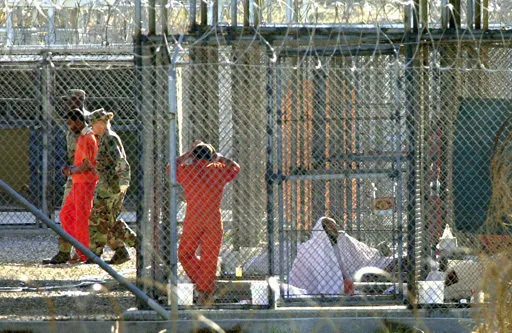
As part of its alleged "desire not to hold detainees any longer than necessary," the Pentagon announced on Tuesday that two Guantánamo prisoners had been transferred to Algeria. This follows the repatriation of two other Algerians -- Mustafa Hamlili and Abdul Raham Houari -- at the start of July, who were the first Algerians to be released from the prison in its six-and-a-half year history.
Cynics could argue, with some justification, that the releases were less to do with benevolence than with the fact that the US administration has finally decided to clear out as much of the dead wood at Guantánamo as possible, following the US Supreme Court's momentous decision, in June, that the prisoners have constitutional habeas corpus rights; in other words, that they have the right to challenge the basis of their long detention without charge or trial before an impartial judge.
Like Hamlili and Houari before them, the two men just released -- Mohammed al-Qadir and Abdulli Feghoul -- had been cleared for release, following what the Pentagon refers to as "a comprehensive series of review processes," since the first round of the annual Administrative Review Boards, held in 2005-06, on the basis that they no longer constituted a threat to the United States and its allies and/or no longer had ongoing intelligence value. These have become such commonplace expressions in connection with the Guantánamo prisoners that it's easy to forget that holding prisoners for over six years without charge or trial and then releasing them because they are no longer regarded as a threat or as a source of intelligence to be exploited like lab animals is utterly illegal.
To use rather less euphemistic terminology, both al-Qadir and Feghoul were released because the administration was unable to build a case against them, and, as I indicated above, because the authorities are anxious to scale down the challenge to executive power that was manifested by the Supreme Court in June's ruling in Boumediene v. Bush. As a result, however, they are also, to some extent, guinea pigs in a hazardous experiment.
Although neither man was realistically accused of being a member of al-Qaeda or the Taliban, or of raising arms against the United States, it's probable that, as has happened with Hamlili and Houari, they will face charges of leaving the country without permission, traveling on false passports, and of being connected, in some nebulous manner, with terrorist organizations, which will either be dismissed or lead to jail sentences.
The method whereby the Algerian authorities reach their supposed judicial decisions is mysterious, to say the least, which is another of the reasons that it has taken so long for the Americans -- and for their British allies, who have been similarly disposing of unwanted Algerian nationals from the UK -- to bypass international treaties preventing the return of foreign nationals to countries where they face the risk of torture by negotiating vague "diplomatic assurances" with the countries in question that purport to guarantee that the returnees will be treated humanely.
In the case of Tunisia, where two cleared prisoners were returned last year, this has been an unmitigated disaster, as both men were summarily imprisoned, subjected to show trials and sentenced to jail sentences of three and seven years, and a US District Judge, Gladys Kessler, promptly intervened to prevent the return of a third cleared Tunisian, ruling that he could not be returned to Tunisia because he could suffer "irreparable harm" that the US courts would be powerless to reverse.
With Algeria, the approach may, perhaps, be more appropriately compared to the tossing of a coin, or, as I put it when Hamlili and Houari were repatriated, to a kind of Russian Roulette, which, though marginally better, is hardly appropriate after all these men have been though. Their "crimes," after all, amounted to little more than traveling to Afghanistan at the wrong time, and being seized and sold by Pakistani forces after fleeing the death and destruction wrought by the US-led invasion of October 2001.
As I explain in my book The Guantánamo Files, al-Qadir, who was 25 years old at the time of his capture, had lived in Germany for seven years, but had spent some of that time in prison. Released on bail in 2000, he made his way to London, where he spent ten months before traveling to Afghanistan in June 2001 "to immigrate, make money, and find a wife." He denied an allegation, produced under unknown circumstances by an alleged but unidentified "al-Qaeda operative," that he had trained at the Khaldan military training camp, and explained that he had been staying in a house in the city of Jalalabad, but that, when the Northern Alliance were advancing on the city, the owner asked him to leave, and he then made his way to Pakistan with other refugees, even though he was ill with malaria.
Abdulli Feghoul, who was 41 years old when he was seized, had also lived in Germany, and had traveled to Afghanistan in 2001. He too had been staying in Jalalabad, and ran up against a similarly unsubstantiated allegation that he had trained at the Durunta military training camp. In an attempt to clear his name, Feghoul attempted to call a Belgian witness of Turkish origin to vouch for him, but the prisoner refused, and was released soon after, as the governments of Europe scrambled to repatriate their citizens. In April 2007, Feghoul told his lawyers, "It seems that I am buried in my grave," and in February 2008, Human Rights Watch reported (PDF) that he had not been allowed a single phone call home in his more than six years of detention. In addition, he explained that the Red Cross had finally "brought him photos of his family in early 2008, but that the prison guards searched his cell and took two of the photos away."
After so long in this most hideous form of limbo -- cleared for release but still held in isolated cells as though they had actually been convicted of heinous crimes -- I can only hope that both men gain some sort of justice in Algeria, and that suitable homes can be found for the dozens of other cleared prisoners -- over 65, according to the Pentagon -- who are also desperate to be freed from Guantánamo, but who do not wish simply to exchange one form of arbitrary and unjust imprisonment for another.