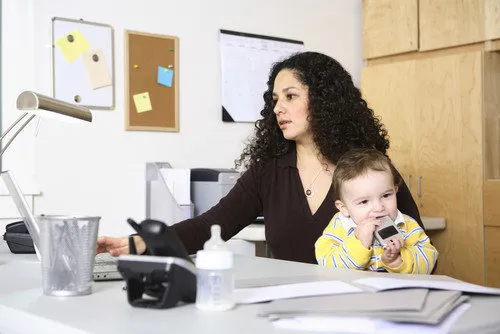
Ever wonder what happens to a worker who becomes disabled for weeks from injuries in a car accident? Or the worker who has a baby but no maternity leave? Or the worker whose parent, suffering from Alzheimer's, falls and hits his head and can no longer live alone?
Here's what happens, and neither option is appealing:
One, they stay home, a necessity in such cases as an auto accident or giving birth. It risks losing pay, and, sometimes, the job. In either case, it can set off a downward spiral. A 2001 Harvard Law School study found that a quarter of two-income couples who filed for bankruptcy did so after one of them missed work to recover from an illness or to care for a family member suffering an illness.
Or, two, they can work through the illness or injury, or they can return to work before recovery is complete. Neither is ideal -- for the health of the worker or for the affected family member. Workers who return too soon often relapse, causing more lost productivity; and in the case of sick kids, The American Academy of Pediatrics says "family-centered care" is a key contributor to better health outcomes but for kids whose parents can't stay home their health suffers.
Whichever the choice, workers are left to fend for themselves with no protections against lost income. It happens every day across America, and in each instance, it's neither right for the family nor smart for businesses or the economy.
Slowly, that's changing. While partisan rancor in Congress undermines the possibility of passing legislation any time soon that would require employers to offer a minimum number of paid sick days, or create a national insurance program for paid family and medical leave, a handful of cities and states have enacted programs that safeguard workers and their families, and others are considering them.
Connecticut along with San Francisco, the District of Columbia, and Seattle now all require at least some employers to offer a minimum level of paid sick days. California and New Jersey now offer paid family and medical leave insurance, allowing workers to take up to six weeks of leave for the birth of a child or to care for a seriously ill family member and longer to recover from one's own illness.
Now, it's Washington state's turn.
Recently, I had the privilege of testifying before a joint session of its House and Senate labor committees on two important measures under consideration. One would provide funding for a program enacted in 2007 yet never implemented that would allow workers to take up to 6 weeks of paid parental leave. The other would expand that law to allow leave for family care and for a worker's own medical needs. Lawmakers have yet to identify funding streams.
Despite the urgent need in a changed world, where we no longer have stay-at-home moms to care for ailing family members and the obvious medical, economic and social benefits of paid leave, some committee members seemed unconvinced. They expressed concerns about the impact on the state budget and on businesses.
Those concerns are misplaced.
Administrative costs would be minimal because Washington state, like all states, has an agency already processing unemployment insurance claims. Adding paid family leave would take a little time but not a lot of additional money.
The business argument doesn't wash either. In California, where paid family leave is funded entirely through a payroll tax on employees, a new study by researchers Ruth Milkman and Eileen Appelbaum found that 89 percent of state businesses viewed paid family leave as positive or having no effect, 87 percent said it generates no additional costs and 9 percent said it actually saved money.
Families are struggling today and the economic costs of being ill, having a baby or taking care of a sick family member only make families and children more vulnerable.
But it's not only families who lose -- employers lose valuable employees who must choose care over work, and the economy loses income that is reinvested in the community.
The question before lawmakers in Washington state and else where isn't whether workers should be able to take time off to care for ill family members or to recover, without losing pay. The real question is why all states aren't following California, New Jersey, and Connecticut with a smarter economic policy that protects families against these risks, reduces the shock on business and the economy and preserves the health and well-being of America's next generation.