iPhone app iPad app Android phone app Android tablet app More

Featuring fresh takes and real-time analysis from HuffPost's signature lineup of contributors
Annie Spiegelman

GET UPDATES FROM Annie Spiegelman
 

Bee Deviled: Scientists No Longer Bumbling Over Cause Of Colony Collapse Disorder

Posted: 09/19/2012 12:14 pm

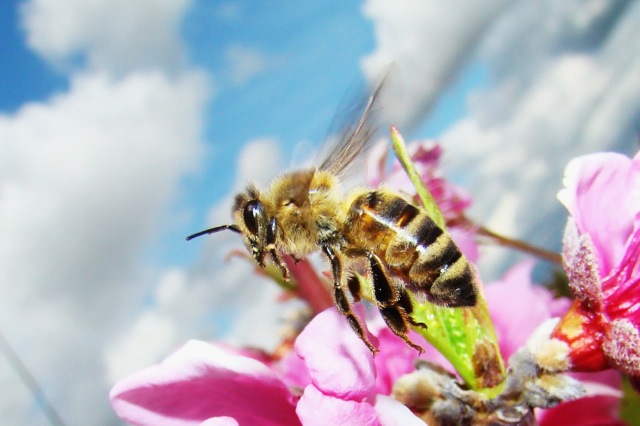
2012-09-14-kyleandersonphotography.jpg
Photo courtesy of Kyle Anderson Photography

Though worldwide bee health has been on the decline since the 1990s, it wasn't until the fall of 2006 that beekeepers nationwide began noticing millions of bees vanishing from their hives. This syndrome, named colony collapse disorder, or CCD, is characterized by the disappearance of adult honey bees from the hive, leaving the newborns to fend for themselves.

If you're not a huge fan of the bee, why should this matter to you? Well, if you like to eat food, you should be concerned. Besides gathering nectar to produce honey, bees pollinate agricultural crops, home gardens, orchards and wildlife habitat. As they travel from blossom to blossom in search of nectar, pollen sticks to their furry body and is transferred to another flowering blossom enabling it to swell into a ripened fruit. It's estimated that about one-third of the human diet is derived from insect-pollinated plants and three-quarters of all plants on the planet depend on insects or animals for pollination.

Most scientists now agree that the main causes of colony collapse disorder are nutritional stress, pathogens (mites, viruses and fungus), and pesticides. Two recent studies published in Science strengthen the case that a relatively new class of systemic insecticides entitled 'neonicotinoid pesticides' are indeed key drivers behind recent pollinator decline.

Not knowing how to even pronounce the word neonicotinoid,I decided to contact Pesticide Action Network, North America, (www.panna.org) where trained agronomists, chemists, ecologists and analysts track and translate science, making it publicly accessible to the rest of us. I spoke with Heather Pilactic, Panna's Co-Director, about the recent bee die-offs and what consumers can do to support the struggling beekeepers.

According to PANNA's reading of the latest science, these new studies show that pesticides do play a significant role in honeybee deaths. How large a role?

How big a role neonics, or any other bee-toxic pesticides play in CCD and pollinator decline really depends on the situation. The relative contribution of each of these three main causes will vary with location, timing, exposure levels, genetic vulnerability of a hive, etc.in ways that defy meaningful quantification. But the really short answer is "big."

What we do know is that pesticides are absolutely driving bee losses in a number of different ways: Increased herbicide use (driven by RoundUp Ready GE crops) is killing off habitat that bees rely on for nutrition. As for older pesticides, foliar (spray) applications of any number of pesticides while bees are foraging, is still common practice.

Bees are especially vulnerable to many insecticides: when you spray when and where they are eating, they die. New science out of the University of Pennsylvania's bee team shows that adjuvants, or "inert" ingredients that make up the bulk of a pesticide product formulation are impacting bee health as well.

A new class of fungicides -- once rarely used on corn -- have since 2006 been widely promoted as yield boosters. What little we have studied about the effects of fungicides on bees points to their synergistic effects when combined with neonics (as they often are): they increase the bee-toxicity of the latter up to 1,141-fold. The chemistry of yet another new class of fungicides indicates that they have insecticidal effects. Emerging science further points to fungicides as killing off important bee "gut" microbiota -- such as the bacteria that bees rely upon to turn pollen into bee bread, or the friendly bacteria that combat infection.

That's depressing enough but there's more. (Hang in there, pilgrim.) What's all the talk we hear about neonicotinoid pesticides?

Neonicotinoids, covers at least 142 million acres of U.S. countryside, much of it corn -- on which bees rely heavily for protein. As systemics, these insecticides course through plants' vascular systems to be expressed in pollen, nectar and guttation droplets. This class also happens to be very long-lasting, so they are accumulating in the soil, and saturating the environment in ways we have yet to quantify.

The most widely used of these neonicotinoids (imidacloprid, clothianidin, thiamethoxam) are known to be highly acutely toxic to bees, and have a variety of sub-lethal effects ranging from disorientation to memory, immunity and reproductive impairment. These pesticides are clearly making bees sick, and dead -- but so do a lot of other pesticides. What makes these neonicotinoids suspect is that they are known to be highly toxic to bees, pervasive, long-lasting and relatively new. Perhaps coincidentally, the emergence of CCD in the U.S. roughly coincides with the 5-fold increase of the level of neonics used on corn seed: seed companies began marketing seeds treated with a 5X level of neonicotinoids (1.25 mg/seed vs. .25) in 2004.

The peril of the bees is sounding an alarm warning us of environmental degradation but we're be too busy texting, facebooking and watching reality TV to notice. What are they trying to tell us with all that buzzing and disappearing?

Bees are an indicator species. They signal the well being of our broader environment, so their message is important. It is also one that I believe we are capable of receiving. Our generation, and our children's generation face overwhelming environmental issues. How do we process climate change? Water and food shortages? Biodiversity collapse? In a sense, the escape to virtual worlds is understandable. But I think of saving the bees as one of those graspable, manageable things that we can accomplish -- and that when we do accomplish it, the effects will ripple and magnify. If we stop poisoning bees, they will thrive and the world we live in will be more resilient as a result.


Why are you picking on Bayer's clothianidin? Doesn't Bayer make chewable baby aspirin?

Bayer's clothianidin -- which is one of the most toxic substances to bees that we know of -- remains on the market, in our view, illegally. There is no valid field study supporting its registration. The backstory is long and sordid, and we're still on the case. What it comes down to is that EPA has long been using this little-known loophole called "conditional registration" to speed pesticides to market with little or no safety data in hand. According to the Natural Resources Defense Council, of the 16,000 current product registrations: 11,000 (68 percent) have been conditionally registered -- that's 2/3 getting an essentially free pass to market.

So the Environmental Protection Agency tests for safety after the product has been on the market? That's reassuring... I need to go hide under my bed.

Registrants (such as Bayer) are then supposed to submit safety data according to defined criteria on a set deadline. What they do instead is delay, deliberately ignore certain criteria, or otherwise game the system to avoid real oversight. In the case of clothianidin, the field study they submitted was so poorly done as to be laughable -- it had no control and was on the wrong crop (canola instead of corn). EPA originally accepted it, then downgraded it and then neglected to close the loop.

Sounds like the pesticide industry has the EPA by the balls . . .What can the public do to help shift policy decisions that can help bees, beekeepers and people who like to eat safe food?

Our food system has always been a political arrangement in one form or another. What's heartening about the last 5 years or so is that the conversation is widening because folks are realizing that this is a political issue much more so than a lifestyle one. More people are seeing themselves as stakeholders in a rigged food system, and doing something about it. And that's a good thing! That's democracy.

So the MAN is still calling the shots? That's getting so old!

It is true that corporations and wealthy people have too much power in government -- but that won't change unless ordinary people engage the political process. Members of Congress truly are motivated by speaking with constituents who have a story to tell and know their issue. Decision makers still read the local papers, especially opinion pages. Get in the habit of writing letters to the editor, or OpEds. Or, get in the habit of making one phone call a week on one issue or another; before you know it, you'll be getting meetings with decision makers. Nobody can do everything, but we can all choose one thing and do it. For my money, I say, "get informed and get in the ring." Go to our website (www.panna.org) to get engaged, or pick another group working on this issue. What matters is commitment.

What is the "Imminent Hazard" legal claim filed by beekeepers and environmental groups?

"Imminent hazard" is policy-speak for "emergency so pressing that EPA has authority to take immediate action." Bees dying off en masse, year after year, is an emergency by any meaning of the term, and we petitioned EPA urging them to take action on this basis. Earlier this month they declined to do so, sticking to their original 2018 timeline for completing the analysis of neonic's impacts on bees (decisions and implementation would stretch out further still).
Luckily, members of Congress are starting to pay attention. Senators Gilibrand, Leahy, Whitehouse, and most recently, Markey, have all sent letters to EPA essentially telling the Agency to hurry up.

Homework assignment:

Between now and September 25, 2012 we have an opportunity to respond to EPA's recent decision that "pollinator declines don't present an imminent hazard." We can't wait till 2018 to do more studies on how these toxins are poisoning bees and the rest of us suckers. That's plain lame. Bee die-offs are an emergency requiring immediate action-Sign the petition at: Action.panna.org/dia/action/public/?action_KEY=11359

Buzz Annie at www.dirtdiva.com

2012-09-14-GardenPosterMEDIUM.jpg


FOLLOW GREEN
Photo courtesy of Kyle Anderson Photography Though worldwide bee health has been on the decline since the 1990s, it wasn't until the fall of 2006 that beekeepers nationwide began noticing millions ...
 
 
  • Comments
  • 41
  • Pending Comments
  • 0
  • View FAQ
Comments are closed for this entry
View All
Favorites
Recency  | 
Popularity
Page: 1 2  Next ›  Last »  (2 total)
04:11 AM on 11/08/2012
Now the hard one. If human children grew up in the same time span as other species of our size and activity level we would not need all this infrastructure that we see and work with. Our children do need a long time to become adult so we need all this stuff for them. Now tell me how much of it do we dedicate clearly "Here for the Children," Answer: None of it! Just ask a child. Our one job in this life is raising the children. Apply set logic to unanswerable science question and get your answer without a vote and today! Become a child again for a few moments and just enjoy the world. And remember, no one is born crazy, we are all driven crazy, mostly by mean-spirited, hateful actions that any child could tell you is wrong.
04:09 AM on 11/08/2012
I think this is an area of human life that my anthropological training tells me I must use an alternative method to draw a definitive conclusion in time to avoid a possible disaster. Now as I remember, Bayer developed the Aspirin, perhaps a hundred years ago. It is the most studied drug in history. If you pick up a PDR and look it up it will tell you that the course of action of an aspirin (how it works) is unknown. So my alternative method of coming to a conclusion is needed as science cannot clearly define the actions of more complex things. I get myself a classroom full of elementary school children and ask them. They nail stuff like this all the time. Empirically obviously frightening was their answer when asked what they thought. Killing without reason is bad. Burning coal for electricity has poisoned every trout stream that the USGS tested in 2010, 1400 streams. My school kids just smell the coal and said bad. Every person in America has mercury poisoning, yes even the children.
12:09 AM on 09/28/2012
Clothianidin (made by Bayer) has been banned in Germany. Bayer is a German company. Bees don't have borders. Clothianidin should have a world-wide ban. We are all connected.
04:02 PM on 09/26/2012
Actually, execs at Monstersanto & Bayer are laughing their __ off, knowing that most of *us* will be dead (or sterile) with no way back by the time we realize we should stop their nefarious plans. Bayer, a derivative of IGB Farben, the corp that ran Auschwitz, works hand-in-hand with M.santo. Not only are they destroying the planet's pollinators, M.santo sells a product called "Remembee" (TM), an anti-viral, modifying the bee at the RNA-level. What does it do? It protects bees AGAINST the Israeli Acute Paralysis Virus & against the effects of neonicotinoid pesticides. But now M.santo OWNS those bees => thus, they can control which food to pollinate. Look at the revolving door of M.santo & govt: Roger Beachy (USDA NIFA), Michael Taylor (FDA Dep Cmmsr), etc. See http://bit.ly/wqaAUI & http://bit.ly/Q0KLBd. No more organic, heirloom tomatoes. They'll pollinate only their GM-crops. What's in the genetic modification? Something to mess up our reproductive systems? How many more generations will we be? With or without mutations, cancer, sterility? We were warned by Nazis: "What we cannot accomplish by force we will accomplish by stealth." They just have to avoid eating the poison they sell, we'll die off by the millions & their offspring will inherit the resources left on this planet. Sure, it'll be toxic, but with so many robots, nanotech, & less people to feed, I believe this is a dystopian nightmare well underway. Research it yourself. Skepticism is a virtue.
06:43 AM on 09/26/2012
Neonicitinoid pesticides are a new development. Colony Colony Collapse Disorder has been documented in the United States since the late 1800s. Just sayin'
photo
HUFFPOST SUPER USER
LangstonA
Attempting to stand in the gap
08:35 PM on 09/22/2012
I just want to point out that in Germany neonicotinoid pesticides were banned over FIVE YEARS AGO. Things may have changed recently but the EPA used to ask for scientific validation that a pesticide did not kill and adult honeybee. Well these nicotine based pesticide were not killing her, they were doing to her something similar to what they do to human women. They were supressing her appetite. So she wouldn't go out looking for pollen and she would eventually die.
02:58 PM on 09/22/2012
A few questions: Can we humans survive successfully without bees? Will it just be a matter of losing approximately 1/3 variety of fruits and vegetables? If so, why drastically alter pesticide use? Faux processed fruit-type sweets and synthetic vegetable-like analogs may suffice instead. Many fruits and vegetables are easily perishable, resource heavy and some view, fast becoming more luxury item than necessity.

ON THE OTHER HAND... some might say bees are critical for human survival and vital for the ecosystem, and that endangered fruits and vegetables are essential for quality human existence.

We each have our own agendas and dogmatic beliefs. What is the TRUTH, without prejudice and profit driven partiality? Or, are we unable to ascertain the truth? If so, let the chips fall where they may. And perhaps, analog soy-lent green may become a staple of our future rather than idle postulate from our past.
02:50 PM on 11/14/2012
In theory I agree with you,we can suffice with our vegetable-like analogs but the problem is not just the decimation of the bees, it is the decimation of pollinating insects. Humans are altering the landscape of survival for all the species of the planet and only guessing at what the outcome will be. Humans tend to make decision that only relate to their generation and not the next.

S.A.M.
HUFFPOST SUPER USER
Scott Martini
The meaning of life: eat, survive, reproduce
12:09 PM on 09/22/2012
"Not knowing how to even pronounce the word neonicotinoid,I decided to contact Pesticide Action Network, North America, (www.panna.org) where trained agronomists, chemists, ecologists and analysts track and translate science, making it publicly accessible to the rest of us."

So after admission of ignorance of the subject matter the author obtains analysis from an organization whose goals are "to replace the use of hazardous pesticides with ecologically sound and socially just alternatives." ( http://www.panna.org/about ) and makes no effort whatsoever to evaluate the science outside the framing of PAN's co-director.

No follow-up with the actual authors of the science, links to supporting information, nor credentials establishing the authority of the interviewee are provided for the reader's evaluation. A single-source persuasion piece with no verification of veracity get you a D in English and an F in Journalism.

(Note: I'm not saying that the information presented in this article is incorrect; I'm pointing out that it is incomplete and unconvincing.)
photo
HUFFPOST SUPER USER
Jean Clelland-Morin
religion / the Golden Rule
03:05 AM on 09/22/2012
Vegans like to turn you off to honey by calling it "bee vomit". That's not why I don't eat it. I think humans need to quit using and abusing other species - it is gravely hurting the planet.
photo
HUFFPOST SUPER USER
Will Wittmann
06:28 AM on 09/22/2012
Its gravely hurting the planet to eat honey?
photo
HUFFPOST SUPER USER
Gordon Hilgers
Poet and writer
08:39 PM on 09/21/2012
....and the top executives of Monsanto are thinking, We'll be dead when the _____ hits the fan, so why care?
12:54 PM on 09/21/2012
Here's that petition (it didn't load from the link):
http://action.panna.org/p/dia/action/public/?action_KEY=11359
10:58 AM on 09/21/2012
Annie Spiegelman obviously had more agenda than knowledge. she clearly knows very little about bees. "much of it corn -- on which bees rely heavily for protein" - no they don't, corn is a very poor source of protein for bees, they'll usually prefer pollen from anything else.

"killing off important bee "gut" microbiota -- such as the bacteria that bees rely upon to turn pollen into bee bread" - bee bread is simply pollen mixed with honey or nectar.

If she can't get simple facts right, how credible is the more technical stuff?

The 'organic crowd' will seize on anything they don't understand and put a spin on it to prove a point. Just because something is new, technical or profitable, it isn't necessarily a bad thing.
01:22 AM on 09/22/2012
In response to your comment; you raise some interesting conjecture with your points and accusatons. Actually, bee bread or bee pollen consists of bee saliva, pollen and nectar, not honey. Bees rely heavily upon their microflora to digest pollen and break down pollen protein content. In fact, some proteins are difficult for bees to digest, if not impossible. Corn gives off voluminous amounts of pollen that bees highly prefer. Indeed corn pollen is a strong protein source for bees. Annie has provided accurate information. Accusing the "organic" crowd of "seizing on anything" may actually diminish your credibilty rather than support, a la if you can't get your accusations right, how credible are you with the more technical stuff?
photo
HUFFPOST SUPER USER
Will Wittmann
06:29 AM on 09/22/2012
Oh snap
photo
HUFFPOST SUPER USER
Rodger leMonde
I call them as I see them.
02:37 PM on 09/22/2012
So which agricultural conglomerate do you work for?
07:17 AM on 09/21/2012
It doesn't matter in the UK.
DEFRA have announced that the studies are inconclusive because they don't mirror the *exact* conditions honey bees live through.
If you extend that logic though, any harmful substance can never be proven as such because the control areas would need to stretch over such a large geographical area, it would be impossible to maintain the strict conditions necessary.
Seems DEFRA are either completely unfit for purpose or they've been given instructions by the politicians who had their campaigns paid for by the agro-chemical companies.
BTW...did you know 'Heroin' is a brand name? Copyrighted to Bayer...
07:09 AM on 09/21/2012
Getting involved politically at the local level is good. To have a bigger impact simply eat only organic veggies and fruits. Do not eat processed foods at all. I know, that's far more difficult but it needs to be done because if you don't eat organic veggies, then soon you'll have to grow your own.
05:56 AM on 09/21/2012
Heavy going, but helps understanding the complexity of the problem. Its not just one thing, its the combination of several ways we are poisoning the earth.