
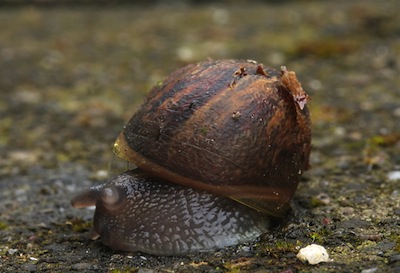
Most of us homeowners can handle a pest infestation in the garden, but once insects or rodents come inside our homes to hang out and eat like teenagers, we run for the broom, or the spray can or as my friend Ron did; stand on the kitchen stove barking while waving a hockey stick at two raccoons.
Most often homeowners will be able to solve an indoor pest infestation on their own by preventing or correcting a condition by sealing cracks or holes or purchasing an environmentally safe insecticide. Many outdoor infestations can be solved by homeowners placing a sample of the insect into a baggie and bringing it to their local Master Gardener desk for a diagnosis. Many cities now have Master Gardeners through their University Extension program. (A national list of phone numbers can be found at the American Horticultural Society's website.) Once the pest is diagnosed, the least-toxic product may be advised or the homeowner will be advised about which predators or beneficial insects they could purchase or attract to their yard to eat the pest for lunch.
However, if you can't seem to conquer a severe infestation on your own, indoors or outside, it's time to consider hiring a professional pest control company. If so, you'll want to hire a company that chooses to use less-toxic chemicals. According to the EPA, an estimated 45-million pounds of pesticides are used annually in homes and gardens in the United States, with sales totaling more than $2 billion annually. The Center of Disease Control (CDC) reports that 90 percent of us here in the US have a mixture of up to 43 pesticides in our bodies. Many of these chemicals have been linked to health problems such as cancer, birth defects, reproductive health problems and neurological problems.
Chemical pesticides should only be used as a very last option in garden or home pest defense especially if children are present. They're much more vulnerable to pesticides since their bodies are still growing. John Wargo, director of the Yale Center for Children's Environmental Health, states, "More than ninety percent of pesticides and their inert ingredients are never tested for their effects on developing nervous systems. Children are more affected by exposure to such chemicals because they are smaller and their organs are not mature." In 2000, a study published in the journal Cancer reported that children with non-Hodgkin's lymphoma were seven times more likely than healthy kids, to have grown up in a home where pesticides were sprayed, and were three times more likely to live in a home which was treated regularly by a professional exterminator.
The first step is to look in your local phonebook under Pest Control and see if there's a company who advertises its service as :environmentally safe." If not, check online. You can also check at www.beyondpesticides.org/safetysource. Click on "Find a Provider" and then "search by state." Green Shield is the first national "Integrated Pest Management" certified program in the country. This program certifies pest-control companies who meet stringent prevention-based standards. You can try to find a local provider also on their website at www.greenshieldcertified.org.
Once they arrive at your house, ask how they plan to solve the problem. If pesticides are immediately suggested, ask what your other non-chemical options are. If chemicals are the only solution, ask them for the names of the products and ask to see a "Materials Safety Data Sheet." You're really making friends now! But your family's health is more important than if the rat-poison guy likes you or not. (If the MSDS looks like a foreign language, try www.lungusa.org where they'll teach you how to read a Material Safety Data Sheet.)
If spraying is the only option, ask to only spray specific areas, to target the pest. If there will be spraying outdoors, that's another concern, as this often leads to water contamination in the entire neighborhood. That's yet another way to lose friends and neighbors. Tell the pest guy you'll call him in the next few days. Then do your homework. Go to Pesticide Action Network's Pesticide Database and look up the health effects of the chemicals listed on the MSDS and see if the pesticide chosen is listed in the high-risk category.
As a final note, pests don't like clean houses or yards. They enjoy messy clutter and moldy dirty places. The first line of defense is keeping your home and yard clean; fixing leaky faucets, picking up outdoor debris, sealing cracks, washing your pets (and children!) vacuuming rugs, keeping kitchen counters and cupboards free of crumbs.
For you, fellow New Yorkers, dealing with the lovely cockroach clan, both boric acid and diatomaceous Earth (DE) have both shown good results. DE has little toxicity to humans and pets, while boric acid has a low acute toxicity and should be handled carefully. Both of these are stomach poisons which cause dehydration and death. Boric acid is a bit slower acting. Place these powders under large kitchen appliances or in crevices and cracks in the wall or cupboards. Use a mask, goggles and gloves when applying these dusts. Keep away from food, children and pets. Baits or sticky traps are also good for a smaller infestation.
For more information and fact sheets on getting rid of pests reasonably and responsibly, both indoors and outdoors, visit Washington Toxics Coalition at www.watoxics.org and www.ourwaterourworld.org.