
Americans love to claim about anyone they don't like in the White House that his latest exercise of power was "unprecedented." Nearly every program, edict, war, executive order, and piece of legislation is attacked for supposedly breaking new ground. Usually, this characterization is misguided. It is often all too easy to go back in time and find precedents for today's allegedly unprecedented acts.
It was actually something special, however, when President Obama ordered the drone killing of U.S. citizen Anwar al-Awlaki. He was located in Yemen, a nation with which the U.S. is not officially at war. He was targeted for almost two years as a terrorist, an unlawful combatant, yet was not even given the watered down due process that has typified post-9/11 detention policy. He was killed not for having a proven role in planning terrorist attacks, but mostly for his vitriolic words directed against the United States. So was Samir Khan, another U.S. citizen, whose pro-al Qaeda website sealed his fate, despite the fact that advocacy -- even of violence and overthrowing the government -- has in most cases been treated as protected speech since Brandenburg v. Ohio (1969).
Obama's summary execution of these Americans, conducted as a military operation through the CIA, would indeed seem to break with precedent and qualify as one of those watershed moments in America's long retreat from the rule of law. While liberals criticized the Bush administration for warrant-less wiretapping and detentions without trial, one would think that the outright killing of an American citizen without due process would qualify as a greater offense.
The legal gymnastics used to defend this and previous executive power grabs usually cite the supposed failure of the Constitution to "grant" rights to whichever particular class of people in question -- in this case, enemy combatants or "traitors," since al-Awlaki and Khan cannot be said to lack protection on grounds of citizenship. All such arguments turn the Constitution on its head. Not only does the Constitution specifically authorize the federal government to deal with treason (unlike most of the other crimes it currently prosecutes), thus implying that the Constitution does have something to say about "traitors" -- namely, that they be afforded all the due process rights of any other criminal suspects under the Constitution -- but its silence on enemy combatants should mean that this particular label is constitutionally void of any separate meaning or need for special treatment.
Most importantly, the Constitution does not "grant" rights to anyone -- rather, it gives powers to the U.S. government and defines and limits those powers with respect to the rights of people. People have rights regardless of the Constitution; the government, on the other hand, is a legal fiction brought into existence with its powers circumscribed by the Constitution. Moreover, the Bill of Rights does not distinguish between normal criminals and traitors, nor even citizens and non-citizens -- instead, it requires that "no person... be deprived of life, liberty, or property, without due process of law."
That's if we want to look at the matter as a cold constitutional question. As for practicality and ethics, the presidential supremacists defending detention without habeas corpus and "enhanced interrogation" techniques during the Bush years made an argument that was more difficult to refute than Bush's critics would like to admit. The argument essentially went like this: "If the president can kill people in war, what is so bad about detention, torture, and wiretapping? In war, people die, and so any lesser violation of a person's rights would seem less extreme in comparison."
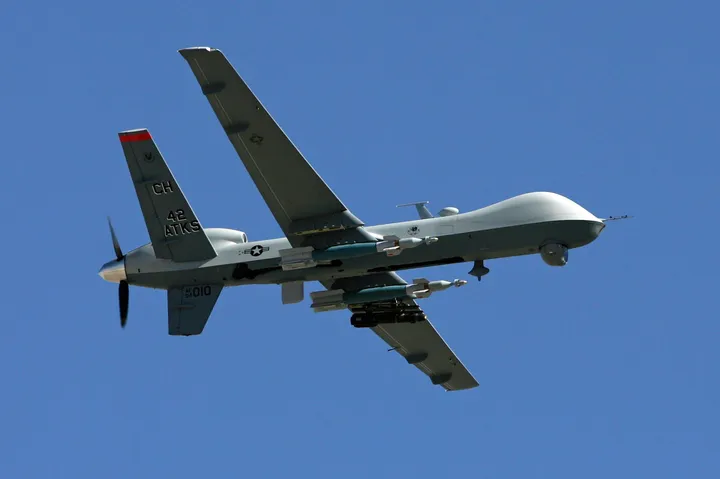
Indeed, modern war itself is a crime greater than any one of its constituent parts. Lawless detentions, assassinations, surveillance, mistreatment of prisoners, and killing the innocent are all elements of this larger evil. In August, reports revealed that an estimated 168 children had been killed in the U.S. drone attacks in Pakistan, started under Bush and ramped up dramatically under Obama. Certainly, there are no wars without atrocities, and in some ways the least controversial part -- the mass killing -- is the worst. The many thousands snuffed out are often dismissed as "collateral damage." Perhaps this is why al-Awlaki is getting so much more attention than Khan, to say nothing of the thousands of other victims killed by previous drone attacks who were never individually "targeted."
Yet the deliberate murder of al-Awlaki should frighten us. It reveals the limitless nature of the modern presidency's power, not because killing an American citizen is morally worse than killing a non-citizen, or bombing a country in an "undeclared" war is less ethical than in a "legal" one, but because it demonstrates that even by the supposed rules governing presidential power, the presidency is even less restrained than before.
In terms of sheer power, the presidency rivals any in world history. It has controlled the nuclear button, run the CIA, and maintained primary influence over all other nations. It has set economic policy, conspired to centrally plan world monetary affairs, and waged massive wars costing millions of lives all around the world. Now it has its own hit list, sending robots to distant lands to snuff out the targeted. Perhaps the most significant point, however, is the public's reaction.
Many progressive Democrats cheer on Obama's toughness here as with the Libya war, proving that he can be as hawkish in foreign affairs as can the Republicans. Most conservatives celebrate Obama's power grab as well. A CNN.com poll found 70 percent of respondents supportive of the strike. And most Americans seem to blindly accept the propaganda that al-Awlaki was a "leader of al-Qaeda" rather than a much lower-level cleric who probably enraged U.S. leaders largely because he was a U.S. citizen who could condemn the United States in fluent English.
Perhaps just as only Nixon could go to China, only Obama could warm the nation up to executive assassinations of U.S. citizens. Many of those likely to find a problem with the act are enamored of the President, and those most opposed to the President admire the act.
Yet both conservatives and liberals should be horrified. If Bush's detentions without trial were objectionable to liberals, and Obama's domestic ambitions offend conservatives, why should this not be a universal outrage? What greater tyranny could there be than a president's power to order a citizen executed without consulting Congress or the courts?
This action has indeed crossed a line, descending further toward the very lawlessness the United States claims to stand against. Yet even in setting a new precedent, the Obama administration was in a sense following the footsteps of presidential predecessors. This was not the first time the U.S. government has committed an act that sinks beneath our judicious standards. Given the lack of mass outrage about it, we can hardly expect it to be the last.