
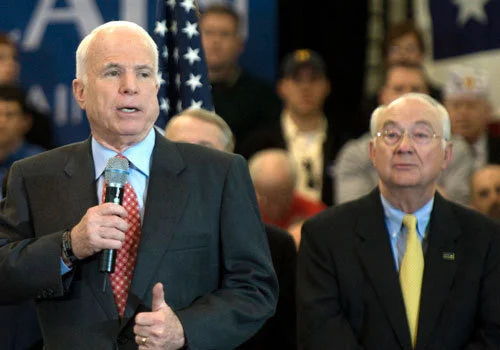
Sen. McCain's economic musings put me in mind of that famous East Texas used car salesman, Elmo Fudpucker. "Tell 'em anything," he used to tell his sales staff, "but give 'em a good screwin'."
It really is psychological for John McCain.
Asked to defend his admittedly paltry gas plan in April, he touted the "psychological boost" of shaving a few cents off the gallon. Asked last month to explain the purpose of an offshore drilling plan that does not even purport to alter the current energy supply, McCain argued that while it "may take some years" to kick in, drilling promises a beneficial "psychological impact." So when Phil Gramm chastised Americans for whining about a "mental recession," he was actually channeling McCain's psychological view of our economic problems. The media lapped up the gaffe but missed the point.
Gramm was not "off message." McCain's economic platform rests on the premise that the nation's economic challenges are minor and primarily psychological. How else can you explain his policies? McCain has not even proposed a short-term stimulus. His tax cuts ignore middle-class workers -- about 100 million households, including 37 million seniors, would get no relief. Only 1 million seniors see rebates under his proposal, which brazenly prioritizes wealthy households over elderly Americans living on fixed incomes.
Then there's that McCain penchant for scheduling economic help a few years down the road. (Although perhaps the psychological boost is instantaneous.) The only plank of McCain's tax agenda that is not tailored for the superrich -- boosting the exemption for dependents -- would not even start until 2010. And it would not take full effect until 2016, according to the nonpartisan Tax Policy Center, which recently issued a 39-page report on both candidates' tax plans.
And McCain's tax plan is so regressive that some liken it to a third term for President Bush. But that's just not fair to Bush.
Bush's signature tax cuts were skewed toward the richest Americans; roughly 31 percent of the money went to the top 1 percent of taxpayers. Yet under McCain's two proposed tax cuts, a staggering 58 percent of the benefits go to the top 1 percent of taxpayers. That finding is from a report by James Kvaal and Robert Gordon, policy experts at the Center for American Progress, about the "Bush-McCain-Norquist Tax Agenda." Tax activist Grover Norquist, a Republican insider, has crowed that McCain adopted his organization's "entire agenda" of slashing the corporate tax rate, vetoing all tax hikes, extending the Bush tax cuts and abolishing the alternative minimum tax.
But you don't have to rely on the nonpartisan policy experts. (Objective analysis is apparently passé, anyway.) McCain's plan is so narrowly focused on the demands of elite activists, even conservative stalwarts are blanching. In a recent editorial, National Review shared its "worries" that McCain's plan ditched middle-class Americans: "It offers very little in the way of direct benefits to Americans in the middle of the income scale." And that's from a magazine enthralled with tax cuts for the rich.
While McCain tries to sell an elitist agenda for its psychological value, Barack Obama is running on a rather concrete agenda for the general public. His tax benefits are spread across 95 percent of households, including a $1,000 cut to offset payroll taxes for working families. It starts "in the very first year" of the plan, an Obama economist recently noted, in contrast to McCain's delayed gratification. And Obama's $50 billion stimulus prioritizes an economic rebound, including $10 billion to address foreclosures. And it's $50 billion more than McCain has proposed for a stimulus.
A rocky economy will likely consume the next administration. The president will face the twin challenges of stimulating overall growth while reining in a plutocratic era of surging inequality, predatory lending and corporate scandals. Tax policy reveals the values a candidate brings to these challenges, and today's nominees could not be more different.
At bottom, diverting 60 percent of tax cuts to very wealthiest Americans is not only bad policy for a contracting economy -- it is regressive class warfare:
"I don't believe the wealthiest 10 percent of Americans should get 60 percent of the tax breaks," says one candidate. "It's clear that there's a growing gap between rich and poor in America, the haves and the have-nots. And many studies have indicated that -- and I think that the people who need it most and need the relief most are working middle-income Americans, and that's what I want to give to them."
It's a sound critique of McCain's current plan. And it came directly from McCain, back in 2000. That was also the McCain who voted against the Bush tax cuts in 2001, proclaiming:
"I cannot in good conscience support a tax cut in which so many of the benefits go to the most fortunate among us, at the expense of middle-class Americans who most need tax relief."
McCain's own record reveals that his tax plan is not only bad policy, obviously, but also craven. It reflects the sellout of a man who used to know better. Some chide McCain for saying he does not fully "understand" the economy. The real problem, however, is that he does not understand that leadership demands courage and consistency.
Why did McCain go from populist to plutocrat? Why has he failed to explain his massive reversals on this key election issue? Is his heart in this fight? Could he really deliver on a promise to out-Bush Bush in regressive taxes he once deplored?
Those are some "psychological" challenges Americans can live without.
--
This post is adapted from my Politico column. For more on McCain's economic problems, here's a discussion where even Pat Buchanan agrees that McCain is part of Bush's failed policies:
Want to reply to a comment? Hint: Click "Reply" at the bottom of the comment; after being approved your comment will appear directly underneath the comment you replied to
Sen. McCain's economic musings put me in mind of that famous East Texas used car salesman, Elmo Fudpucker. "Tell 'em anything," he used to tell his sales staff, "but give 'em a good screwin'."
Oh, ye of little faith!
I'll bet you fellow lower middle classers have forgotten all about trickle-down!
We've been shovelling all that money to the top few percent because we'll benefit in the end, remember? The Decider told us so. Don't you believe him? It's going to get very much better for us very, very soon. Senator McCain's tax policies will just hasten the day and increase the size of the final payout for us.
[Cargo cult, anyone?]
I think I can answer your question of why McCain sold out to the neocons - illegal wiretapping. They've got something on him, and he's now owned.
Part II
There may be a light at the end of the Iraq tunnel, but the US and Israel attitude towards Iran may lead to WW III, even though Iran is allowed by the NNPT to enrich to 5% (commercial power plant levels, not the 95% required for a weapon), and has not been proven to have exceeded their boundaries - and the the current US NIE states that Iran stopped work on the bomb - and that it will be several years before they can actually build a bomb, and that the president of Iran is up for re-election...
If the US, Israel and Iran agreed to enrich uranium to 5% in a consortium based in Iran, I'll bet that the price of oil would come down to $80 a barrel within three months.
Can't we just make nice with Iran and see how it goes? If we and Israel both are members of Iran's consortium, and have access to any nuclear site in Iran, what's not to like? They get nuclear power, we get to make sure that they don't get the bomb. IF they kick us out, we can still attack before they can build the Bomb, so we're really not losing anything, and may be preventing WW III.
What's really entertaining is to look back at all of the republican pundits 6 months whining and complaining about how Bush doesn't get enough credit for the great economy
LMFAO
McCain and Graham understand that the economy needs investment, not more personal spending. The corporate tax cut itself would accomplish tremendously more than a $50b stimulus program. It would increase corporate investment, increase hiring and jobs, and bring US and foreign money flows into the US which would strenghten the dollar and reduce commodity prices. Obama's plan would increase consumption, which is exactly what we don't need considering the trade imbalance, balance of payments problem, the ongoing lack of investment in the US, and the high household debt in the US.
You have a lot of faith in Corporations, I don't. How do you know what they will do with the money? They might spend it on dividends and executive bonuses. They might spend it to cover the cost of firing everybody in the US, and starting up in China. Spending money on infrastructure will create US jobs for certain, and maintain our ability to support US business. If an unemployed person gets a job repairing our crumbling infrastructure he may pay off some of that household debt. Don't forget that putting food on the table is personal spending and we don't care if you and Gramm (or Graham whoever that is) don't like it.
Increases in infrastructure spending will not affect the labor market to any significant degree. It would employ a number of people in total that would be very small relative to those employed in residential construction and its related industries throughout the housing boom, or even relative to those employed in the non-residential construction segment of the economy now. As for companies just moving to China, how are lower corporate taxes going to result in that? The value of the dollar is relatively low at this point and labor is fairly cheap making the US very competitive for investment, especially for European companies. Many corporations invested abroad earlier in this decade because of the strong dollar and relatively high labor costs relative to other countries, but many companies have been expanding rapidly in the US over the past two years as the US has become more competitive.
We're supposed to accept parsing from a commentor who thinks McCain's crony is named "Graham"? The massive tax cuts on corporate profits would just enable them to move American jobs overseas quicker. Much of the corporate savings would go directly into the pockets of the corrupt and obscenely wealthy CEO's who run these looting institutions, and most of the rest would probably end up in the campaign coffers of other Repig troglodytes. Your whole post is a clumsy fabrication from beginning to end.
Look around. American banks are failing because of a lack of capital. Our biggest financial institutions are selling pieces of their equity " and their souls " to sovereign wealth funds to raise cash. The debt pyramid constructed by Fannie Mae and Freddie Mac is tottering. All because of a lack of invested capital. After all, why should anyone invest in American stocks? The market is dropping, the dollar is weakening, and interest rates are the lowest in the world.
Now Obama pledges to double the capital gains tax. This misguided policy will drive capital off shore and turn a flow into a torrent. The financial problems of American banks will be amplified.
Reagan, Bush, Clinton, Bush. Years of de-regulation, downsizing government, cutting taxes. I just looked around and you are right about the mess, but whose misguided policies are driving capital off shore? Obamas? Don't vote for McSame.
Banks are failing because they went crazy buying and selling loans they should have known were going to go bad. Probably most of them did know, but under the current Repig president, there is no penalty for either stupidity or failure--- as long as you're a Repig.
I wonder what McCain thinks the psychological impact is on the oil market of someone being nominated as a final candidate for President of the US who likes to sing "bomb bomb bomb, bomb bomb Iran"?
Have you noticed that every time Iran is threatened oil goes up $5 a barrel?
And when an Iranian and American sat together in the same room and the American could hear the Iranian speak, oil came down $15 a barrel in three days?
How much of the price of a barrel of oil is the instability cost? Supply is uncertain because the instability in the area. The more instability, the more ways to screw up the flow of oil, the higher the prices. Can you imagine how much it costs to insure a tanker in those waters these days? Hire workers for Iraqi fields? It's not costing 4 times as much to flow the oil than it did three years ago...
If Iraq settles down - with an agreement for timelines, instability will come down. If the US and Israel could make nice with Iran, the price would go down dramatically.
Last night, John McCain's campaign manager Rick Davis...
UPDATE: A day after Roseanne's blogs from below...
Update: Keith Olbermann had Rachel Maddow on "Countdown" Tuesday night to celebrate...
"How honest are we if we tell the truth most of the time &...
I must admit that listening to McCain answer Pastor Rick Warren's questions...
Obama's been to Hawaii. We're moving...
In a candid interview via satellite from China, Olympic...
RENO, Nev. — So much for hugging in church. A day after Barack Obama and John McCain exchanged...
All hail the comeback of Christie Brinkley, Cover Girl. The former supermodel graces...
Michael Phelps, Michael Phelps, Michael Phelps. With all the play his name gets right now,...
NEW YORK — The suspense didn't quite compare to the identity of "Deep Throat,"...
Turning conventional neuroscience on its head, new research suggests the...
BURKE, N.Y. -- Everywhere that Janet and Ken Tacy...
Posted July 22, 2008 | 10:30 AM (EST)