

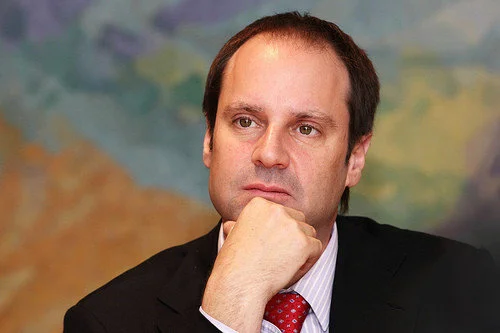
The Edmonton Journal recently called Jeff Skoll "the greatest Canadian you've never heard of." And during his TED Talk in 2007, he joked, "I've actually been waiting by the phone for a call from TED for years." But in fact, Jeff Skoll, beyond being the first president of eBay, has been a pioneer in the world of cutting edge philanthropy with the Skoll Foundation, with its mission of global peace and prosperity; with the Skoll Global Threats Fund, confronting the greatest dangers our world faces today; with Participant Media, which has produced more than 30 movies, including Syriana, An Inconvenient Truth, Good Night and Good Luck and Waiting for 'Superman'; and with the Skoll World Forum, which I attended in March in Oxford.
Today, he is being presented with Canada's highest civilian honor, the Order of Canada, for his wide-ranging philanthropic work. The Order, which will be presented by Governor General David Johnston, carries the motto Desiderantes Meliorem Patriam ("They desire a better country").
It's a richly deserved honor. Through his network of organizations designed to have a powerful impact on our world, he's working to create the critical mass necessary to bring about the changes our world so desperately needs. His résumé is at once remarkably varied and obsessively single-minded. His vision is simple and vast at the same time: to use all the tools at his disposal to change the world.
Skoll made his mark, and his fortune, as an online entrepreneur. In their 2011 book Abundance, Peter Diamandis and Steven Kotler identified Skoll as one of a rising class of "technophilanthropists" -- tech entrepreneurs who made their money before the age of 40 and are now turning their attention and resources to solving the world's biggest problems.
The theme of this year's Skoll World Forum was "Flux," which Jeff calls "the one constant" in our ever-changing world. Fortunately, he is helping to establish another constant: the social entrepreneurs achieving measurable results in solving heretofore intractable problems all across the globe. His Skoll Centre for Social Entrepreneurship is like a R&D lab for empathy, a super-collider for generating the kind of urgency that is so tragically absent among our political leaders. As Stephan Chambers, chairman of the Skoll Centre, put it during this year's Forum: "I have cried every day this week. Remember as I tell you this, that I'm male. And British. And from Oxford."
So, the Order of Canada's motto, "They desire a better country," fits Skoll, but only to a degree. He has gone far beyond merely desiring a better country, and indeed a better world, to empowering people to achieve solutions everywhere in the world.
What follows is a transcript of my interview with Jeff Skoll, a man who fits perfectly in our Inspirationals series, combining as he does an audacious vision, an innovative mind, and a deeply empathetic heart.
Why don't we start with your latest tweet, about your visit with Bill Gates to talk about a new movie about education.
We're actually thinking of doing a project with Davis Guggenheim, who directed Waiting for 'Superman'. The idea would be to do a TV special about great teachers and what makes teachers great. The Gates Foundation is really a great partner for this sort of thing, given their emphasis on education. At Participant, when there's a project we're passionate about, we're going to do it!
That reminds me of what you said in your introductory remarks at the Skoll World Forum, "When anyone tells me I can't do something, I stop listening." Do you remember the last time somebody told you you couldn't do something?
It seems to happen every time I start a new organization. When I started Participant, there was a lot of resistance. I heard all the silly quotes, like "the streets of Hollywood are littered with the carcasses of people like you who come to town and try to make movies." I just wanted to make good quality films that were about something and not worry so much about whether they were successful commercially or not. And they've done just fine commercially -- clearly there is an audience for this kind of thing.
The other one is when I started the Skoll Global Threats Fund. Its five big issues are climate change, Middle East change, nukes, pandemics and water. People often roll their eyes when they hear about those issues, because they are really big. And I think that's the biggest challenge I've ever tried to tackle. And the jury is out on how well we're doing on any of these things. But when you have the opportunity to make a difference -- how many people are in the position to be able to make a difference? I'm lucky enough to be in a position to at least try.
Of course, you put yourself in that position, because there are many successful people who don't choose to take the opportunity to make a difference. In your 2010 speech at the Stanford Graduate School of Business, you told the graduates, "And, unlike the successful business leaders of your parents' generation, you won't have to wait until you retire to think about giving back, getting involved in your community or philanthropy."
I think that's absolutely true. I think it's important to get started early. Because early on you make mistakes. And you learn from those mistakes and then you can double down on the things that work.
When I started the Skoll Foundation, I ran it myself for a couple of years, but didn't really have a clear focus about what we were doing. We made some grants that didn't necessarily work out. But it was through that that we began to see that there were certain kinds of grantees that were, in fact, highly successful, highly leveraged, with a business model. These turned out to be social entrepreneurs. If it weren't for those two or three years of trial and error, we might not have found our niche.
I think what you've stressed again and again is a sense of urgency -- that this is the time to really prioritize giving back. And interestingly enough this is an area where you and Warren Buffett and Bill and Melinda Gates agree.
I was just at the second annual Giving Pledge gathering, which Warren and Bill and Melinda started. If nothing else, last year there were 40 or 50 or so pledgers -- almost entirely old white men who are self-made. We had a breakout session during the gathering and we had four options: education, health, being a more effective philanthropist, and international giving. People self-selected into which groups they wanted to go to. Of the 40 or 50 pledgers, only four selected international giving -- me, Bill Gates and a couple of others. Everybody else was all about health and education.
I think for the older generation, they tend to focus more on traditional things, like putting up a wing in a hospital or doing health research or helping fund new kinds of schools. All those things are great, but for the younger generation I think there's more of an inclination to look more globally.
And at the same time, you are looking at the problems in the U.S., including growing unemployment and challenges facing young people. Are you looking to do more in this country?
In large part, on the movie side of things we aim at issues where the U.S. can make a difference, whether it's climate change or nuclear weapons or water or pandemic preparation. Participant is growing to be an international company. We've just done our first Spanish language movie. We did a film set in Iran last year, in Farsi. But for the most part we're an LA-based production company, trying to reach a western audience first and foremost.
On the social entrepreneur side, there's a good balance. Most of our teams are based in the U.S. but do their work outside the U.S. We have a documentary coming out relatively soon, hopefully this summer, that's like Waiting for 'Superman', only about hunger. It shows that there are about 80 million people in the country who are hungry or obese -- two different sides of the same coin, with poverty at the base.
The movies and documentaries you're making in a way take you back to your childhood ambition of being a writer. Here you are, being a storyteller, but also an impresario, bringing together other storytellers to amplify what you want to communicate. Do you sometimes think you are, in a very roundabout way, actually fulfilling an early dream?
As a kid, I didn't tell these stories -- I didn't know how -- but I wanted to be involved in the big issues. I figured storytelling was the best way to get people engaged. I didn't think it was the best way to make a living, but I always pursued a journalistic sideline. For example, I was editor of my school's newspaper as an undergrad and at Stanford.
For me eBay was a step on the road. I thought it would be a learning opportunity, after which I would go on to start my next company. And hopefully at that point I would have enough money to start writing all these stories. Well, eBay turned out to be a much bigger blessing than I could have imagined. And I thought, rather than writing these stories myself -- and probably fairly poorly -- I could hire writers and turn them into film and TV. So Participant is the unexpected outgrowth of the path I started on.
I see Participant as just the knee of the curve. We do six to eight movies a year. We have a digital division that does short-form video. We'll soon have a TV division, and, knock on wood, we'll be buying a TV channel. So that opens a whole new way to reach people with entertainment that inspires.
You are really hoping to help find solutions for every major social problem. Especially with the Skoll Global Threats Fund. Does one threat in particular keep you awake at night?
The one that keeps me up for sure is the Middle East. Because I think things are so tenuous over there. To address it, the strategy that we've been trying to use, with social entrepreneurs, is providing job growth for youth.
Have you ever had an imaginary conversation with a young Jeff and thought about what he would say about all you've created -- Participant, Skoll Foundation, the World Forum, the Global Threats Fund?
The young Jeff wouldn't have had a clue, that's for sure. Growing up in a middle-class family in Canada, I really didn't know much about philanthropy, running a company, or starting companies.
We actually had an interesting exercise a teacher had us do in high school. He asked us what you wanted written on your tombstone and then work backward from there. I found that such a powerful exercise because it helped clarify the path that I wanted to take with my life. Which again, was to get involved with the big issues in the world. And there were other things, like having a good family life and all that kind of stuff. But whenever I've come to a fork in the road, going back to that master plan of knowing what you want to be doing has been a very powerful metaphor.
I didn't really know that my path would lead through things like eBay and the Skoll Foundation and Participant, but I did always have the uber goal of trying to find these big issues and make a difference. And I don't really know what the future holds as well. For all the things we're doing, I don't know that it's enough. The social entrepreneurs are great and making a difference in the world. The movies are doing well and having an impact. But there are still major problems in the world. I don't know what's next.
I've always avoided politics. In Canada growing up we never talked politics. In America it's a much different thing. But maybe that's the next frontier -- to really engage politically -- because that ultimately is where the power is held.
Would you ever consider engaging to the point of running for office?
Oh dear, no. I admire people who have done so. I think it's so brave to run for public office -- you're just putting yourself out there and opening your life completely for scrutiny. I admire people who do run for office and do a good job. It's really hard. So maybe the next frontier is figuring out how to have a political environment that isn't so corrosive and toxic.
As you are dealing everyday with all the threats and dangers that we are facing, how do you keep your faith and sense of optimism and possibility?
When I think of the major threats in the world, long term, we do have the time and the ability to solve them -- even the most intractable threats. Think about nuclear weapons and how horrible it is that there are so many of them around the world. And yet none of them have been used since 1945.
And at the Global Threats Fund, we're working on something to bring virus pandemic detection down to about 72 hours. So if you can catch it at that point through all these detection labs we're building around the world, that's pretty optimistic.
One of the quotes I want to ask you about is from your TED Talk. You said that in your youth you read Ayn Rand and James Michener: "Their stories made the world seem a very small and interconnected place. And it struck me that if I could write stories that were about this world being small and interconnected, maybe I could get people interested in the issues that affected us all, and engage them to make a difference." The fact that these writers made the world seem smaller and interconnected clearly resonated with you. Is that the way to help us feel we can actually make a difference?
I think of it as empowered self-enlightenment. In the past, if there was an earthquake in China or Chile, people wouldn't know about it until a letter arrived by ship, or some other way, a year later. But now, anything that happens anywhere in the world we know about almost instantly.
I'm on the board of an organization called the National Center for Arts and Technology, run by Bill Strickland, a social entrepreneur who was in Waiting for 'Superman'. Bill has built these tremendous centers in these schools. The same kids that are graduating at 30 percent rates in the local high schools are graduating at 90/95 percent rates in his programs. I've been on the board, working with him since 1999. At one point he asked me, why do you care? You don't live in those neighborhoods. It's because these neighborhoods affect everybody, whether it's crimes or poverty or drugs or prison populations. We're all better off if these neighborhoods are better off.
Let's end on something personal. You've said that when you were 14, and your dad came home and announced that he had cancer, that was a pivotal moment in your life. How do you bring together this personal prioritizing that became so important, when your father told you he was afraid he hadn't done the things he had wanted to with his life, with that sense of our own self-enlightenment?
When that happened to my dad, it was a real call to action to get started on doing all the things I felt could make a difference in the world. The flip side, on a more personal note, is that I haven't had kids yet. Most of my friends by now have multiple kids, or have been divorced twice. But I've never been married. So in terms of a personal thing, that's become my most important personal goal.
But your dad is with us? Is he living in Canada?
My parents are alive and well and they're living in Las Vegas. And they're still together, 54 years.
That must be very good to have in your past, something I definitely didn't have. My parents separated early and I ended up getting divorced.
Well, it seems to be the norm. All I can say is we all make our mistakes, and hopefully they pass quickly and we learn from them.
Now, having children, and caring for your personal life is up there on your list of priorities.
It certainly is. I used to work crazy hours, night and day. And now I've mellowed a bit and I'm trying to have a little more fun and, god willing, maybe even go for my first vacation in a few years.
But when you take a vacation, can you actually disconnect completely?
Oh, that would make me very nervous.
Add your voice to the conversation on Twitter: twitter.com/ariannahuff