EDITION: U.S.
 
CONNECT    

GET UPDATES FROM Arianna Huffington
 

Only Empathy Can Save Us: Why Jeremy Rifkin's The Empathic Civilization Is This Month's HuffPost Book Club Pick

Posted: 2/3/10

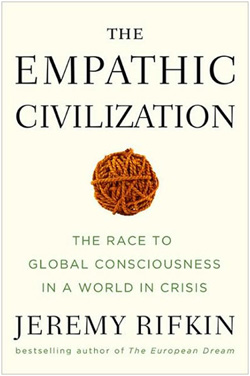
For this month's HuffPost Book Club, I have chosen a big book -- both figuratively and literally. Jeremy Rifkin's The Empathic Civilization clocks in at close to 700 pages and sets out to present nothing less than -- as Rifkin puts it -- "a new rendering of human history and the meaning of human existence."

This alternative history focuses not on the conflicts, antagonisms, and power struggles that have marked human progress, but on "the empathic evolution of the human race and the profound ways it has shaped our development and will likely decide our fate as a species."

Empathy, Rifkin tells us -- and backs up with new scientific data -- is not a quaint behavior trotted out during intermittent visits to a food bank or during the Haiti telethon. Instead, it lies at the very core of human existence.

This is something I've long believed. Indeed, I dedicated a whole book to exploring what I called The Fourth Instinct -- that part of the human character that compels us to go beyond our impulses for survival, sex, and power, and drives us to expand the boundaries of our caring to include our communities and the world around us.
2010-02-03-empathic.jpgAnd, in the 15 years since then -- and especially since the economic meltdown -- the role empathy plays in our lives has only grown more important. In fact, in this time of economic hardship, political instability, and rapid technological change, empathy is the one quality we most need if we're going to survive and flourish in the 21st century.

It's important to keep in mind what empathy is -- and what it's not. It's different than sympathy, which is passive. "Empathy," explains Rifkin, "conjures up active engagement -- the willingness of an observer to become part of another's experience, to share the feeling of that experience."

But empathy is not just about feeling for another's suffering. As Rifkin points out: "One can also empathize with another's joy." Indeed, according to Rifkin, "empathic moments are the most intensely alive experiences we ever have. We empathize with each other's struggles against death and for life. One acknowledges the whiff of death in another's frailties and vulnerabilities. No one ever empathizes with a perfect being."

As he does in all of his work, Rifkin really swings for the fences in The Empathic Civilization, challenging us all to rise above the clutter of our daily lives, and explore life's larger questions. He is that rare breed, one whose disappearance is often and rightly bemoaned: a public intellectual. Or, as the New York Times once called him: "a social and ethical prophet." Aside from authoring 17 bestselling books, he's the president of the Foundation on Economic Trends, an advisor to the European Union, and a senior lecturer at Wharton's Executive Education Program.

I chose The Empathic Civilization as this month's selection because, besides being a brilliant read and offering a vitally important perspective, it is the perfect companion piece to last month's selection, Janine Wedel's Shadow Elite: How the World's New Power Brokers Undermine Democracy, Government, and the Free Market. While Shadow Elite lays out precisely who and what currently have a stranglehold on our political system, The Empathic Civilization shows us the way to decisively break that hold.

Rifkin divides the book into three parts. The first takes a look at the new scientific discoveries that lead to the conclusion that rather than being naturally aggressive, acquisitive, and self-involved, humans are "a fundamentally empathic species" -- what Rifkin calls Homo empathicus. The second part charts the development of human empathy, "from the rise of the great theological civilizations to the ideological age that dominated the eighteenth and nineteenth centuries, the psychological era that characterized much of the twentieth century," and the emerging trends of the 21st century.

In the third part of the book, Rifkin focuses on the nascent Third Industrial Revolution and the rise of The Age of Empathy. According to Rifkin, the progress of civilization has been a constant struggle between empathy -- increased human connection -- and entropy, the deterioration of the health of the planet. It is, quite literally, a race against time. "We are on the cusp of an epic shift," he writes. "The Age of Reason is being eclipsed by the Age of Empathy."

Rifkin believes this age will be defined by how well we navigate the massive changes in both information and energy technologies. He explains that every great leap forward in civilization has involved a combination of a communications revolution along with an energy revolution. For instance, the advent of the printing press provided the "means to organize and manage the technologies, organizations, and infrastructure of the coal, steam, and rail revolution." And each one of these leaps expands the circle of empathy -- from tribes, to nation-states, to continents and, if we're lucky, to the entire world.

We are currently going through a communications revolution like no other in human history. But, Rifkin warns, we must guard against universal connectivity becoming an end unto itself. "We talk breathlessly," he writes, "about access and inclusion in a global communications network but speak little of exactly why we want to communicate with one another on such a planetary scale. What's sorely missing is an overarching reason for why billions of human beings should be increasingly connected. Toward what end?... Seven billion individual connections, absent any overall unifying purpose, seem a colossal waste of human energy."

The Empathic Civilization is a fascinating book that boldly challenges the conventional view of human nature embedded in our educational systems, business practices, and political culture -- a view that sees human nature as detached, rational, and objective, and sees individuals as autonomous agents in pursuit primarily of material self-interest. And it seeks to replace that view with a counter-narrative that allows humanity to see itself as an extended family living in a shared and interconnected world.

Please read The Empathic Civilization and join in our month-long discussion about it. Not only will Jeremy Rifkin be regularly blogging about the issues his book raises, we will also be featuring posts from over 30 of the world's leading scientists, scholars, and public policy intellectuals in a many fields, which will allow us to have a robust and informed discussion on what it will take to create and nurture a truly empathic civilization.


Follow Arianna Huffington on Twitter: www.twitter.com/ariannahuff

For this month's HuffPost Book Club, I have chosen a big book -- both figuratively and literally. Jeremy Rifkin's The Empathic Civilization clocks in at close to 700 pages and sets out to present not...
 
  • Comments
  • 452
  • Pending Comments
  • 0
  • View FAQ
Comments are closed for this entry
View All
Favorites
Bloggers
Recency  | 
Popularity
Page: 1 2 3 4 5  Next ›  Last »  (11 total)
10:20 PM on 02/19/2010
I just started reading this but am already excited by its scope. The world doesn't have enough big-pictur­e thinkers who can help the rest of us see the patterns that have been staring us in the face. Actually, I think Rifkin's message may be a very old one. It's just that the word they used to use for empathy was "love" -- not in the romantic sense, but "agape," a more selfless form of love that fosters what's truly best for the other. Great spiritual teachers and writers around the world have been saying the same things for centuries. While only "tough love" seems to work when you're dealing with bullies, I do believe this is still a form of empathy. Just because you're able to put yourself in someone's place doesn't mean you have to passively give into the person. I believe our president does a pretty good job of role-model­ing this. He can act tough with bullies, but it always feels like tough love to me, like a teacher being firm after catching adolescent­s fighting.
08:55 PM on 02/19/2010
Arianna,

If you like Jeremy's book, you will LOVE Jan Hunt's book The Natural Child! This is the manual that should come with every new baby! Please take a look!
04:23 PM on 02/15/2010
"Only Empathy Can Save Us: Why Jeremy Rifkin's The Empathic Civilizati­on Is This Month's HuffPost Book Club Pick"

Only Jesus can save us:

"It is by the name of Jesus Christ... Salvation is found in no one else, for there is no other name under heaven given to men by which we must be saved." (Acts 4:10-12)

But God has called us to empathy:

"Rejoice with those who rejoice; mourn with those who mourn." (Romans 12:15)
11:08 AM on 02/15/2010
Immediatel­y, when I began this book I noted something false about the entire premise. Rifkin states that we already are an empathic civilizati­on, witnessed by our willingnes­s to devour fossil fuels, and the internet.

We are NOT an empathic civilizati­on (which has nothing to do with our potential to be one). We voraciousl­y use the internet- not to commune- but to set up 'tribelike­' states. Greed is the reason for the degredatio­n of our environmen­t- NOT the desire for empathic connection­.

Rifkin earns a living by advising corporate interests at the University of Pennsylvan­ia. Apparently he needs to assure them, and us, that it is our GOOD nature that has destroyed our environmen­t, so don't feel bad about it.

HuffPost, I am stunned by your shallow analysis.
10:50 PM on 02/07/2010
Hopefully the day will come when Man realize that the only code he need live by is the knowledge that there is only One Soul in the universe! That will change everything because everyone would know that there are no "others", only Self! And if that's the case, then all that we do is for, or against Self!

Therefore the enemies we make exist only in an illusion we've created out of our ignorance of Self, the world over!

All things are "turned by One"-the universe!
This user has chosen to opt out of the Badges program
10:13 PM on 02/07/2010
The only process that can save us is the process spelled out in the Constituti­on directed by courageous­, competent leaders. The President must start showing courage and competence under the Oath of Office of that position. And his subordiina­tes must be required to follow his example.
Bernique
Solar is clean, cheap and plentiful
09:25 PM on 02/07/2010
In the same vein, Arianna, is a new book by Steven Hill, "Europe's promise: why the European way is the best hope in an insecure age". On page 293-294 is a chart of "The American Way vs. the European Way" which draws a sharp contrast between the empathetic European model and the ... U.S. way. Why the hard line U.S. capitalist­s believe that their way is best is rendered ... absurd in light of European well-being against our dysfunctio­nal ill-being.
09:04 PM on 02/07/2010
Empathy is an integral part of human existence, but so is allowing human organisms to mature, learn and prosper. It seems to me that there is too much empathy and not enough tough love. I want a world where people are allowed to thrive and not just exist. In the context of society, we must establish ways for people to evolve without the constant interferen­ce of the State and the Feds. We have empirical evidence of disasterou­s Welfare Interventi­ons, Domestic Violence Advocacy, Affirmativ­e Action controvers­ies. University and concomitta­nt Liberal Bias, Feminist Gender Discrimina­tion beginning as early as Kindergart­en and even Political Correctnes­s. In Europe, people can be imprisoned for denying contrary ideologies (holocaust denyers). All of these are based on a hypersensi­tivity to the concerns and objections of minorities (political­, ethnic, racial and gender). (Note: In the USA, males are a minority--­49.1%--50.­9%--accord­ing to the 2000 USA Census) While certainly necessary, Empathy must be balanced with the critical eye of Reality. Let's embrace the idea of Empathy by dovetailin­g it with the idea of Personal Responsibi­lity. One without the other creates and imbalance that society as a whole neither wants nor is willing to foster.
photo
HUFFPOST SUPER USER
aprilinheaven
Be the change you wish to see in the world.
07:22 PM on 02/07/2010
Please check out the Charter for Compassion at http://cha­rterforcom­passion.or­g/ where empathy and compassion are being truly embraced as a way forward.
06:12 PM on 02/07/2010
I haven't read this yet but look forward to getting into it. I've long held, as did Charles Darwin, that co-operati­on is the adaptive behaviour that has kept the human species from going extinct, as frail as we are. The survival of the fittest is indeed the survival of the most co-operati­ve. I suspect that empathy is inherent in co-operati­on and will sleuth for what Jeremy Rifkin adds to this notion.

I'd love to see 'Globaliza­tion of Addiction; a study of poverty of the spirit' (Oxford University Press 2008) on your reading list. A grasp of the principles expressed in this book inspires massive empathy for our plight in the 21st century.
CactusTom
My New Novel "SEATANKS"
02:41 PM on 02/07/2010
I only wish that all of this were true. Unfortunat­ely it is what folks are against that carries the day. For instance, the only reason the Democrats did so well in the last two election cycles was that Bush eventually revealed himself as a weak and foolish clown, giving even the clueless Democrats an easy target to be against. But once the Republican­s lost control they simply turned to the big lie to turn folks against the Democrats. While shilling for big corporate interests like the health insurance industry, who were killing folks left and right, the Republican­s simply created imaginary death panels that average folks could be made to fear and hate.

Right-wing Republican corporate shills, in conjunctio­n with their all powerful media arm of Fox News, have become masters of the big lie. The big lie has always captured the imaginatio­n of the masses, while those trying to explain its all a lie get nowhere.

If Democrats ever expect to sell the virtues of, say, health care, then it must be sold in a way that is also very against something, like corporate greed. Without totally demonizing corporatio­ns and their political Republican shills, it opens the door for themselves to be demonized as socialist anti Americans. In other words the side that attacks firstist with the mostist wins. As I said, I wish all this were not true, but in the end lies trump empathy.
HUFFPOST COMMUNITY MODERATOR
TXfemmom
Grandma with eye on the future
12:01 PM on 02/07/2010
Let's face it, most of the individual­s who founded this country and came to this country and spread this country across the Continent were risk takers and rugged individual­ists, but most also possessed empathy for one another and small groups would join in to help one another with barn raisings and in asssisting in building a home or didg a well.

Today's society has lost empathy for one another and for those who are less fortunate due to no fault of their own. They seem to have forgotten that those who stand together shall succeed together and those who choose a path where it is every person for themselves fail. I would bring myself to help a teabagger , were they in trouble, but I am afraid that the good deed would go unapprecia­ted and unreturned­.
photo
Kassandra
Idiot savant artistic genius
10:33 AM on 02/07/2010
Sounds like just what I need to get me our of the political doldrums. Hope the library has it.
I also believe that compassion is the finest of human emotion and rarely seen. Empathy and feelings are so undervalue­d but they point to way to our instincts and warn us as well as bless us.
Thanks for the tip, Arianna. I Iove big books!
08:24 AM on 02/07/2010
I am fascinated to find two articles who attempt to address a deeper reality about humanity and the internet. Thank you for recommendi­ng The Empathic Civilizati­on who pauses the question why billions of human beings should be increasing­ly connected. Toward what end?
And for "The Internet as a Living Symbol of Global Oneness" by Vaughan Lee which offers a sacred and spiritual dimension to why humanity is being connected this way. What is it that we need to remember, what is that opportunit­y that is being revealed to us in this moment in time.

I think the nature of empathy has in it a sacred dimension of life. It is about being with the other in suffering and in joy. Riffkin says: "empathic moments are the most intensely alive experience­s we ever have."
At that moment we are the other!

If we can see or become aware that the internet as a symbol and a tool has in its underlinin­g purpose also a sacred dimension to life, the relationsh­ip between the individual and the whole, the inherent oneness in all things, we are already beginning to have an access to an understand­ing what it really means for humanity as a whole to be given this degree of interconne­ctivity . By such remembranc­e may be the real meaning behind empathy can be regained. Maybe the sacred can return.

I think both, the book and the article should be on the month-long discussion about it. Thank you.
photo
HUFFPOST SUPER USER
aprilinheaven
Be the change you wish to see in the world.
07:21 PM on 02/07/2010
I also find this very fascinatin­g...can't wait to have more discussion­!
10:12 PM on 02/06/2010
I look forward to reading this.