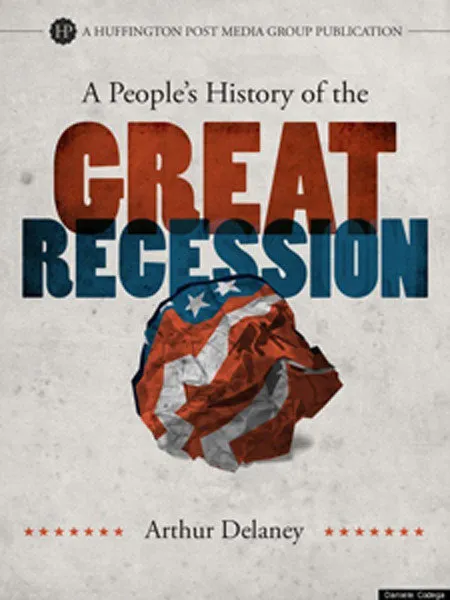
Two years ago, I asked Arthur Delaney, one of our gifted young reporters at The Huffington Post, to focus his coverage on one thing: putting flesh and blood on the data of our economic crisis, and bringing to our readers the real stories of the unemployed, of those facing foreclosure, of the "formerly middle class."
It was 2009, and the decline of the middle class was a subject I had become obsessed with, both in my own writing and in HuffPost's coverage of the economic crisis. From foreclosures to unemployment to household debt to bankruptcies, it was clear the American middle class -- the foundation of our democracy -- was under assault from all sides. And it was equally clear that we in the media were not doing nearly enough to spotlight the real-life day-to-day impact this was having on people's lives.
Arthur embraced his mission with a powerful combination of passion, empathy, and a healthy dose of anger. His poignant reporting has now been collected in A People's History of the Great Recession, an e-book that is being published today, in the shadow of Labor Day and in the wake of the worst jobs report in 11 months.
When Arthur first began looking at the struggles of those affected by the economic crisis, we considered calling him our "Economic Suffering Correspondent," but that seemed too dreary (though by no means inaccurate). So instead we called him our "Economic Impact Correspondent." His job was to find families and individuals dealing with the consequences of the economic devastation and tell their stories in ways that captured the public imagination and touched people's hearts.
"People work for justice when their hearts are stirred by specific lives and situations that develop our capacity to feel empathy, to imagine ourselves as someone else," says Paul Loeb, author of Soul of a Citizen. "New information -- the percentage of people out of work or children in poverty, the numbers behind America's record health-care costs, the annual increases in greenhouse gases -- can help us comprehend the magnitude of our shared problems and develop appropriate responses. But information alone can't provide the organic connection that binds one person to another, or that stirs our hearts to act. Powerful stories can break us beyond our isolated worlds."
And it was both our readers and those whose stories Arthur was telling day in and day out who were moved by his work. I remember arriving at Citi Field in Queens at 5 in the morning to greet the people arriving to board the 200 buses HuffPost had provided to get people to Washington for Jon Stewart's Rally to Restore Sanity. One of the buses was to be filled with 99ers -- those who had been unemployed for over 99 weeks (the point at which all unemployment benefits end). Dozens of them reached out to me to ask, "Where is Arthur?" Arthur had become part of their lives, not just an arms-length reporter, but someone who used his compassion, his empathy, and his considerable talents to make a difference in their lives by ensuring that their plights were known and their voices heard.
It was this same caring and dedication, sometimes tinged with outrage, that Arthur brought to his encounters with those entrusted with making public policy. I remember one morning in Nancy Pelosi's office when she was still the Speaker. She was meeting with a number of reporters from our DC bureau, and was describing her legislative plan. When she finished, Arthur cried out: "So what can we tell the unemployed? I get emails every hour, 'What's going on?'"
It's all too easy for far too many reporters to ignore the fact that what goes on in Washington is about more than political theater. But not for Arthur.
The gulf between the real concerns of the public and the circus that's been going on in Washington has seldom been so great. For Arthur, however, there's an irrefutable and palpable connection between policy and the day-to-day impact it has all across America. If all those in the media had Arthur's passion, and his talent for bringing these stories to life, our leaders would, in the memorable words of Richard Clarke, be running around with their hair on fire.
I hope that Arthur's A People's History of the Great Recession will help bring that much-needed sense of urgency to the public debate and our leaders' priorities.
If it's true we can do "whatever we set our mind to," as the president said upon announcing the killing of Osama bin Laden, then how about we set our mind to reigniting the American Dream for everybody, and not just those few for whom the recession is an out-of-sight-out-of-mind problem of the past? There is no more important thing we can do as a country right now. One place to start is with ourselves. Our politicians have chosen to narrow their imaginations, but they can't narrow ours.
There is no question that the media also have a responsibility here, and I include everyone in the media -- mainstream, new media, all of us. Because bearing witness is ultimately the highest calling for journalists and indeed for all citizens -- especially at a time of multiple crises and so much struggle in the lives of millions.
So as Washington disconnects, the rest of us need -- more than ever -- to connect. In times of crisis and disruptive change, empathy is the most valuable quality we can nurture if we're going to reclaim our destinies -- and our nation's. Arthur's book is a testament to the power of bearing witness.
You can get A People's History of the Great Recession, which was created and distributed using BookBrewer, at Amazon, iTunes, Barnes & Noble, and Kobo.
Follow Arianna Huffington on Twitter: www.twitter.com/ariannahuff
© 2011 Alan Abel
Why not establish a 24-hour television channel that highlights available jobs throughout America? All kinds in fifty states. Including working for the government. And Uncle Sam pays for relocating while the employer arranges affordable housing.
Certainly this plan would create a national migration of individuals and families.
But if you’re married with two kids, lost your job and health insurance, no more unemployment insurance and depleted all savings, your only alternative is bankruptcy, and possibly a homeless shelter. So why not move to another city and get a new life?
This may sound like a fantasy, but it’s a viable solution because the unemployment figures will go higher. No question about it. Ask any economist. If our government can bail out the banks, why not people? The cost would be a pittance compared to the billions handed out to bankers. And action is needed today, not tomorrow.
Meantime, the governor of each state and mayors of cities, will be asked to locate and list the vacant and abandoned factories or buildings in their communities that could be converted into low cost housing. Thi
Our country is not great. It’s the greatest. During World War II army engineers could build bridges across the rivers overnight. By morning tanks, trucks and troops were crossing a river to engage and defeat the enemy. We need that sort of ingenuity during these catastrophic times now. Let’s build bridges over the troubled waters in America!
(abelalan2000@yahoo.com)
I wrote to Arthur Delaney in 2009 thanking him for his unrelenting dedication to the human faces behind this tragic Great Recession. I ended it that his grandchildren will be proud of his work on behalf of the voiceless.
I substitute teach in the most extreme economically depressed areas of a major city in Ohio. I watch our Governor attempt to end collective bargaining rights of those whose dedication to teaching transcends everything else.
I will show up to add my vote against this weird tryanny seeking to destroy what's left of the middle class. I don't exactly know what day it was when it became acceptable to kick and man or woman when their down. But I watched Senator Bunning threaten a filibuster against extending unemployment benefits. How these "leaders" can show their face in public is beyond me. Kentucky doubled up though electing another right wing radical to do some more kicking.
Show up to vote next time....not that it makes any difference because it probably won't. The United States is a callous country.
Advice: learn to live with what you have, enjoy your small daily pleasures, keep smiling, and make friends who don't make you feel envious with their world travel and electronic gadgets. You don't need that stuff. Don't confuse net worth with human value.
The public is almost constantly barraged with liberal drivel that corporations are bad, they are the enemy, they take from and abuse everyone and that is simply NOT always true. Just like people and society there are a few bad apples and the majority a good, wholesome citizens.
If you don't like a company use your market place power to boycott them. If you don't like the company you work for, find another one or start your own!!
Interview the Homeless, the families foreclosed on: How much did they owe that caused them to lose the roof over their family's head? Were they in Modifiction? Was it because they missed answering a default motion because they didn't recognize the Bank? or a Foreclosure Mill's Attorney told them not to worry? Was it one missed payment, or two for $650.each and $1500. in late fees and Attorney's fees of $5000. that was the final nail in the coffin? Then ask: How much PMI Insurance did the Bank receive on that home, or Banks if they foreclosed more than once on the same property. How much did the Brokers and Banks make on credit default swaps on that property? How much would it have cost to preserve the American family in their home vs what we have been forced to spend to bail out Wall Street's greed? Which still continues unabated, because champions like Eric Schneiderman and Elizabeth Connelly are slowly silenced. Can Matt Taibbi and Shahien Nasirpour do it all? Thanks for Part I, but this time in history still must be chronicled, for 16 million homeless children who have become the generation of shattered dreams.
The lesson form the 30's is this. Big government borrowing and spending was not the answer. Big government cannot fix everything. Big government is not the answer to all questions.
These agencies and policies may be well meaning, but we have to stop the cargo hold from filling with water and close most of the agencies before the whole ship goes down.
To anyone who has tried to raise a ship it is far easier to replace the cargo tossed overboard (sad as it may be) than the near impossible task of restoring a sunken ship.
It seems like many young people think you just have to go to a college, any college, for four years, and get a degree, any degree, and the world will be at your feet. But if you didn't learn anything, and don't know anything, then all you will have is a giant bill.
http://www.nytimes.com/2011/05/19/business/economy/19grads.html?_r=1
“For twelve years this Nation was afflicted with hear-nothing, see-nothing, do-nothing Government. The Nation looked to Government but the Government looked away. Nine mocking years with the golden calf and three long years of the scourge! Nine crazy years at the ticker and three long years in the breadlines! Nine mad years of mirage and three long years of despair! Powerful influences strive today to restore that kind of government with its doctrine that Government is best which is most indifferent.
For nearly four years you have had an Administration which instead of twirling its thumbs has rolled up its sleeves. We will keep our sleeves rolled up.
We had to struggle with the old enemies of peace—business and financial monopoly, speculation, reckless banking, class antagonism, sectionalism, war profiteering.
They had begun to consider the Government of the United States as a mere appendage to their own affairs. We know now that Government by organized money is just as dangerous as Government by organized mob.
Never before in all our history have these forces been so united against one candidate as they stand today. They are unanimous in their hate for me—and I welcome their hatred.
I should like to have it said of my first Administration that in it the forces of selfishness and of lust for power met their match. I should like to have it said of my second Administration that in it these forces met their master.â€
This is who many voters thought they were electing in 2008.
http://www.flixya.com/blog/3201910/Beautiful-Butterflys