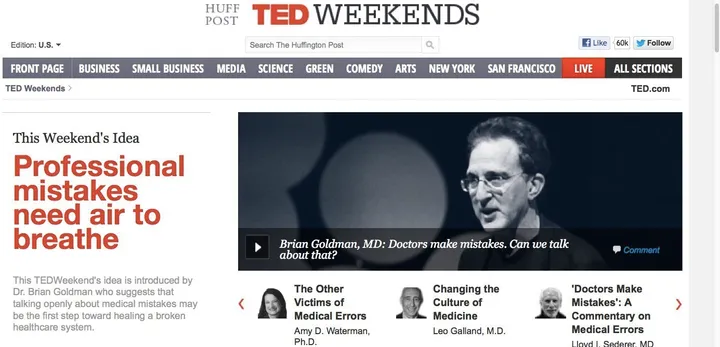
TED and HuffPost are planning an exciting experiment in the weeks ahead. We want to highlight some of today's most intriguing ideas. But to do so in a way that sees those ideas morph and develop in real time, in response to input from thousands of contributors, perhaps including you.
Because that's the thing about ideas. They're not set in stone. When exposed to thoughtful people, each of whom may bring an additional insight, they're capable of adaptation until they find their most potent form. A form that can truly go viral and perhaps impact millions of minds. As Thomas Edison -- who, unfortunately, never gave a TEDTalk -- put it, "To have a great idea, have a lot of them."
Here's our plan. Every weekend for the next year, we'll introduce a theme, anchored to a TEDTalk we think has at its core a powerful and timely concept. But rather than simply offering it up as is, we're opening it up to you to write your own post about it, leave a comment behind, and help refine it, asking questions like:
- How is this relevant now?
- What are its real world implications?
- How might this idea be used to shape the future?
- What are the main criticisms that could be leveled at it?
- How can it be improved?
- How can it be spread?
TEDTalks are famously limited to 18 minutes, but the essence of TEDWeekends is that when the TEDTalk ends, the evolution of the idea begins. So along with the TEDTalk you'll see blog posts written by others giving their own take. We're also inviting graphic artists to illustrate the essence of an idea visually. Meanwhile, the speaker behind the talk will be online chipping in to the conversation. (We've recently seen some great examples of this on TED.com, like this one.)
TED is known for sharing great ideas in talk form. The Huffington Post is famous for amazing perspectives generated by its passionate audience. Together therefore, there's a unique opportunity to do something significant: take a great idea, and use the power of the crowd to make it greater still. We'd love you to be part of this.
Brian Goldman, M.D. kicks off TEDWeekends with his talk "Doctor's Make Mistakes... Can we talk about that?" His key idea -- that talking openly about medical mistakes may be an important step toward healing a broken healthcare system -- is especially pertinent theme in these last few days before the election. We hope you'll introduce your ideas into the conversation, which will include doctors Dean Ornish, David Katz and Patricia Fitzgerald -- and many more -- as well as members of our community weighing in with their expertise or personal experience.
So check out TEDWeekends, where we'll also be co-premiering with TED several talks for the very first time. Follow us on Twitter using the hashtag #TEDWeekends, and email tedweekends@huffingtonpost.com if you would like to contribute a blog post for future TEDWeekends. As always, use the comments section to let us know what you think. And we want to say a special thank you to Chevy Volt for sponsoring TEDWeekends, and helping us amplify ideas.
P.S. If you'd like a quick primer on how ideas germinate and morph, here's a wonderful talk by Steven Johnson.
Add your voice to the conversation on Twitter: twitter.com/ariannahuff