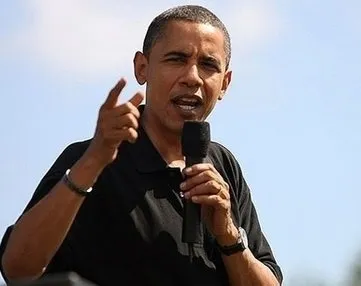
As everybody who follows this stuff knows, Barack Obama will accept the Democratic presidential nomination on the 45th anniversary of Martin Luther King's "I Have a Dream" speech. King's vision of a color-blind America is universally quoted, but as Drew D. Hansen points out in his book, The Dream: Martin Luther King, Jr., and The Speech That Inspired a Nation, such was not always the case.
The speech was delivered on Aug. 28, 1963, at the March on Washington. The march itself was a grand moment, an example of American democracy at its finest: a quarter million people peacefully assembling in the nation's capital to demand equal rights for a long-suffering minority. In the days leading up to it, however, white leaders were anxious. Despite its welcoming rhetoric, the Kennedy Administration turned D.C. into an armed camp, with 17,000 troops ready to swoop in and implement a declaration of martial law.
The march was short; one-eighth a mile, from the Washington Monument to the Lincoln Memorial. There were several scheduled speakers. King was last. (Anti-Semitic blacks would do well to remember he was preceded by a rabbi from the American Jewish Congress.) Like everyone else, he was allotted five minutes; but in private he had been told he could take as long as he pleased. (He finished in around ten.) Hansen informs us that the "I have a dream" refrain was not new; King had used it on other occasions. But to the millions watching it live on TV, it was a revelation. Afterward President Kennedy said, "That guy is really good."
Yet the speech was largely ignored until King's assassination five years later. This was due to polarizing perceptions. It's easy to forget how hated this man was. When he won the Nobel Peace Prize, many people viewed him as a troublemaking fool or a communist agent. And it went downhill from there. Between 1965 and 1968, everything he had worked for seemed to be falling apart. Riots erupted in almost every major city. White backlash swept law-and-order conservatives into office, setting the stage for Nixon's Southern strategy. Black militants advocated separatism and armed confrontation. King's failure to integrate housing in Chicago, the first step in his plan to carry the civil rights movement north, was a significant setback. And his brave stance against the Vietnam War ruptured relations with Lyndon Johnson.
When he made his fateful trip to Memphis, his influence was at its lowest ebb. Sadly it took a bullet to change that. Hansen shows how, practically overnight, the "I have a dream" speech was thrust to the forefront of the discourse on race, where it remains to this day. Conservatives love to cite the line about the value of an individual one day hopefully being measured only by "the content of his character" as proof that King would have opposed identity politics and affirmative action programs. They ignore -- or haven't read -- the rest of the speech, which is an indictment of America for not living up to its ideals. When King died he was moving more to the left, not the right. He would have fought vigorously for social and economic justice against Nixon, Reagan, and the Bushes; but he would have done it without the off-putting rhetoric and self-serving antics of Jeremiah Wright, Al Sharpton, and Jesse Jackson. This is how Obama can demonstrate he is King's heir when he appears at Invesco Field in two weeks. King told whites in 1963 that they were supposed to behave better, that they should demand more from themselves morally. But he did it without sounding like a scold or a fiery radical. Obama can do the same. And then he can end with his own rousing vision of the future.