
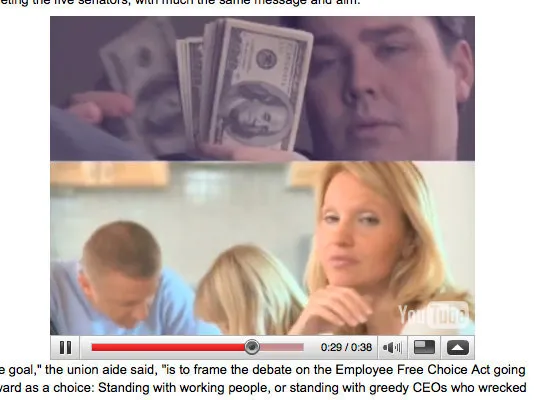
Yesterday, the union movement ramped up its attacks on the Chamber of Commerce over its "two-faced" approach to the Employee Free Choice Act's provision requiring arbitration if a business won't bargain in good faith after a union's been chosen by workers. As the AFL-CIO Now blog observed:
The latest Big Business tactic is to attack the provision of the Employee Free Choice Act that guarantees workers who form a union a fair first contract -- a vital provision, because more than 50 percent of workers who form a union don't have a contract after one year and more than a third still don't have a contract after two years.
Corporations are crying about the possibility they might have to take part in arbitration with employees if they don't reach a first contract after three months of talks -- even though they're enthusiastic about arbitration in a wide variety of circumstances where they have the advantage.
In a new ad running in key newspapers, American Rights at Work again challenges corporate hypocrisy on arbitration. When it's a big corporate entity against an individual, as in credit card disputes or personal injury claims, corporate spokesgroups like the Chamber of Commerce say arbitration is a way to settle any sort of dispute "fairly, quickly and inexpensively." But when it's time to bargain over better wages and benefits for their workers, these same groups are viciously opposed to even the possibility of requesting arbitration.
To union activists, what's especially galling is how fervently businesses embrace arbitration when it allows them to avoid being held accountable for negligence towards employees or the defrauding of consumers. As Stewart Acuff, the special assistant to the President of the AFL-CIO, observes, "It's pretty simple: arbitration is fine for them when it keeps them out court and limits damages to business. They use it to settle credit card disputes, mortgage payment disputes, and whenever it limits businesses liability and negligence. But when they look at arbitration for workers, then all of it sudden they hate it when it's simply used as an incentive to force good-faith bargaining, a last resort to allow workers to get a collective bargaining agreement."
In contrast, business interests have so championed and abused little-known arbitration provisions to keep themselves from being sued that they've spurred new legislation pushed by the Fair Arbitration Now coalition designed to rein in their excesses. A few days ago, NPR featured the story of Jamie Lee Jones who was repeatedly raped by co-workers of Halliburton in Iraq but has been barred from suing the company because of an employer's contract she signed preventing a lawsuit. As the NPR story noted:
Jones was escorted by security to the company clinic for a rape examination. When the rape kit examination was done, the evidence was turned over to Halliburton security.
The young woman's breasts were so badly mauled that she is permanently disfigured. It has been four years since the attack, and despite the physical and circumstantial evidence, the Department of Justice has declined to investigate.
Seeking Justice Through a Suit
Justice Department officials refused to explain or comment in any way to NPR about the case. Jones has decided that if she can't have her day in criminal court, she'll sue Halliburton and its former subsidiary, KBR, in civil court.
"I want corporate accountability," she says. "I was so brutalized that I'm going to have to remember this the rest of my life. And Halliburton was so uncompassionate that they even let the men work there, still, after I went home."
Heather Browne, director of communications at KBR, says that while the company can't speak to the facts since the case is ongoing, it denies any liability in the attack. And she argues that any dispute with Jones, even one involving charges of rape, must go to arbitration.
So Jones is now going to court seeking the right to sue. She has become one of the nation's leading arbitration reform advocates.
An Arbitration Culture
If Jones' case is remarkable, the fact that arbitration is involved is not. In the past 20 years it has become a dominant feature in the legal relationship between American corporations, their employees and their customers.
If you use credit cards, have a cell phone contract, bought a house from a builder or put your mother or father in a nursing home, you have very likely signed away your right to be heard in court if there's a problem. It's called pre-dispute mandatory binding arbitration.
Public Citizen's David Arkush, one of the country's leading researchers on arbitration, says many consumers have no clue as to the rights they're signing away.
"In the fine print of those contracts is a provision that says that they can never sue the company if they have a dispute," Arkush says." Instead they have to go a private, secret tribunal chosen by the company."
To top it all off, businesses rig the arbitration process against consumers and employees by barring them from going to court if there's any fraud or negligence before a dispute occurs, and only the company can choose the arbitrator.
The arbitration provision in the Employee Free Choice Act, on the other hand, only uses arbitration if negotiations between business and labor have broken down for 120 days after negotiations begin, and both businesses and the union must agree on their arbitrator from a vetted list of private arbitrators approved by a federal agency, the Federal Mediation and Conciliation Service.
All that makes the two different types of arbitration strikingly different: one is a business ruse used by businesses to deprive customers and workers of their rights, and the other is a bulwark designed to protect workers' rights against bad-faith bargaining.
The new pro-labor ad attacking such hypocrisy, running in Capitol Hill political newspapers as negotiations in the Senate are heating up, puts the issue starkly:
Big Business is happy to support arbitration when it's in their best interest. But when it comes to negotiating contracts with their workers, Big Business would rather use delay tactics to avoid paying better wages and benefits. It's only fair that corporations agree to arbitration for workers who are trying to negotiate a first contract after forming a union. Arbitration is a key part of the Employee Free Choice Act that will let both sides reach a fair agreement.
One reason the Chamber and other Big Business interests are turning to attacking arbitration is that their previous bogus claims that the legislation takes away the right to a secret ballot have been exposed as a fraud on Capitol Hill. (The bill actually gives workers the choice -- now determined by employers -- of whether to form a union by majority sign-up or secret-ballot election.)
Of course, you don't hear Newt Gingrich or the Chamber of Commerce championing the rights of on-the-job rape victims like Jamie Lee Jones to sue and avoid arbitration, indeed when it comes to abused employees or defrauded consumers they hail arbitration as the best way to handle any disputes. In fact, in May 2008, more than a dozen business trade groups wrote a letter to Congress stating, "Arbitration is an efficient, effective, and less expensive means of resolving disputes for consumers, employers, investors, employees and franchisees, in addition to the many businesses that use the same system to resolve business disputes."
As the SEIU Blog sums up their attitude, "Corporate Lobbyists: We Were for Arbitration Before We Were Against It." Among the paeans to the glories of arbitration offered by business leaders before they attacked its use in the Employee Free Choice Act:
"For more than 80 years, arbitration has helped Americans settle disputes fairly, quickly and inexpensively, without having to file a lawsuit or navigate the court system." - Lisa Rickard, president of the US Chamber's Institute for Legal Reform (4/2/08)
"Arbitration is mutually beneficial, which is what we have always thought." - Arne Wagner, assistant general counsel for Bank of America [ABA Journal, December 1994]"[F]ederal policy... favors the use of arbitration as an efficient, effective, and less expensive means of resolving disputes...Arbitration, has served as an essential valve for the nation's overburdened civil justice system." - Letter to Senate Judiciary Committee signed by US Chamber of Commerce, Retail Industry Leaders Association, National Retail Federation, National Association of Manufacturers, Jackson Lewis, et al (2/7/08)
Just a little bit of a double standard, no? Arbitration is the best thing ever when it comes to protecting their wallets, but when it comes to adding the safety net of first contract arbitration during collective bargaining, it's the devil incarnate that must be stopped at all costs.
Despite such hosannas to arbitration, they're not-so-surprisingly eager to denounce arbitration as a "mortal threat to American freedom" when workers want it after months of stalled labor negotiations.
And the research is now irrefutable that a majority of workers who select a union don't get a contract in their first year as a result of business stalling tactics; if businesses can't bust a union through illegal intimidation before an election, then they've got a second shot at union-busting by foot-dragging tactics and lowball proposals to slash wages and benefits by the company. As American Rights at Work reports:
One year after a successful union election, 52 percent of employers deny their workers a contract. According to Cornell University researcher Kate Bronfenbrenner, 52 percent of workplaces had no collective bargaining agreement one year after a successful union election. Two years after an election, 37 percent of workers' unions still had no labor agreement.
It's easy to determine when businesses will back or oppose arbitration: if it seems likely to screw workers and consumers out of their day in court, then they see it as good, and it if might possibly help workers achieve decent wages and benefits through labor negotiations, then it's bad. As Paula Brantner, the attorney who heads the pro-worker Workplace Fairness advocacy organization, observed recently:
So if employers truly think that arbitration is a better system than resolving disputes in court, then why are they fighting the Employee Free Choice Act [EFCA] provision? You don't have to be a cynic to realize that they're inclined to fight any effort to level the playing field for workers, which the Employee Free Choice Act would do. Just as they're spreading the myth that EFCA would eliminate the secret ballot, it just comes naturally for them to confuse the public about the other EFCA provisions that would empower workers.
But if corporate America doesn't want "a bureaucrat from Washington" to tell people how to run their businesses, then we have to wonder why they want arbitrators who are not even required to know the law or follow it passing judgment on their employment practices. Essentially, companies are talking out of both sides of their mouth: they want to impose an unfair arbitration process on their employees, but cannot bear to have even a fair arbitration process applied to them.
But workers don't have to accept this hypocrisy: we can work to support both the Arbitration Fairness Act and the Employee Free Choice Act. If both were to pass, workers would be able to go to court for their employment and civil rights claims (under the Arbitration Fairness Act), and leave arbitration to the unions and employers who know how to use it best (under EFCA). But that might simply be too much fairness for employers to handle.
And while the Chamber of Commerce and its GOP allies like Newt Gingrich have been painting a nightmarish scenario of jackbooted bureaucrats imposing job-killing arbitration concessions, the real truth of how arbitration works in labor negotiations has been ignored. As a new Roll Call column by two Harvard and MIT labor scholars, including Arnold Zack, the former past president of the National Academy of Arbitrators, points out:
Something is drastically wrong with a labor law when an employer can ignore and thwart the will of the majority of its employees.The Employee Free Choice Act currently before Congress addresses this problem by assuring time for negotiations and mediation as the first step in the process and arbitration when agreement is blocked.
The bill has led to a misguided debate and mistaken information about the role played by arbitration in a well-designed and professionally administered dispute resolution system. This has made the current bill an easy target for opponents to argue that everyone will end up having a contract imposed by "government arbitrators" who know nothing about business or labor issues...
If passed, the Employee Free Choice Act would assign a mediator by the Federal Mediation and Conciliation Service as soon as a new unit is certified to support the negotiations by offering the full range of mediation, education, and facilitation services helping the parties reach a voluntary agreement. The vast majority of cases are likely to be resolved through negotiations and mediation.
In fact, settlements are reached more than 90 percent of the time in public sector jurisdictions that provide mediation prior to arbitration. So, contrary to those who argue every case will go to arbitration, the presence of arbitration encourages and enhances the ability of the parties to reach voluntary agreements in negotiation and mediation -- and incidentally does so without imposing on employees or employers the risks and costs of a strike to get a contract.
After being smeared by hyperbolic distortions about the bill's arbitration provision and research by the Chamber's extremist libertarian scholar-for hire, Richard Epstein, the union movement is finally hitting back on this issue. The latest inside-the-Beltway barrage follows up on last week's first round of attack ads against the Chamber's "hypocrisy." As a spokesman for American Rights at Work (ARAW) told The Hill newspaper this week:
"Labor law reform must ensure that workers who want to join a union are able to do so without facing endless delays from corporations seeking to deny them a voice in the workplace," ARAW spokesman Josh Goldstein said. "Big Business' position is hypocritical and motivated by their desire to maintain a status quo in which corporations make millions while middle class families struggle to get ahead."