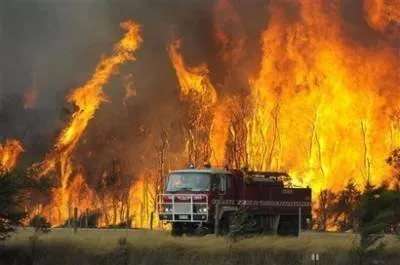
CNN recently ran a story about the devastating wildfires raging across southern Australia, a natural disaster that may have involved climate change, normal weather patterns, and even arson. 200 people have died so far and the loss of homes and property is stunning. The story included an interview with a man who sent his family to safety and then endured the utter and complete loss of his home near Melbourne. Life as he knew it was over, and the man could have allowed himself to be crippled by grief, overcome by loss, or paralyzed by tragedy. Instead he responded like water to the obstacles before him and moved immediately to redefine his role in the world by becoming a relief worker who helped neighbors preserve what they could and reach safety. Heroic and straightforward, it is a tale of instantaneous transformation, an example of the ability of the human mind to avoid attachment and reach a state of higher consciousness.
The same morning I heard the story, I taught a class in sword sparring in a local park. I was reminded that such fluidity of mind is rare and wonderful. Showing my students a particular attack, I was surprised to see that they were unable to counter it even when they knew it was coming. In other words, shown the problem and shown the solution they had trouble adopting that solution even when it was physically trivial. Over and over again they would fall into the same trap, repeatedly making the same wrong move in response to the attack and then cursing themselves for doing it. Typically it took twenty to thirty tries before all of them could inhibit whatever reflexive panic reaction the attack had initially elicited in favor of a new, better response -- one that allowed an effortless and effective defense.
It was a fascinating lesson in what creatures of habit we are, and in just how unusual and amazing was the Melbourne man's ability to shift gears. We all suffer from an emotional and intellectual inertia that may in the case of physical movement also involve so-called muscle memory, but is more likely to stem from the way our brain works. We really are creatures of habit, and our tendency to get attached to things, habits, routines and reactions runs deep. While it is possible that the magnitude of the tragedy ripped the fire victim from his patterns and roots, it is also a well-known fact that even the threat of death does not always do so: soldiers freeze in battle and get blown away; pedestrians hesitate in the middle of the street and get run over, swordsmen of yore, stuck in their patterns of movement, were routinely cut in half.
Learning to remain relaxed and go with life's flow is a high achievement indeed. Mind-body practice helps, meditation helps, but in the end it is self-awareness that is required -- an ability to turn the zoom lens of the mind to the widest possible angle, one that allows us to see ourselves trapped in our habits and to see our place in the world in broader perspective. We must not expect ourselves not to feel -- to do so would be to yearn to become a robot -- but rather to feel, experience, and then regain our equilibrium and move on.
A recent San Francisco State study shows that possessions don't bring lasting happiness. Australian fire victims, facing the loss of their homes and possessions, are unlikely to find much succor in this news. Certainly the fires are a horror, a terrible human tragedy to be rued and mourned by all of us. Yet for the one person (perhaps there are many more) who managed to transcend suffering and act in a way that redefined himself, this particular example of material loss turned out to be a freeing and empowering development -- a step toward something he might not otherwise have achieved.
Should we court disaster, natural or unnatural or wish it on anyone for the sake of personal growth? Obviously that's a preposterous idea, and indeed perhaps the exception fire victim was already a living Bodhisattva, a person of enlightenment devoted to service who needed no such hot boot to behave as he did. If this was not the case, something both terrible and wonderful happened. The rest of us can only hope that when life takes a difficult turn or twist we find ourselves able to rise to meet it with grace.