NOTE: Since this post was written, Sakineh Ashtiani has reportedly been freed.
The battle for emancipation is part of a proud tradition that will shape the future of the regime and Islam itself.
Last month, Mohammad Javad Larijani, the head of the Iranian High Council for Human Rights, in New York for a UN session, was asked by Fareed Zakaria on CNN about stoning for adultery and the case of Sakineh Ashtiani whose death sentence by stoning has attracted worldwide outrage.
Mr. Larijani, who has condemned the West for its "fixation on death by stoning," replied that stoning in Iran is implemented only in cases of "extreme" adultery, leaving us to wonder about the difference between extreme and moderate adultery. He also claimed that cruelty is culturally relative, criticizing the West, where people weep over puppies while their governments kill children. Thus in one stroke, Mr. Larijani obliterated Iran's 3,000-year history and culture. He also managed to denigrate the very religion that he and the regime claim to represent, reducing Islam to a set of barbaric laws.
In the past 30 years, officials of the Iranian regime and its apologists have labeled criticism, especially with regard to women's rights, as anti-Islamic and pro-Western, justifying its brutalities by ascribing them to Islam and Iran's culture. It is ironic that Mr. Larijani makes such remarks about Ms. Ashtiani, a 42-year-old mother of two, who is hardly Westernized or in any sense political. Like most victims of the stoning law, she comes from a poor traditional and religious background, one that the regime claims to defend.
This is a good time to ask apologists for the Islamic regime, who degrades Islam? Who imposes stoning, forced marriage of underage girls and flogging for not wearing the veil? Do such practices represent Iran's ancient history and culture, its ethnic and religious diversity? Its centuries of sensual and subversive poetry? What makes the guardians of the Islamic Republic more Muslim or more Iranian than others? And is not the claim that everything related to freedom of expression and religion, or the rights of women and minorities, belongs to Western culture an insult to Islam?
From its very inception, the Islamic regime used Islam as a political and ideological tool. Human rights and freedoms, especially those of women and minorities, became signs of Western "cultural invasion." The first law the regime abrogated was one that protected women at home and at work. In those uncertain first months after the revolution, women staged numerous protests. On March 8, 1979, about 100,000, according to reports, poured into the streets of Tehran to protest against Ayatollah Khomeini's edict on mandatory wearing of the veil, chanting: "Human rights are neither Western nor Eastern, human rights are global." They were attacked by vigilantes with acid, scissors, knives and stones, but forced the Ayatollah to wait to implement his edict.
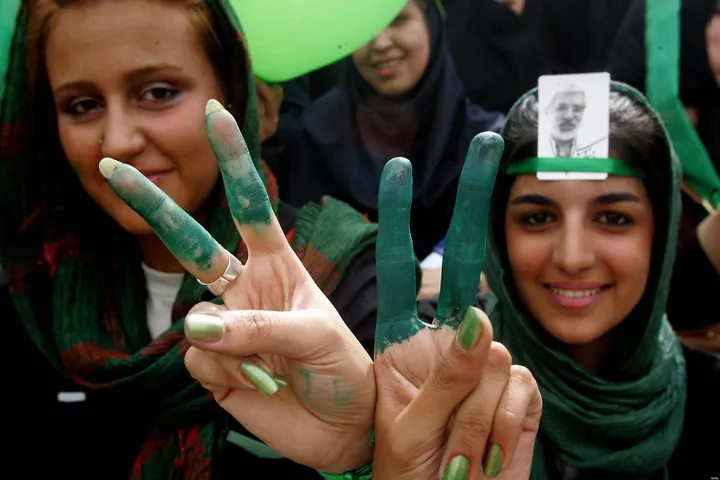
30 years later, in the 2009 protests against the rigged elections, Iranian women recaptured their spirit. It was the images of women at the forefront of these protests that attracted attention. They were young and old, traditional and modern, secular and religious, yet they presented a united front. It became clear that the laws on women's rights were in the interests of neither orthodox religious women nor secular modern ones.
Perhaps most intolerable for the regime was the huge presence of youth, the children of the revolution. The main difference between this generation and their parents was that young people have been jailed, flogged and tortured or, in the case of the 23-year-old Neda Agha Soltan, murdered, for their desire for freedom. Another example among many is Shiva Nazar Ahari, now 26, who has been protesting against the regime since she was 17, whose story is told below.
Women like Shiva or Neda might be inspired by the ideas and struggles of women in other parts of the world, just as the Islamic regime has borrowed from totalitarian ideologies -- it is no accident that President Ahmadinejad denies the Holocaust and that his government has given legal permission to a website that promotes Adolf Hitler. But Iranian women do not need Western examples; what mainly motivates them is the reality of their own lives and those of their mothers and grandmothers. Just like Mr. Larijani, they can claim a tradition within Iran's history.
To justify its mutilation of Iran's present, the regime confiscated its history, cutting and pasting in its own version. Understanding women's resistance starts with resurrecting ghosts that have haunted the Islamic regime from its very inception.
The first woman to question the basic tenets of absolutist monarchy and orthodox religion in Iran had no connections with the West. Known by her title, Tahereh (the Pure), she was born into a prominent religious family in Ghazvin in 1814 and became a poet. Married at 14, she left her husband and children to follow the Babi movement, the precursor of the Baha'i religion.
She became one of its most outspoken leaders, demanding radical change. In 1848 Tahereh appeared unveiled, announcing the advent of a new religion. Many fled in horror and one man slashed his throat at such an act of sacrilege. Tahereh was put under house arrest and strangled in 1852, her body being thrown down a well to prevent it becoming a shrine. As they came to kill her, she said: "You can kill me as soon as you like, but you cannot stop the emancipation of women." So her life and death became synonymous not just with freedom for women, but for Iran as a whole.
If it were only Tahereh who challenged the system, we would remember her mainly as a colorful legend. But in the decades after her death, many more Iranians questioned political and religious absolutism. In 1906, women marched in the streets of Tehran, taking off their veils and demanding their rights. From the very start, many progressive Iranians felt that the fate of women was central to change in society. Their adversaries also felt this.
By the time of the revolution in 1979, women were involved in all walks of life, and laws had been revised to eliminate sex discrimination and implement equal pay. Women worked at universities, in the police and judiciary, and in government. Iranian women gained the vote in 1963, 11 years before women in Switzerland. In the 1970s Iran had two women ministers.
Women's rights were neither part of a foreign plot nor privileges granted by a shah for an ayatollah to take away. Woman supported the revolution for different reasons, some because they agreed with it, but many because they wanted more rights, greater freedom of expression. That they were mistaken and naive about what revolution would bring, and paid a heavy price for it, does not lessen this truth.
The ghosts of Tahereh and the men who secretly murdered her are back, as the Islamic regime today condemns Sakineh to death by stoning, murders Neda and jails Shiva, not because they are agents of the West, but because it fears them and feels vulnerable in the face of a resistance that is not just political, but existential. Iranian women have once more become the canaries in the coalmine, the standard by which degrees of freedom can be measured. Their resistance will not only shape Iran's future, but have far-reaching effects on Muslim countries and the way Islam is defined.
The stories from Iran's present and past are reminders that freedom, democracy and human rights, or fundamentalism, fascism and terrorism are not geographically and culturally determined, but universal. Every culture has something to be ashamed of, but every culture also has the right to change, to challenge negative traditions, and create to new ones.
In the end, Mr. Larijani's cynical words will be forgotten. What will be remembered are those of Shiva Nazar Ahari when she wrote to a cell-mate:
When your heart trembles for the rights of another human, that is when you begin to slip; that is when the interrogations begin. When your heart trembles for another prisoner, a woman, a child laborer, that is when you become the accused. When you find faith in people and believe in humanity and nothing else, that is when you commit your first crime.
Shiva Nazar Ahari was first arrested at the age of 17, in 2001, participating in a candlelit vigil in solidarity with the American people after 9/11. She taught homeless and refugees' children and in 2002 joined the Student Committee for the Defense of Political Prisoners.
In 2006, after becoming spokeswoman for the Committee of Human Rights Reporters (CHRR), Shiva was expelled from university. She has been in and out of jail since, most recently in June 2009 when she was sent to Evin prison in Tehran, spending 33 days in solitary confinement in one of the notorious cells called a "human coffin," because its size makes it impossible to stretch one's arms or legs.
Despite being threatened by Saeed Mortazavi, Tehran's prosecutor-general, who told her that she would be murdered if she did not stop working on human rights, Shiva persevered. This September she was charged with "attempts to deface the Islamic Government," "assembly with intention of conspiring against the Islamic Government," "disturbing the public peace of mind" collaborating and "waging war against God."
It was not Western culture, but life in Iran that drove her to such lengths. As a friend says, Shiva empathized with all victims, regardless of belief or ideology:
She burst into tears for the student prisoner Akbar Mohammadi and the political activist Heshmat Saran who both died in prison. She burst into tears for Delara Darabi who died because of the Qesas law [eye-for- an-eye execution punishment]. She burst into tears for two Kurdish prisoners who were quietly executed a few years ago. She also burst into tears many other times for other victims.
Originally published in the Times of London.